Virgin SBS against White Lined Chipboard for Retail Facings
Virgin SBS provides superior print brightness, stiffness consistency, and crack-free scoring, whereas recycled board lowers initial cost but adds waste.

Furnish
Solid bleached sulfate boards are produced entirely from chemically digested virgin pulp, whereas white lined chipboard places secondary recovered fibers beneath a thin, bleached top liner. These structural and optical differences originate in the pulping process. Virgin solid bleached sulfate, designated commercially as SBS or SBB, relies on kraft chemical pulping to dissolve lignin from natural wood, leaving a sound matrix of cellulose and hemicellulose.
Hardwood fibers ~ principally birch and eucalyptus, measuring 1.0 to 1.5 millimeters ~ provide surface smoothness, opacity, and uniform ink acceptance. Softwood fibers from pine or spruce, running 2.5 to 3.5 millimeters, form the internal tensile network that handles mechanical scoring and flexing. White lined chipboard (classified under European packaging standards as GD2 or GT2) is made from post-consumer and post-industrial paper waste.
Mechanical repulping repeatedly shears these fibers; with every cycle, mean fiber length drops, hydrogen bonding sites are lost, and internal cohesion declines. The finished sheet is a multi-ply construction: a bleached virgin or high-grade deinked top ply over bulky middle and back plies composed of mixed mechanical pulps, box scrap, and newsprint.
Furnish purity directly governs optical stability under retail illumination. Bleached softwood and hardwood kraft pulps contain virtually no residual lignin, preventing photo-oxidative yellowing over prolonged shelf exposure. In standard testing under ISO 2470, which measures the diffuse blue reflectance factor at 457 nanometers, prime virgin SBS registers between 88 percent and 92 percent ISO brightness.
That baseline reflectance provides a neutral, dependable ground for multi-color offset lithography and flexography. White lined chipboard depends on a clay coating to conceal the dark recycled plies underneath. The top liner of GD2 chipboard achieves an ISO brightness between 78 percent and 83 percent.
Because the underlying core contains residual inks, groundwood lignin, and carbon particles, light penetrating the thin coating is partially absorbed within the sheet.

Bleached Kraft Matrix against Recycled Triplex Plies
Primary chemical fibers form an interconnected cellulose network free of debris. Kraft pulping strips away the aromatic lignin polymers binding wood fibers, leaving clean material with high tensile properties. As the sheet forms on a multi-wire Fourdrinier or cylinder machine, fibers orient predominantly in the machine direction, establishing predictable directional strength ratios.
Internal cohesion in SBS develops through direct hydrogen bonding between fibrils, reinforced with wet-end starches. Without groundwood pulps in the furnish, the sheet remains free of shives, bark flecks, and pitch deposits that interfere with clean ink transfer.
Recycled white lined chipboard uses a layered construction engineered to build bulk while limiting virgin fiber consumption. The top layer consists of bleached chemical pulp or sorted deinked office waste. Beneath it, two or three filler plies incorporate mixed paper waste, boxboard cuttings, and crushed corrugated medium.
The back ply reflects the grade classification: GD2 carries a grey back of unsorted secondary fiber, while GT2 uses a white or light-grey back of sorted deinked stock. These recycled plies contain high proportions of mineral fillers like calcium carbonate, talc, and kaolin clay that accumulate across recycling cycles. While inorganic fillers provide bulk and opacity at low cost, high mineral loading diminishes fiber-to-fiber bonding.
To prevent delamination, mills spray starch formulations between the wet plies during multi-cylinder wet-end forming.
Brightness Stability under Retail Lighting
Spectrophotometer readings under ISO 2470 show distinct differences in optical permanence over six-month display periods. Retail environments rely on high-output fluorescent or LED fixtures emitting across the 400 to 700 nanometer spectrum, frequently accompanied by trace ultraviolet radiation. Virgin SBS boards, manufactured with fully bleached chemical pulps and optical brightening agents, preserve their color coordinates across extended display cycles.
CIE L a b color values for high-grade SBS show minimal drift, holding delta E shifts below 1.0 after 180 days of continuous 1,000-lux illumination. Visual shifts on virgin retail facings remain imperceptible to consumers.
White lined chipboard undergoes noticeable optical degradation under identical conditions. Secondary fibers in the core and back plies contain residual lignin that photo-oxidizes as light filters through the surface coating. Ultraviolet exposure breaks down mechanical pulp residues, generating chromophores that migrate toward the surface.
Spectrophotometric tests demonstrate that GD2 chipboard facings lose 3 to 5 ISO brightness units within 90 days of retail exposure, drifting toward a dull yellow or grey cast. Printed over this substrate, halftone process inks suffer altered dot gain and hue shifts, leaving pastel tones and open white spaces visibly compromised on recycled cartons.
Spectrophotometer testing under ISO 2470 at 23 C and 50 percent relative humidity shows virgin bleached kraft maintains 89.5 percent ISO brightness after 180 days of exposure to 4000K LED store illuminants, compared to 81.2 percent for recycled white lined stock.
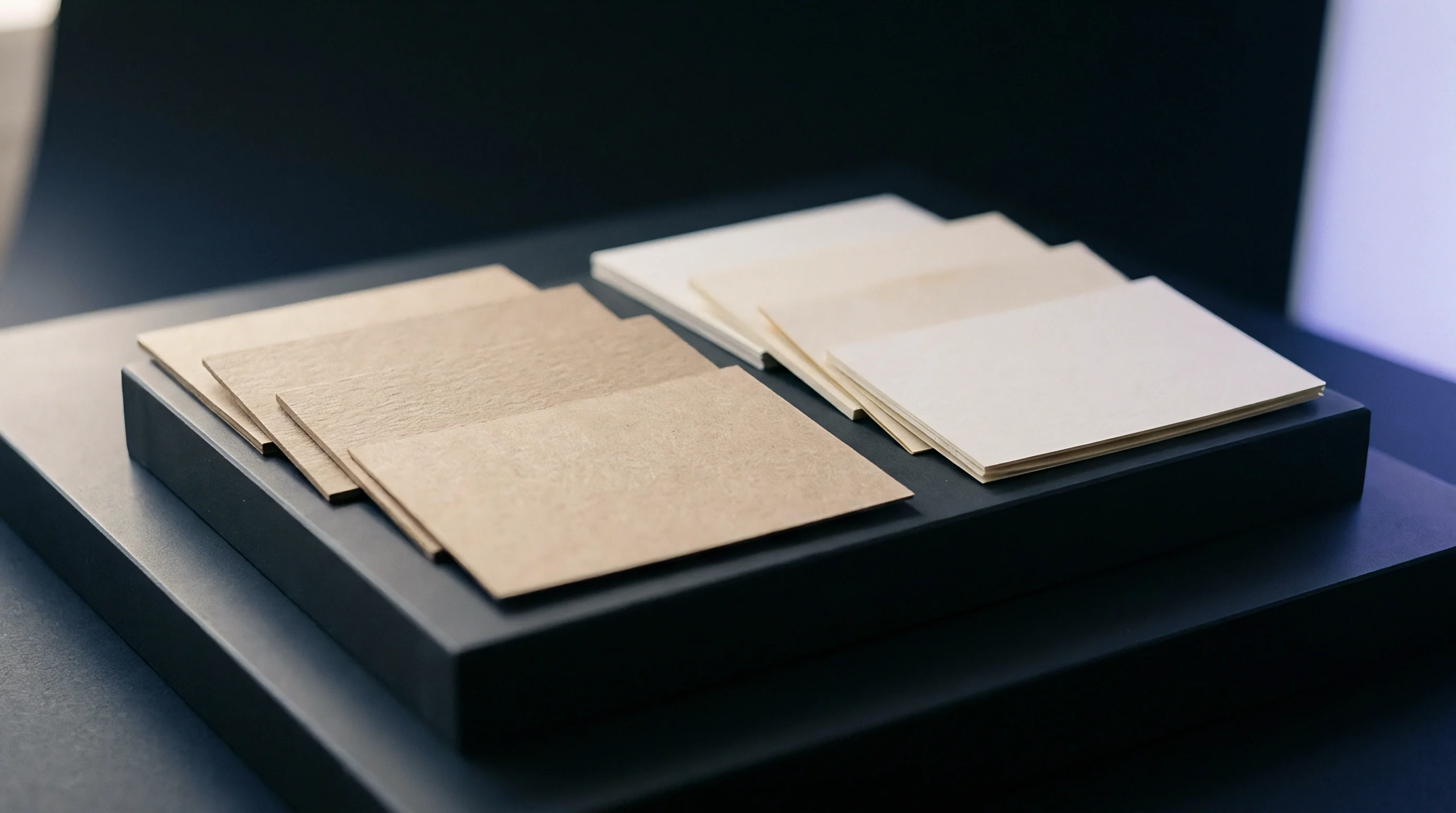
Internal Bond Integrity and Ply Delamination
Inter-ply adhesion determines how well paperboard withstands shear stresses on high-speed converting and packaging lines. Internal bond strength ~ evaluated via TAPPI T541 z-directional tensile testing or ISO 15754 Scott Bond impact methods ~ quantifies the energy required to split a board along its internal plane. Virgin SBS features a uniform density profile through its caliper, exhibiting z-directional tensile values typically between 250 and 350 kilopascals as a result of continuous hydrogen bonding throughout the cross-section.
This cohesive strength prevents sheet separation during hot-melt gluing, tear-tape pulling, or deep embossing.
White lined chipboard delivers lower and less uniform internal bond values, generally falling between 120 and 180 kilopascals. The boundary between the bleached top ply and the recycled middle ply represents a frequent point of failure: short secondary fibers and heavy filler concentrations limit mechanical interlocking across the interface. On high-speed cartoning equipment, vacuum feeder cups can cause localized ply separation.
Cold-chain storage introduces further mechanical stress, as differential moisture absorption strains the starch-bonded ply interfaces. Once internal plies separate, cartons lose structural squareness and cause feeder jams on filling lines.
| Property Standard | Test Condition | Virgin SBS (SBB) | Recycled WLC (GD2) |
|---|---|---|---|
| Top Ply ISO Brightness (ISO 2470) | C/2° illuminant, 23°C / 50% RH | 88.0% – 92.0% | 78.0% – 83.0% |
| Internal Bond Strength (TAPPI T541) | z-directional tensile, 23°C / 50% RH | 250 – 350 kPa | 120 – 180 kPa |
| Opacity (ISO 2471) | Diffuse illuminant, black backing | 98.0% – 99.5% | 99.0% – 100.0% |
| Cobb 60 Top Surface (ISO 535) | Distilled water, 60 seconds exposure | 25 – 35 g/m² | 35 – 50 g/m² |
| Lignin Content (Chemical Assay) | Kappa number evaluation | < 1.0 (Bleached Kraft) | 8.0 – 14.0 (Recycled Mix) |
Under laboratory spectrophotometric evaluation, virgin fibers demonstrate consistent color metrics across production runs. That reproducibility comes from controlled chemical digestion and elemental chlorine-free bleaching sequences that remove non-cellulosic impurities. Recycled chipboard mills source furnish from municipal collection streams, causing run-to-run variations in fiber species, residual contaminants, and surface energy.
Subtle shifts in grey back shade generally fall within standard commercial tolerances, though ambient store lighting fails to fully mask background yellowing over extended seasonal display.
Calibre
Micro-caliper profiling across a parent reel reveals structural density variations that directly affect carton behavior on automated packaging lines. Caliper (stated in micrometers or points) governs flexural rigidity, while basis weight (measured in grams per square meter under ISO 536) dictates the mass of fiber and mineral content per unit area. Virgin SBS board exhibits a lower bulk density, from 0.90 to 1.05 cubic centimeters per gram, delivering high bending stiffness at a lower total sheet mass.
White lined chipboard, which packs short recycled fibers alongside heavy mineral coatings and internal fillers, displays a higher density of 1.20 to 1.35 cubic centimeters per gram. This higher bulk efficiency allows virgin fiber to yield significant mass savings for identical carton dimensions.
Bending stiffness scales with the cube of board thickness. ISO 534 governs the measurement of caliper under a static dead-weight load of 100 kilopascals, while ISO 2493 defines bending resistance using two-point loading at a 15-degree deflection angle (expressed in millinewtons or Taber units). Because secondary fibers exhibit a lower elastic modulus than virgin chemical pulp, white lined chipboard demands greater thickness and basis weight to achieve equivalent stiffness.
A retail carton requiring 150 millinewtons of machine-direction stiffness can be produced from a 300 micrometer (300 g/m²) SBS board. Achieving that same 150 millinewton benchmark in GD2 chipboard requires a 380 micrometer sheet weighing approximately 420 grams per square meter ~ a basis weight penalty greater than 35 percent.

Mass Distribution and Structural Density
Weight comparisons between virgin kraft and recycled boards illustrate substantial structural density disparities. On the paper machine, virgin pulp slurries dewater rapidly through the forming wire, allowing uniform fiber distribution in both machine and cross directions. Precise headbox hydraulics govern fiber orientation, yielding a balanced sheet structure.
This uniform consolidation produces consistent caliper across the full web width, with mill tolerances for virgin SBS generally keeping thickness variation within plus or minus 3 percent of target.
Manufacturing recycled white lined chipboard requires couching multiple wet plies together under mechanical rolls. Because drainage rates differ across furnish layers, mills apply heavy wet and dry calendering to correct surface and caliper profiles. This intense calendering crushes the recycled filler plies, increasing overall sheet density and reducing structural bulk per gram of fiber.
Consequently, cross-machine caliper profiles for WLC frequently fluctuate within plus or minus 6 to 8 percent of target specifications.

Stiffness Tradeoffs in Automated Box Blank Handling
Bending resistance dictates how reliably flat carton blanks erect within high-speed packaging machinery. Automated cartoners draw blanks from magazines using vacuum cups, square all four panels at speeds exceeding 400 cartons per minute, and insert contents through open end flaps. These vacuum systems rely on predictable board deflection to break the side seams cleanly.
When bending stiffness drops below machine tolerances, panels flex without properly opening along the pre-scores, causing feed stoppages and line downtime.
Balancing board stiffness between SBS and WLC requires managing directional stiffness ratios. Paper machines align fibers primarily parallel to the web direction, resulting in machine-direction (MD) stiffness values 1.8 to 2.5 times higher than cross-direction (CD) values. Virgin SBS maintains a stable MD/CD ratio, enabling converters to control panel bowing while maintaining scoreline flexibility.
Recycled chipboard displays wider ratio fluctuations as waste furnish blends change from run to run. Cartons converted from variable WLC lots frequently exhibit uneven panel bulge under top-load compression.
Contractual ISO 2493 bending resistance tolerances of plus or minus five percent prevent cartoner feeder jams caused by low-rigidity board batches.
Converting Headroom and Die Cutter Tool Wear
Steel cutting rules experience accelerated abrasive wear when converting recycled chipboard loaded with calcium carbonate fillers. Flatbed and rotary die-cutting utilize ground steel knives striking hardened counter-plates to shear the board. Virgin SBS consists of soft, unfilled chemical fibers that cut cleanly under moderate rule pressure; cutting die life on SBS jobs regularly reaches 500,000 to 750,000 impressions before knife replacement is necessary.
Cutting debris remains minimal, keeping impression blankets and optical register sensors clean.
Recycled chipboard contains abrasive contaminants including silica, glass traces, metal specks, and high volumes of calcium carbonate filler. These inclusions dull steel cutting edges prematurely, necessitating re-ruling or die refurbishment after 150,000 to 250,000 impressions. Worn cutting rules crush rather than slice the sheet edge, generating significant paper dust during conversion.
This dust settles on printing plates and blankets in subsequent print passes, causing hickeys and pinholes in solid ink layouts. Contact micrometers track continuous caliper across parent rolls to identify cross-machine drift.
- Anvil Shear Wear occurring prematurely due to abrasive calcium carbonate fillers in secondary recycled plies.
- Crease Matrix Misalignment resulting from cross-machine thickness drift exceeding plus or minus seven percent.
- Blank Extraction Failure caused by insufficient cross-direction stiffness during high-speed vacuum feeding.
- Flaking at Cut Edges where short recycled fibers separate from the binder resin under heavy die pressure.
- Surface Hickeys generated by loose paper dust migrating from abrasive cut edges onto offset printing blankets.
| Substrate Grade | Basis Weight (ISO 536) | Caliper (ISO 534) | Bulk (ISO 534) | MD Stiffness (ISO 2493) | CD Stiffness (ISO 2493) |
|---|---|---|---|---|---|
| Virgin SBS 250 | 250 g/m² | 255 µm | 1.02 cm³/g | 110 mN | 52 mN |
| Virgin SBS 300 | 300 g/m² | 310 µm | 1.03 cm³/g | 185 mN | 88 mN |
| Virgin SBS 350 | 350 g/m² | 365 µm | 1.04 cm³/g | 290 mN | 140 mN |
| Recycled WLC GD2 300 | 300 g/m² | 240 µm | 0.80 cm³/g | 75 mN | 34 mN |
| Recycled WLC GD2 380 | 380 g/m² | 310 µm | 0.81 cm³/g | 175 mN | 80 mN |
| Recycled WLC GD2 450 | 450 g/m² | 370 µm | 0.82 cm³/g | 280 mN | 125 mN |
| Testing conducted at 23°C and 50% relative humidity. Bending resistance measured at 15° deflection angle using a two-point tester. | |||||
Inserting a clause into supply contracts that specifies a maximum caliper variance of plus or minus three percent under ISO 534 testing shifts financial liability for cartoner feed jams back to the board mill.

Crease
Scoring rule profile and matrix channel geometry govern whether folding boxboard bends smoothly or fractures along scorelines. Creasing creates a localized hinge along intended fold lines. When a carton panel folds through 90 or 180 degrees, the exterior liner stretches while the interior liner compresses.
Virgin SBS accommodates these opposing forces because its long softwood chemical fibers elongate across the outer fold radius without rupturing. The smooth coated surface remains intact, preserving continuous ink coverage across the score.
White lined chipboard presents distinct converting challenges during high-speed folding. Secondary fibers in the core and back plies lack the tensile elongation required to absorb outer radius strain. When WLC folds along a primary scoreline, the mineral coating and bleached top layer often crack, revealing the grey unbleached core beneath.
On packaging featuring dark solid inks or metallic finishes, these fissures appear as prominent grey or white cracks along carton edges, degrading package presentation on cosmetics, pharmaceuticals, and dry foods.
Surface Strain Mechanics along Fold Lines
Folding a multi-ply board subjects the outer coated surface to tension while compressing internal layers. The scoring operation presses a male steel rule into the board, driving it into a female counter-channel to create controlled inter-ply delamination and establish an internal hinge. In virgin SBS, high ply bond strength combined with long chemical fibers allows plies to shear internally without structural rupture.
The scored zone flexes cleanly with minimal folding force and high angular precision.
Recycled white lined chipboard lacks the cohesive ply bond strength necessary for controlled internal delamination. Short, stiff recycled fibers fracture upon initial rule impact. Rather than separating cleanly, the recycled plies crush irregularly, transferring tensile strain directly to the exterior clay coating.
Crease resistance (measured via ISO 2493-2) quantifies the spring-back force of a folded score; elevated crease resistance in WLC requires higher gluer belt compression, frequently resulting in carton spring-back and out-of-square folding on packaging lines.
Coating Delamination and Fiber Fracture
Coating layers fracture when the underlying substrate fails to distribute localized shear stresses during ninety-degree folds. Pigment coatings contain mineral particles bound by latex or starch systems, providing very little intrinsic elasticity. On virgin SBS, the resilient softwood base beneath the coating deforms uniformly, distributing tensile strain across a broader radius and preventing stress concentrations from rupturing the pigment layer.
On white lined chipboard, the rigid recycled core concentrates bending strain directly into the thin top liner, fracturing the coating even at moderate folding angles. Solid ink films then exhibit jagged white fissures across the fold line. Converters attempt to mitigate score cracking on WLC by broadening female crease channels, increasing pressroom relative humidity, or applying clear film laminations.
While polyethylene or PET films bridge the fractured board surface, they add converting cost and complicate pulp recovery during recycling.
Softwood fiber content in the top ply acts as a protective spring that prevents surface coating rupture along major score lines.
Should High Moisture Storage Alter Score Depth?
Uncontrolled humidity shifts within transit containers can alter board moisture levels between 6 and 9 percent. Water acts as a natural plasticizer in cellulose structures. When virgin SBS takes on moisture in humid environments (above 70 percent relative humidity), chemical fibers relax, slightly reducing bending stiffness while making scorelines more pliable.
SBS cartons stored under humid conditions preserve scoreline integrity without panel collapse or warping.
White lined chipboard reacts unfavorably to moisture fluctuations. Recycled fibers absorb ambient moisture rapidly due to residual hemicelluloses and damaged cell walls, weakening inter-ply starch bonds and reducing internal bond strength by 30 to 50 percent. Under compressive loads in humid retail conditions, softened WLC cartons suffer severe panel bulge and score failure.
Conversely, under dry conditions (below 30 percent relative humidity), WLC becomes brittle as short fibers lose plasticity, triggering extensive scoreline cracking during cartoning.
- Position the male scoring rule precisely over the center of the counter-plate channel using optical registration tools.
- Select a female channel width equal to 1.5 times the board caliper plus the male rule thickness for SBS substrates.
- Increase the channel width factor to 1.8 times board caliper when running white lined chipboard to accommodate core compression.
- Adjust scoring penetration depth until internal ply delamination occurs without penetrating the top clay coating layer.
- Verify score fold resistance using an automated crease stiffness tester to ensure opening forces remain below cartoner thresholds.
Whether novel acrylic water-based topcoats can entirely duplicate the strain absorption of extruded polyethylene films on recycled folding boxboard during low-temperature winter transit remains an open technical question.

Waste
Material losses from edge trim, make-ready staging, and press waste significantly adjust the real financial comparison between substrates. Paperboard is customarily purchased by the metric tonne, where GD2 white lined chipboard features a lower unit price than virgin SBS ~ often discounted 25 to 40 percent. Assessing substrate value solely on price per tonne overlooks basis weight differences, pressroom efficiency, job waste, and extended producer levies.
Because WLC demands higher basis weight to match SBS stiffness, virgin paperboard provides a substantially higher carton yield per purchased tonne.
Converting floor operational metrics strongly favor virgin SBS. Offset presses running virgin board achieve maximum rated operating speeds ~ frequently 16,000 to 18,000 sheets per hour ~ without surface picking or dust-related stoppages. Color matching and register targets are attained quickly during make-ready due to uniform surface smoothness and consistent ink holdout.
White lined chipboard, with greater surface roughness (ISO 8791 PPS values between 1.5 and 2.5 micrometers) and higher dust generation, forces press derating to 12,000 ~ 14,000 sheets per hour alongside frequent blanket washes, raising direct hourly conversion costs.
Spoilage Calculations and Press Setup Requirements
Material waste generated during color alignment and register adjustment directly impacts net production cost. Make-ready scrap for offset lithography on virgin SBS averages 150 to 200 sheets per changeover. Uniform top-ply ISO brightness and consistent ink receptivity allow press operators to reach target densities rapidly, while predictable dot gain minimizes tonal corrections across the form.
Make-ready waste on recycled white lined chipboard routinely reaches 400 to 600 sheets per job setup. Fluctuating base brightness and uneven coating porosity require repeated ink key adjustments to maintain critical brand shades across different quadrants of the parent sheet. Paper dust shedding from slit edges collects on inking rollers, requiring intermediate wash-ups during setup.

Eco Modulation Fees and Extended Producer Responsibility
Packaging compliance fees across retail sectors depend heavily on fiber purity and composite laminates. Extended Producer Responsibility (EPR) regulations throughout Europe and North America assess financial tariffs on consumer packaging based on recyclability and structural composition. Unlaminated virgin SBS achieves high recyclability scores because its long chemical fibers yield premium pulp for subsequent packaging cycles, incurring baseline EPR rates.
Recycled white lined chipboard receives more complex treatment under eco-modulation frameworks. While WLC incorporates recovered fiber (reducing raw material extraction tariffs), high mineral filler content, residual hot-melt adhesives, and potential mineral oil saturated hydrocarbon (MOSH/MOAH) residues can trigger specific processing penalties. If a converter laminates WLC with plastic film to control scoreline cracking, the resulting composite material attracts maximum EPR surcharges under circular economy legislation, shrinking the landed cost advantage of recycled board.
Lower substrate purchase prices often disappear once converting floor spoilage and reduced press speeds enter the accounting ledger.

Quantitative Landed Cost Comparison for Retail Cartons
A cost breakdown for a 500,000-unit folding carton order demonstrates the total financial impact of substrate selection. Consider a production run for 500,000 cosmetic cartons measuring 70 x 35 x 120 millimeters. Achieving the specified top-load compression strength of 200 newtons requires either a 300 g/m² virgin SBS sheet (310 micrometer caliper) or a 420 g/m² recycled GD2 chipboard sheet (380 micrometer caliper).
The parent form nests 30 carton blanks, requiring 16,667 net sheets to fulfill the order.
| Cost & Performance Metric | Virgin SBS (300 g/m²) | Recycled WLC GD2 (420 g/m²) |
|---|---|---|
| Raw Substrate Cost per Metric Tonne | $1,650 / tonne | $1,100 / tonne |
| Parent Sheet Weight (700 x 1000 mm) | 0.210 kg / sheet | 0.294 kg / sheet |
| Required Good Sheets (30 blanks/sheet) | 16,667 sheets | 16,667 sheets |
| Production Spoilage & Make-Ready Waste | 3.5% (583 sheets) | 7.5% (1,250 sheets) |
| Total Parent Sheets Purchased | 17,250 sheets | 17,917 sheets |
| Total Tonnage Consumed | 3.623 tonnes | 5.268 tonnes |
| Total Raw Board Material Outlay | $5,978 | $5,795 |
| Press Operating Speed (Offset Print) | 16,000 sheets/hour | 12,000 sheets/hour |
| Press Hours & Running Cost ($350/hr) | 1.08 hrs ($378) | 1.49 hrs ($522) |
| Die Cutter Tool Wear Surcharge | Baseline ($0) | $250 (Tooling Wear Allowance) |
| Eco-Modulation EPR Tariff ($/tonne) | $80 / tonne ($290) | $120 / tonne ($632) |
| Total Landed Cost for 500,000 Cartons | $6,646 | $7,199 |
| Landed Cost per 1,000 Cartons | $13.29 per thousand | $14.40 per thousand |
The net yield calculation demonstrates that while GD2 chipboard is priced 33 percent lower per gross tonne, a 40 percent basis weight penalty, elevated make-ready waste, slower press output, die maintenance charges, and higher EPR eco-tariffs make the virgin SBS carton $1.11 per thousand units more economical on a finished landed basis. Downgauging virgin solid bleached sulfate from 330 to 280 micrometers cuts net packaging costs by 3,420 dollars on a 500,000-unit retail beauty run while preserving top-load stacking strength.
- Basis Weight Efficiency Ratio evaluating the mass required to meet target bending stiffness limits.
- Make-Ready Waste Factor accounting for color registration and ink absorption variance.
- Maximum Rated Press Speed bounded by board surface picking resistance and dust generation limits.
- Die Cutter Tool Maintenance Schedule factoring abrasive mineral filler content into die blade replacement costs.
- Net EPR Eco-Modulation Tariffs calculating end-of-life disposal levies per material classification tier.
A five percent increase in make-ready spoilage on recycled board adds twelve thousand dollars in press re-run costs during a high-volume cosmetics launch.
Shelf
Retail shelf presentation depends on preserving dimensional accuracy, structural stackability, and color stability under continuous illumination. Packaging appearance on the retail shelf represents a critical physical indicator of brand quality. Facing panels require sharp vertical creases, true flat walls, and crisp graphic definition.
Virgin SBS provides a clean, rigid structure that maintains square panel geometry under vertical loads. Recycled white lined chipboard serves functional packaging requirements, but introduces compromises in panel flatness, corner definition, and graphic permanence over time.
Panel bulging occurs when side walls bow outward under secondary load forces or ambient humidity shifts. Compression resistance ~ evaluated via the Box Compression Test (BCT) per ISO 12048 ~ measures the peak vertical force a finished carton supports before side-wall collapse. Because virgin chemical fibers possess high tensile and compressive moduli, SBS cartons maintain high BCT ratings across variable ambient conditions.
White lined chipboard cartons, exhibiting lower fiber elasticity and greater susceptibility to mechanical creep, show progressive panel distortion during extended shelf display.
Compression Performance and Long Term Structural Stability
Stacking performance tests quantify a carton’s ability to support vertical dead loads in multi-tier retail arrangements. Finished goods are frequently stacked three to five units high on shelves or in point-of-sale trays, where base cartons carry cumulative overhead weight alongside floor vibrations from retail traffic. Virgin SBS maintains vertical stiffness under continuous loads due to cohesive hydrogen bonding throughout its chemical kraft matrix.
Recycled white lined chipboard exhibits progressive mechanical creep under sustained top-load forces. Short secondary fibers and fractured cell walls yield under continuous stress; across a 90-day retail display cycle, WLC carton panels can bow outward by 1.5 to 3.0 millimeters. This lateral deflection compromises vertical load capacity, causing upper cartons to lean, degrading shelf alignment, and increasing the likelihood of stock falling.
Surface Smoothness and Print Gloss Fidelity
Parker Print Surf testing determines the micro-roughness profile that dictates halftone dot transfer and clarity. ISO 8791-4 defines the Parker Print Surf (PPS) method, measuring surface roughness under pneumatic clamping pressure to replicate offset press nip conditions. High-grade triple-coated virgin SBS delivers PPS roughness values between 0.8 and 1.2 micrometers.
This surface uniformity enables complete ink film transfer, sharp halftone dot structure, and specular print gloss exceeding 75 percent under TAPPI T480 testing, improving chromatic saturation, small typographic legibility, and hot-foil stamping adhesion.
White lined chipboard top liners yield PPS roughness values between 1.8 and 2.8 micrometers, with micro-voids and surface irregularities caused by coarse recycled fibers beneath the coating layer. During offset printing, ink drains into these surface cavities, producing dot gain variation and visible mottling across solid builds. Specular print gloss on coated WLC typically tops out between 45 percent and 60 percent.
Fine typography printed over WLC displays slight edge bleed, while dark solid areas show uneven visual density.

Goods in Inspection and Mill Quality Audits
Receiving inspection protocols at converting plants identify board variations prior to press staging. Implementing clear quality standards on incoming board stock prevents downstream press delays and finished lot rejections. Receiving personnel verify delivered rolls and pallets against technical specifications ~ checking basis weight, caliper, sheet moisture, and surface shade before approving material for conversion.
Establishing mill certification boundaries for basis weight tolerance protects press runs before finalizing purchase contracts.
Mill quality audits focus on run-to-run uniformity. For virgin SBS supplies, audits ensure sheet moisture stays between 5.5 percent and 6.5 percent per ISO 287, while shade L a b coordinates remain within a delta E tolerance of 0.5 against reference swatches. Auditing white lined chipboard producers requires wider acceptance bands due to furnish variability in recycled waste streams.
Inbound checks for WLC prioritize testing for surface debris, wax pick resistance, inter-ply delamination values, and trace heavy metal compliance under applicable packaging regulations. Identifying out-of-specification board at the receiving dock protects converting efficiency and retail shelf performance.
Selecting a board grade based on structural fiber integrity rather than initial purchase price protects visual shelf authority across long retail display cycles.