Reconciling Chain of Custody Credit Systems with Laboratory Furnish Assays
Credit systems manage paper volumes administratively, whereas lab assays verify physical fibers; commercial files must not conflate book claims with physical stock.


Furnish

Physical Stock versus Book Credits
Reconciling credit accounts against laboratory furnish assays begins with separating paper ledger balances from physical pulp components. Under chain of custody accounting frameworks such as FSC-STD-40-004 Clause 10 or PEFC ST 2002 Clause 6.3, a certified manufacturing facility credits an internal account with certified volume upon receipt of qualifying raw materials. The converting facility then draws down those credits to apply certified claims to outbound packaging batches.
The physical pulp furnish used to manufacture that specific lot of paperboard may contain an entirely different ratio of virgin wood, post-consumer mechanical pulp, or deinked chemical fibres. A packaging line operating with an active FSC Mix Credit balance can legally run one hundred percent uncertified thermo-mechanical pulp through the fourdrinier while stamping the converted cartons with an FSC Mix Credit invoice line. The certificate verifies the integrity of the volumetric ledger across the entity over a designated twelve-month audit period.
It makes zero assertion regarding the exact species, mechanical refining lineage, or recycled yield inside any individual carton.
Analytical laboratories evaluate physical matter rather than accounting entries. When an analytical laboratory receives a board swatch to verify compliance under the European Union Packaging and Packaging Waste Regulation or a brand owner’s furnish specification, the testing protocol operates at the micro-structural and chemical level. Standardised test methods disintegrate the finished board back into individual fibres to assess morphology, lignin distribution, and chemical markers.
The lab report delivers an empirical furnish assay, reporting exact percentages of bleached kraft softwood, hardwood mechanical pulp, unbleached fluting, and recycled secondary fibre bundles.
Under PEFC ST 2002 Clause 6.3, credit claims on shipping documents represent administrative mass-balance balances across an accounting period, leaving the physical furnish of an individual production lot unbound by the certified invoice percentage.
Discrepancies arise when customs authorities or quality teams evaluate an FSC Recycled Credit or FSC Mix Credit delivery note against an empirical laboratory analysis. An assay reporting ninety percent virgin northern bleached softwood kraft from a reel marked as seventy percent recycled credit appears fraudulent to an auditor unfamiliar with credit ledgering rules. The physical sheet carries virgin tracheids, but the commercial documentation carries a recycled claim backed by a registered credit pool.
Resolving this conflict demands tracing the exact conversion window, the raw material input delivery manifests, and the scheme-approved credit withdrawal records.
The gap between the physical sheet and the commercial declaration expands in high-barrier converting operations. Specialty packaging grades frequently blend mechanical virgin groundwood with chemically repulped broke to maintain tensile energy absorption and bending stiffness. If the manufacturing mill operates an administrative credit ledger, the paperboard base stock carries the claim of the credit pool rather than the physical composition running through the headbox.
When border control laboratories perform an assay to verify secondary fibre claims for customs duty classifications or plastic tax exemptions, the physical laboratory receipt conflicts directly with the commercial certificate accompanying the customs declaration.
The customs officer impounds the consignment under suspicion of misdeclaration when the invoice asserts sixty percent post-consumer content while the laboratory bench identifies ninety-five percent virgin bleached hardwood fibre.


Stain

Morphological Differentiation and Staining Chemistries
Differentiating secondary recycled fibre from virgin mechanical and chemical pulp relies on selective histological reagents applied directly to dispersed cellulosic fibres. The standard procedures codified under ISO 9184 parts 1 through 5 and TAPPI T 401 specify optical microscopy techniques to count, measure, and classify furnish fractions based on anatomical structure and chemical reactivity. A complete laboratory furnish assay separates cellulosic material into distinct botanical and processing classes, identifying gymnosperm softwoods, angiosperm hardwoods, non-wood grass structures, and the mechanical degradation characteristic of repeated repulping cycles.
The application of Graff C stain remains the dominant primary benchmark for furnish quantification. Formulated from an aqueous mixture of aluminium chloride, calcium chloride, zinc chloride, and iodine-potassium iodide, the C stain produces differential colorimetric reactions based on the degree of residual lignin, hemicellulose content, and the density of cellulosic crystalline domains. High-yield unbleached softwood kraft reacts to yield dark brown to grey-brown colorations, while fully bleached chemical pulps shift toward bright blue and violet shades.
Virgin groundwood and thermomechanical pulps, retaining elevated concentrations of Native Protolignin, stain vivid lemon yellow. The lab analyst spreads prepared fibres evenly across a ruled microscope slide, traversing predetermined grid axes to tally at least four hundred individual fibre crossings to calculate relative furnish weight factors.
| Reagent Formulation | Chemical Indicator Mechanism | Bleached Kraft Pulp | Mechanical or Groundwood | Secondary Deinked Waste |
|---|---|---|---|---|
| Graff C Stain (ZnCl2 / CaCl2 / AlCl3 / I2 / KI) | Lignin concentration and cellulose accessibility | Uniform blue to deep violet | Intense bright yellow | Mottled violet with yellow fines |
| Wilson Stain (CdI2 / I2 / H3PO4) | Pectins, residual hemicellulose, purification level | Reddish violet to lavender | Brilliant golden yellow | Fragmented pink and purple shades |
| Herzberg Stain (ZnCl2 / I2 / KI) | Free hydroxyl group exposure on secondary walls | Dark wine red to purple | Intense clear yellow | Variable pink to dark blue |
| Selleger Stain (Ca(NO3)2 / KI / I2) | Bleaching severity and delignification depth | Clear sky blue | Yellow with green cast | Patchy purple-blue debris |
Evaluating recycled content introduces significant morphological complexity that chemical colorimetry alone cannot resolve. Repeated mechanical repulping damages the cell wall of wood tracheids and vessel elements, producing distinct micro-structural markers visible at four hundred times magnification. Secondary fibres display broken lumens, crushed cell walls, curled extremities, micro-fibrillar detachment, and high concentrations of cellulosic fines.
The laboratory uses these physical damage signatures alongside residual synthetic sizing and cross-linked binder residues to differentiate genuine post-consumer recovered fibre from virgin mechanical pulp that might otherwise share similar yellow Graff C stain profiles. The analytical report assigns furnish mass fractions by multiplying observed fibre counts by published species weight factors, such as 1.60 for Southern pine unbleached kraft or 0.70 for birch bleached chemical pulp.
Assay uncertainty increases dramatically when analyzing heavily refined chemical furnishes or deep-dyed packaging substrates. Extensive refining fractures external cell walls and creates abundant fines that absorb stains irregularly, skewing the manual count away from larger structural fibres. Pigments, optical brightening agents, and wet-strength polyamide-epichlorohydrin resins coat the cellulosic fibrils, blocking the halide complexes in Graff C or Herzberg reagents from reacting directly with surface hydroxyls.
In such instances, the bench analyst must execute harsh chemical extractions using boiling solvent mixtures or mild acid washes to strip the synthetic coatings before slide preparation, a process that risks destroying delicate mechanical fines and altering the observed furnish balance.
A supplier running mixed broke typically claims that internal process trimmings match post-consumer recycled fibre under microscopic examination, leaving the assay team unable to verify whether the structural fiber damage stemmed from domestic curbside baled waste or high-shear repulping of pristine mill converting trim.


Bench
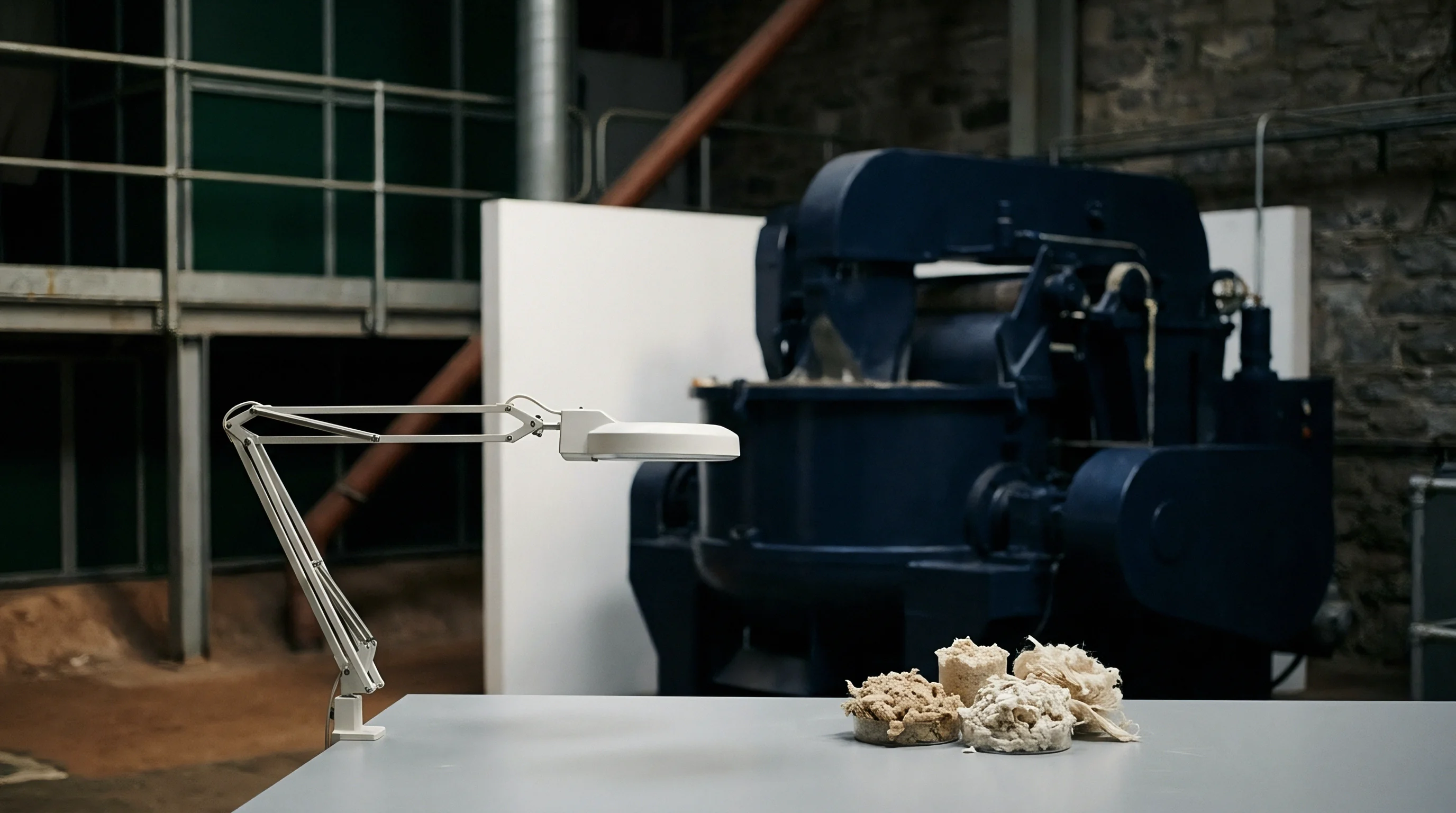
Spectroscopic and Pyrolytic Quantification Pathways
Wet-chemical staining provides morphological identification, yet modern compliance files increasingly demand non-destructive spectroscopy and analytical pyrolysis to quantify non-cellulosic furnish additives and recycled markers. Attenuated Total Reflectance Fourier Transform Infrared spectroscopy enables direct characterisation of the organic surface chemistry of the paperboard sheet without damaging structural fibres. ATR-FTIR scans measure absorption bands associated with synthetic polymeric crosslinkers, surface sizing chemistries, and the spectral fingerprints of residual printing inks that survive commercial deinking operations.
A pristine sheet composed exclusively of virgin bleached kraft displays sharp infrared absorption bands centered at 3330 cm-1 for intermolecular hydroxyl stretching, 2890 cm-1 for aliphatic carbon-hydrogen stretching, and 1030 cm-1 for the pyranose ring carbon-oxygen backbone. Recovered deinked furnishes introduce secondary absorption bands that expose commercial recovery origins. Residual styrene-acrylate surface sizing agents and wet-end retention aids yield pronounced carbonyl stretching peaks between 1720 cm-1 and 1740 cm-1.
Mineral fillers present in recycled newsprint and magazine furnish generate sharp identifying doublets: calcium carbonate absorbs strongly at 1405 cm-1 and 875 cm-1, while kaolin clay exhibits distinct aluminosilicate hydroxyl stretching bands at 3695 cm-1 and 3620 cm-1.
Gas chromatography coupled with mass spectrometry and pyrolysis GC-MS isolates the volatile and semi-volatile chemical additives that survive in industrial recycled pulps. Pyrolyzing a microscopic sample of the substrate at 550 degrees Celsius thermalises the lignocellulosic matrix into distinct monomeric phenols, levoglucosan, and volatile organic acids. Samples derived from virgin chemical pulp yield clean pyrograms dominated by levoglucosan, furans, and guaiacol derivatives.
Furnishes containing post-consumer packaging materials produce distinct synthetic signatures, including phthalate plasticisers, residual styrene dimers, dialkylphthalates from corrugated adhesives, and elevated levels of diisopropylnaphthalenes originating from carbonless copy papers and thermal print coatings.
The quantitative isolation of mineral oil saturated hydrocarbons and mineral oil aromatic hydrocarbons through coupled liquid chromatography-flame ionisation detection serves as a definitive proxy for the presence of secondary recycled fibres derived from commercial print packaging. The testing workflow follows the protocol established in DIN EN 16995, measuring hydrocarbon fractions extracted from the fibrous substrate via organic solvent incubation.
- Sample comminution requires cutting the dry paperboard sample into fragments measuring two millimeters by ten millimeters, avoiding heat generation that volatilises low-boiling hydrocarbons below the dodecane retention marker.
- Internal standard addition introduces specific deuterated and synthetic standard mixtures directly into the dry paper fragments, including bicyclohexyl, perylene, tri-tert-butylbenzene, and n-undecane to establish baseline recovery rates.
- Extraction procedure immerses the prepared board fragments in an equal-ratio mixture of absolute ethanol and high-purity n-hexane, maintaining dark thermal equilibrium at 23 degrees Celsius for twenty-four hours to desorb bound hydrocarbons from the cellulosic fibres.
- Chromatographic separation injects the concentrated solvent extract into a dual-column coupled high-performance liquid chromatography instrument equipped with a silica stationary phase to separate the saturated fraction from the aromatic hydrocarbons.
- Detector integration burns the separated eluent streams across parallel flame ionisation detectors, measuring the unresolved complex mixture humps across the equivalent carbon number retention windows between C10 and C50.
Interpreting chromatography data requires rigid baseline subtraction. Mineral oils present in pristine processing aids, hot-melt sealing adhesives, or paraffin wax barriers can mimic the MOSH profiles typically introduced by recycled newsprint furnish. A pristine virgin kraft board produced on a high-speed machine that employs mineral-oil-based defoaming agents or lubricating oils will yield measurable MOSH fractions between C16 and C24 despite containing zero recycled pulp.
Analytical laboratories must execute gas chromatography mass spectrometry spectral confirmation to separate synthetic aliphatic oligomers from authentic industrial petroleum residues before certifying the presence of secondary furnish.
Under DIN EN 16995 extraction conditions, an assay confirming mineral oil aromatic hydrocarbons between C16 and C35 above one milligram per kilogram demonstrates the presence of secondary print waste irrespective of virgin claims on the accompanying bill of lading.
When the chromatographic assay identifies non-deinked secondary waste in stock certified as virgin under a mill credit ledger, the converting facility faces immediate packaging declaration disputes under food contact barrier directives.


Credit

Administrative Mass Balance and Audit Period Latency
The administrative architecture governing forest certification credits explains how an analytically verified sheet of virgin board legally carries an FSC Recycled Credit or FSC Mix Credit claim. Both the Forest Stewardship Council and the Programme for the Endorsement of Forest Certification permit certificate holders to operate chain of custody credit systems across defined certificate scopes. Under FSC-STD-40-004 Section 10 and PEFC ST 2002 Clause 6.3, a credit system allows an organisation to create a virtual pool of credit points generated by certified input materials and transfer those credits across qualifying output batches manufactured within the same site scope.
The mass balance framework operates on strict numerical equivalence rather than physical tracing. A pulp mill feeds one thousand metric tonnes of certified virgin chemical pulp and one thousand metric tonnes of uncontrolled non-certified pulp into a continuous digestion and bleaching loop. The facility does not maintain separate mechanical storage silos or physical wash lines.
The blended pulp pours into the headbox and dries onto mother reels as a completely homogeneous fifty-fifty mix. Under the rules of the credit system, the facility divides the output into two commercial streams: one thousand metric tonnes are sold with an uncertified invoice designation, and one thousand metric tonnes are invoiced with a high-integrity, one hundred percent certified claim. The certified reels contain fifty percent uncontrolled fibres, yet the commercial paperwork is compliant with scheme laws.
| System Metric | Physical Transfer System | Percentage System | Credit System (Mass Balance) |
|---|---|---|---|
| Input segregation requirement | Absolute physical separation required | Physical separation during batch run | Simultaneous physical mixing permitted |
| Claim calculation mechanism | Direct pass-through of lowest input claim | Rolling average percentage applied to output | Credit ledger accounts drawn down by volume |
| Invoice claim format | FSC 100% or FSC Mix (Single Claim) | FSC Mix XX% (Reflecting batch input) | FSC Mix Credit or FSC Recycled Credit |
| Physical sheet correlation to claim | Exact physical correspondence to fiber inputs | Proportional correspondence within batch | Decoupled: zero correlation guaranteed |
| Audit validity interval | Direct material balance per transaction | Job-specific or monthly rolling average | Rolling twelve-month maximum ledger validity |
Latency within the administrative accounting ledger introduces further divergence from physical reality. Scheme standards permit certified organisations to bank credits within their internal ledgers for up to twenty-four months before expiration. A paperboard mill that processes large volumes of FSC 100% pulp logs during the first quarter of an operating year can accumulate a substantial certified credit balance.
Over the subsequent two quarters, the mill runs entirely uncontrolled or non-certified virgin roundwood. When a packaging buyer places an order in September, the mill draws down its accumulated January credits to issue invoices marked FSC Mix Credit. The packaging engineer receiving the board possesses valid chain of custody documentation certifying the material, but a laboratory furnish assay of the board identifies zero certified wood elements.
The credit account acts as a currency reservoir across the production system. In integrated multi-ply board machines, the top and back plies might receive pristine chemical virgin pulps to ensure printability and water resistance, while the thick middle ply incorporates recycled fluting and thermo-mechanical pulp. If the manufacturing site manages its credit account at the site level across all paperboard lines, credits generated by high-recycled fluting machines can be allocated commercially to offset virgin folding boxboard reels running on an adjacent machine hall.
The commercial transaction remains within the boundaries of the scheme certificates, while the physical board delivered to the converting floor departs entirely from the furnish ratios implied by the claim name.
A verified FSC Mix Credit statement guarantees financial contribution to certified forest management systems at the supplier level while certifying nothing regarding the physical biological origin of the fibers in the shipping crate.
The risk shifts to the brand owner when legal compliance mandates verifiable physical properties, including minimum post-consumer recycled percentages for plastic packaging taxes or European packaging waste fee reductions. Regulatory enforcement agencies review chemical assays rather than commercial certificate registries. When the state laboratory executes an assay that disproves the physical presence of recycled fibre on a pack carrying a recycled credit invoice, the brand’s legal team must defend why an administrative mass balance ledger supersedes statutory physical furnish mandates.
The contractual supply agreement must explicitly distinguish between physical furnish mandates and chain of custody credit allocations to prevent costly regulatory disputes at retail.


Yield

Worked Conversion Mass Balance and Chemical Mass Losses
Establishing clear audit reconciliation between laboratory furnish assays and chain of custody credit balances requires precise conversion arithmetic that accounts for mass loss during processing. The assumption that one metric tonne of purchased baled raw material yields one metric tonne of finished furnish inside a paperboard matrix is technically false. Cellulose recovery yields vary extensively across virgin digestion processes and secondary recovered paper cleaning circuits, shifting the physical mass balance relative to the administrative book credit.
Consider a packaging board mill operating an automated deinking and continuous repulping plant. The facility purchases baled post-consumer recovered paper classified under EN 643 Grade 1.05 (old corrugated containers) to produce the middle ply of a folding boxboard grade, while purchasing FSC 100% Northern Bleached Softwood Kraft market pulp for the outer liners. The commercial contract stipulates an FSC Mix Credit invoice claim, calculated from an internal credit balance built on the purchased volumes of certified virgin kraft and recovered baled stock.
The balance must factor in shrinkage, reject fractions, and chemical dissolution.
A rigorous mass balance calculation demonstrates the physical yield loss and the resulting divergence between purchased material weight, physical furnish ratios, and issued credit claims. The following worked model tracks a four-hundred-metric-tonne gross raw material input campaign.
- Gross input receipt logs two hundred metric tonnes of kiln-dried FSC 100% virgin chemical pulp at ten percent moisture content and two hundred metric tonnes of EN 643 baled recovered paper at twelve percent moisture content.
- Moisture standardisation calculates the bone-dry fiber input mass: virgin kraft yields one hundred and eighty dry metric tonnes, while recovered baled paper yields one hundred and seventy-six dry metric tonnes.
- Repulping yield loss accounts for mechanical contaminants and chemical dissolution: virgin bleached chemical pulp experiences a two percent dry mass loss through screening, yielding one hundred and seventy-six point four tonnes of usable physical furnish.
- Recycled repulping shrinkage removes contraries, staples, non-cellulosic adhesives, wax coatings, and short degraded fines through screening and hydrocyclone cleaning, producing an empirical mechanical yield of seventy-eight percent, resulting in one hundred and thirty-seven point two eight dry metric tonnes of usable secondary pulp.
- Total machine furnish blending combines both physical slurries at the wet end, establishing a total finished bone-dry furnish mass of three hundred and thirteen point six eight metric tonnes.
Physical furnish assay calculations reveal the real composition of the finished board. The virgin bleached kraft constitutes fifty-six point two percent of the dry sheet mass, while the secondary recycled fibre constitutes forty-three point eight percent of the physical sheet. If an analytical chemist tests this board using Graff C staining and morphological analysis under ISO 9184, the assay returns approximately fifty-six percent virgin chemical softwood and forty-four percent recycled mechanical and chemical components.
The certified credit accounting system processes the exact same campaign through a different mathematical mechanism. Under FSC-STD-40-004 Clause 10.3, credits are entered into the credit account based on the certified input material mass multiplied by a certified processing yield factor. If the mill uses an uncalibrated site-wide default yield factor of ninety percent for virgin inputs and eighty-five percent for recovered inputs, the credit ledger books one hundred and sixty-two metric tonnes of virgin credit and one hundred and forty-nine point six metric tonnes of recycled credit.
Over a three-month converting run, the mill can allocate those virgin credits to a completely separate product line running one hundred percent virgin eucalyptus pulp, while applying the entire recycled credit balance to a production run containing physical virgin sheet structures. The physical assay shows fifty-six percent virgin kraft, the mass balance yield proves forty-four percent recycled physical recovery, and the shipping invoice bills the lot as FSC Mix Credit with an internal bookkeeping transfer that records zero recycled physical presence in that run.
Divergence amplifies when mills run heavily filled packaging grades. Adding twenty percent precipitated calcium carbonate filler directly to the wet end alters the gross product mass without generating fibre credits. Standard chain of custody accounting frameworks track wood-based fibre mass rather than total sheet weight, meaning inorganic pigments, water-resistant starch surface coatings, and synthetic barrier coatings must be excluded from credit ledger calculations.
If an analytical laboratory processes a coated folding boxboard without stripping the synthetic coatings, the calculated furnish ratios report falsely low fibre percentages, confusing the commercial compliance audit.
A buyer who specifies eighty percent post-consumer content must explicitly establish whether that threshold applies to the physical furnish assay or the administrative credit ledger before commercial production begins.


Exposure

Border Compliance and Regulatory Penalties
Can physical laboratory assays supersede chain of custody certificates during customs evaluations?
When goods cross regulatory borders, enforcement authorities prioritize verifiable empirical assays over private certification marks. Customs authorities enforce public statutory laws, such as the European Union Deforestation Regulation (EUDR), national extended producer responsibility laws, and anti-greenwashing mandates like the EU Green Claims Directive. A certificate issued by a third-party scheme demonstrates conformity with private standard systems.
It does not provide legal immunity against customs fraud investigations if the physical contents of the shipping container contradict mandatory commercial declarations.
The regulatory divergence carries immediate commercial costs under the European Union Deforestation Regulation. EUDR mandates precise geographic traceability for all wood fibres imported into or exported from the European Union market. Importers must supply the exact geographic coordinates of the land plots where the wood was harvested, backed by satellite imagery and verifiable logging concession records.
Mass balance and credit systems that decouple the physical timber harvest from the shipped pallet are strictly prohibited under the administrative provisions of the regulation. A brand owner claiming EUDR compliance based on an FSC Mix Credit certificate faces immediate consignment seizure if customs authorities use laboratory stable-isotope ratio analysis or trace-element chemical profiling to reveal that the physical furnish originated from high-risk deforestation areas rather than the certified concession listed in the supplier’s due diligence statement.
| Regulatory Framework | Enforcement Mechanism | Physical Assay Evidentiary Standing | Credit System Certificate Defense |
|---|---|---|---|
| EU Deforestation Regulation (EUDR) | Customs holds and origin isotope assays | Primary evidence for origin verification | Inadmissible; physical segregation required |
| Plastic Packaging Tax (UK / Spain / Italy) | Revenue audits and furnish mass spectrometry | Legally binding determination of content | Rejected; chemical and mass proofs required |
| Green Claims Directive (EU) | Market surveillance and microscopic staining | Enforceable baseline for advertising claims | Insufficient to defend specific batch claims |
| US Lacey Act (16 U.S.C. 3371) | Customs declaration audit and wood anatomy | Admissible evidence of species fraud | Secondary evidence; does not cure false Lacey paper |
Commercial exposure escalates under packaging taxation systems designed to drive recycled usage. Under the United Kingdom Plastic Packaging Tax and corresponding secondary plastic components within barrier-coated paperboard, packaging containing less than thirty percent recycled material faces direct fiscal penalties per metric tonne. Importers attempting to substantiate recycled content claims using mass balance credit declarations face rejection by taxation authorities.
Her Majesty’s Revenue and Customs and EU Member State revenue offices demand physical traceability back to genuine secondary material flows or validated batch-specific manufacturing records. When tax authorities test imported cartons using pyrolysis GC-MS and discover that the physical furnish contains ninety-eight percent virgin chemical pulp, the importer of record is assessed unpaid back-taxes, statutory penalties, and potential criminal sanctions for false declaration, regardless of whether the supplier held a valid FSC Recycled Credit certificate.
Brand owners face severe operational risks from retailer rejections and civil litigation. European packaging waste regulations penalise packaging that exaggerates recyclable or recycled attributes on consumer-facing artwork. A folding carton printed with bold consumer statements claiming seventy percent recycled content supported only by an administrative credit system represents a major civil liability.
If competitor groups or consumer protection agencies execute independent laboratory furnish assays using Graff C staining and publish findings that the board contains zero physical recycled fibres, the brand faces immediate mandatory product recalls, inventory write-offs, and public regulatory sanctions.
Packaging buyers mitigate this structural risk by incorporating precise compliance clauses into master supply contracts. The standard procurement agreement must establish that chain of custody certificates satisfy baseline sustainability sourcing policies, while physical laboratory furnish assays govern statutory customs declarations, tax submissions, and on-pack consumer claims.
Failure to align the laboratory testing protocol with the precise accounting mechanism on the bill of lading guarantees that the importer of record remains fully exposed to customs seizures, fiscal re-evaluations, and the total forfeit of cross-border shipments.