Quantifying Transverse Moisture Diffusion Rates in High Speed Multi Ply Mechanical Board Calendering
Transverse moisture diffusion in mechanical board calendering requires precise dwell timing to confine plasticization to surface plies and preserve core bulk.
Sorption
Moisture transport through multi-ply paperboard during high-speed finishing operations occurs via coupled liquid water capillary flux and vapor phase diffusion. In a multi-ply mechanical board structure, such as a folding boxboard featuring a thermomechanical pulp core bounded by bleached chemical pulp outer layers, transverse mass transport governs how moisture redistributes across the thickness profile prior to pressure application. When surface steam or water spray mist hits the moving web, a sharp moisture gradient develops within microseconds.
The top chemical ply absorbs moisture rapidly due to its open pore geometry and hydrophilic cellulose surface, initiating both bound water diffusion through the fiber walls and vapor diffusion within the inter-fiber voids. Density governs transport rates.
Fickian diffusion modeling provides a baseline for quantifying vapor transport through paper matrices under isothermal conditions. The effective diffusion coefficient incorporates structural factors including sheet porosity, tortuosity, and local fiber orientation. At room temperature, typical transverse effective diffusion coefficients for paperboard range between 1.0 multiplied by 10 to the power of minus 10 square metres per second and 5.0 multiplied by 10 to the power of minus 10 square metres per second.
Elevated web temperatures during steam application shift this equilibrium by increasing water vapor pressure and accelerating kinetic energy within the fiber network. Transverse moisture transport transitions from pure Fickian gas diffusion to liquid capillary penetration driven by pore pressure gradients when condensation occurs on the sheet surface.
Surface moisture pickup of 2.5 g per square metre at 23 degrees Celsius and 50 percent relative humidity elevates top-ply local moisture content from 7.2 percent to 18.5 percent within a 35-millisecond window.
Pore radius limits liquid capillary flow. Liquid absorption kinetics follow Lucas-Washburn equations under ambient pressure, but dynamic compression and rapid thermal transfer in machine calenders introduce non-Fickian transport phenomena. Water molecules sorb into cell walls, swelling the fiber matrix and altering the local free volume.
Sorption isotherms described by the Guggenheim-Anderson-de Boer formulation demonstrate that at local relative humidities exceeding 80 percent, multi-layer molecular condensation dominates mass transfer, accelerating liquid movement through micropores. The rate of moisture movement into the inner mechanical core plies determines whether core bending stiffness stays intact during subsequent surface smoothing steps.
Transient Fickian Dynamics and Vapor Transport
Water molecules migrate across the web thickness in response to steep chemical potential gradients generated by surface dampening. High-speed calendering lines operating between 800 and 1400 metres per minute allow minimal contact time between moisture application and the nip center. The transient accumulation of moisture in the z-direction follows second-order partial differential equations where local density, moisture concentration, and temperature dictate the flux vector.
Because thermomechanical pulp contains higher lignin levels than chemical pulp, the sorption rate within the core ply exhibits strong temperature sensitivity, dropping sharply when local temperatures fall below the softening point of amorphous wood polymers.
| Board Layer Furnish Type | Layer Density (kg/m³) | Test Temp (°C) | Local Moisture Content (%) | Effective Diffusion Coefficient (m²/s) |
|---|---|---|---|---|
| Bleached Hardwood Kraft Top Ply | 680 | 23 | 7.5 | 1.8 × 10⁻¹⁰ |
| Bleached Hardwood Kraft Top Ply | 680 | 85 | 16.0 | 4.2 × 10⁻⁹ |
| Chemi-Thermomechanical Pulp Core | 390 | 23 | 8.0 | 5.4 × 10⁻¹⁰ |
| Chemi-Thermomechanical Pulp Core | 390 | 85 | 12.0 | 1.1 × 10⁻⁸ |
| Unbleached Softwood Kraft Back Ply | 620 | 23 | 7.8 | 2.2 × 10⁻¹⁰ |
| Data determined via dynamic vapor sorption and moisture boundary profiling under ISO 187 conditioning standards. | ||||

Temperature Dependence of Layer Diffusion Coefficients
Thermal energy applied during web conditioning lowers the activation barrier for molecular movement through refined fiber walls. Heat penetration drives vapor movement. Arrhenius relationships quantify how temperature increases elevate transverse diffusion rates across both chemical and mechanical furnish plies.
As temperature rises from 20 degrees Celsius to 90 degrees Celsius, the effective diffusion coefficient of water vapor in the mechanical core increases by up to two orders of magnitude. This thermal dependence creates a race between temperature conduction and moisture diffusion during pre-calendering dwell times, determining whether moisture reaches the middle plies before mechanical pressure is applied.
Whether transient non-Fickian vapor condensation spikes at internal ply boundaries can be accurately isolated from pure bulk sorption remains an unmeasured variable in current high-speed line instrumentation.


Transit
Web speeds reaching 1200 metres per minute constrain the time window between steam application and calender nip entrance to less than 50 milliseconds. Managing transverse moisture transport relies on controlling this transit window to ensure moisture remains confined to the surface plies. If the transit time is too long, water diffuses deeply into the mechanical pulp core, softening core fibers and causing catastrophic loss of sheet thickness and bending stiffness during compression.
If the transit time is too short, surface fibers do not absorb sufficient moisture to reach their plastic state, resulting in inadequate smoothness development under calender roll pressures.
Quantifying moisture penetration depth requires calculating the thermal and moisture boundary layer advancement as the board travels from the steam shower to the calender nip. Transit duration varies inversely with machine speed and directly with nozzle-to-nip spatial separation. Dwell times remain short.
At a machine speed of 1000 metres per minute, a spatial distance of 1.0 metre yields a transit time of exactly 60 milliseconds. Within this millisecond timeframe, the moisture front must penetrate between 20 and 40 micrometres into the top chemical ply without breaching the interface of the underlying mechanical core layer. High speed narrows dwell.
- Measure baseline web speed and calculate millisecond transit duration from nozzle outlet to nip centerline.
- Adjust steam shower distance to restrict liquid penetration to outer bleached kraft plies.
- Verify surface condensation uniformity using high-speed infrared moisture profiling instrumentation across the full trim.
- Correlate entry moisture profile with post-calender bending stiffness measurements taken at goods-in testing stations.
Excess steam application distance allows moisture penetration into mechanical core fibers, causing permanent bulk destruction and bending stiffness loss.
Steam Shower Distance and Velocity Scaling
Positioning the application head relative to the press nip defines the moisture penetration depth prior to mechanical compression. Line speed modifications change transit kinetics automatically, requiring proportional adjustments to steam application rates or mechanical position shifts of the steam shower frame. Increasing web speed reduces transit dwell time, which suppresses deep transverse migration and confines plasticization to the outermost fiber layers.
Modern multi-ply board machines adjust steam mass flux dynamically to offset web speed variations, keeping surface moisture content within target bands without deepening the penetration front.
Boundary Layer Moisture Profile at Nip Entrance
Superficial liquid films condense rapidly onto cold board surfaces, creating an asymmetric z-direction gradient. Surface steam condenses instantly. Infrared moisture sensors mounted immediately ahead of the nip measure total moisture mass but cannot resolve z-direction gradients directly.
Engineers calculate the z-direction moisture profile by coupling surface temperature readings with finite element diffusion models calibrated for specific web speeds. The target entry profile exhibits a steep step-change, concentrating 80 percent of added moisture within the top 15 percent of total board caliper.
Improper transit duration positioning causes deep moisture migration into the bulk core, destroying bending stiffness and rendering delivered carton lots unsuited for high-stack packaging applications.

Ply
Multi-layer folding boxboards combine bleached chemical pulp surface covers with high-bulk thermomechanical core stocks. Each ply possesses distinct porosity, pore size distribution, density, and chemical surface characteristics that alter transverse moisture transport. Top plies composed of highly refined hardwood and softwood chemical pulps yield dense fiber networks with small pore radii, generating strong capillary suction forces.
The middle ply, composed of coarse, stiff thermomechanical or chemi-thermomechanical pulp fibers, features lower density, higher bulk, and larger void spaces. Mechanical pulp retains bulk.
Discontinuities in physical structure across ply boundaries create contact resistance to liquid flow. Interfacial zones between chemical covers and mechanical cores often display density variations created during multi-former wet pressing. These density boundaries disrupt continuous capillary pathways, delaying liquid water transit while permitting gaseous water vapor flux.
Internal sizing chemicals applied to specific plies further regulate liquid movement. Alkyl ketene dimer or alkenyl succinic anhydride sizing agents elevate fiber contact angles, inhibiting liquid wetting while leaving vapor diffusion channels open. Sizing limits liquid absorption.
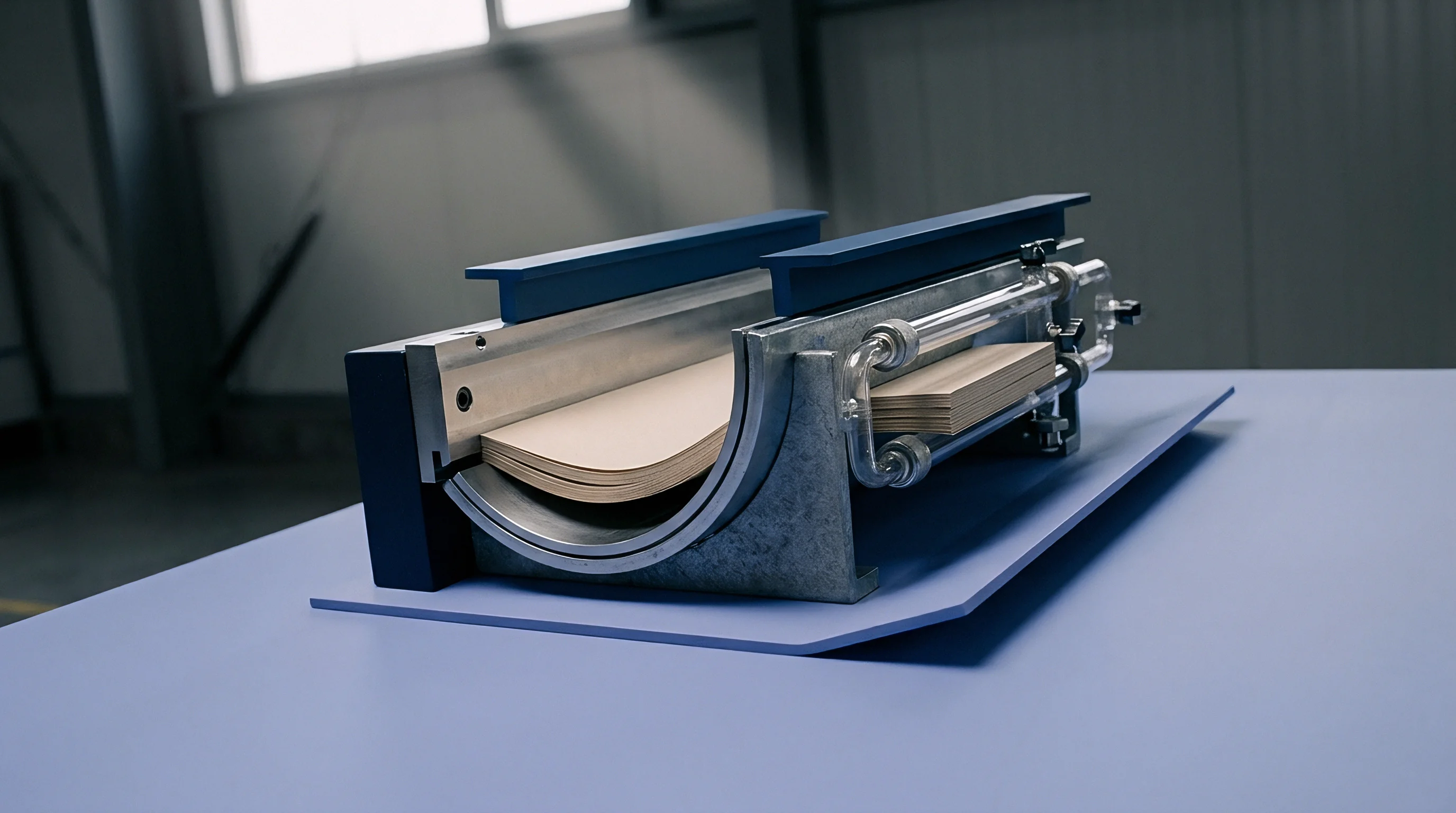
Does Ply Interfacial Density Limit Water Vapor Flux?
Compacted fibers at ply boundaries create localized hydraulic resistance steps that disrupt linear moisture migration across the web thickness. High-density interfaces act as partial barriers to liquid water penetration, causing moisture to pool temporarily in the outer chemical ply. This temporary pooling increases local moisture concentration in the top layer, accelerating fiber plasticization right where smoothness is needed.
Vapor phase diffusion across the interface continues unabated if local temperatures exceed dew point levels, allowing controlled thermal energy to enter the core without liquid-induced fiber collapse.
| Ply Position | Dominant Furnish Type | Grammage Range (g/m²) | Cobb 60 Value (g/m²) | Transverse Vapor Resistance (s/m) |
|---|---|---|---|---|
| Top Surface Ply | Bleached Hardwood/Softwood Kraft | 45 – 65 | 22 – 28 | 420 |
| Under-Layer Ply | Deinked / Bleached Chemical Trimmings | 30 – 45 | 28 – 35 | 310 |
| Middle Core Ply | Chemi-Thermomechanical Pulp (CTMP) | 140 – 260 | 45 – 90 | 180 |
| Back Surface Ply | Unbleached Softwood Kraft | 35 – 50 | 25 – 32 | 380 |
Internal Sizing and Hydrophobicity Barriers
Alkyl ketene dimer treatment alters fiber wall surface energy, suppressing liquid capillary uptake while permitting vapor phase diffusion. Unsized mechanical pulp cores readily absorb moisture if liquid breaches the top chemical layer, leading to sudden bulk loss under calender loads. Sizing the middle ply maintains hydrophobic fiber surfaces, ensuring that any moisture reaching the core remains in the vapor phase and escapes laterally or re-condenses without triggering fiber wall softening.
Tailoring hydrophobic chemical dosages across individual plies establishes precise control over moisture transport boundaries.
- Interfacial delamination split occurs when trapped vapor expands rapidly at ply boundaries inside high-temperature roll nips.
- Core density collapse develops when moisture penetrates thermomechanical pulp layers, lowering fiber glass transition temperatures under compression.
- Surface mottle formation stems from non-uniform transverse liquid flux across localized caliper variations during pre-dampening.
Board suppliers frequently attribute post-calendering stiffness variations to web origin raw furnish fluctuations rather than unmanaged moisture migration during mill calendering operations.
Calender
Soft nip finishing pairs heated hard steel rolls against compliant polymer covers to smooth board surfaces without crushing structural bulk. The primary objective of multi-ply mechanical board calendering centers on maximizing surface smoothness while retaining maximum caliper and bending stiffness. Temperature gradient calendering relies on rapid heat transfer to raise surface fiber temperatures above their glass transition point while the core remains cool.
Moisture gradient calendering works synergistically by introducing surface water to lower the glass transition temperature of surface fibers specifically, allowing deformation under reduced mechanical pressure. Moisture plasticizes outer fibers.
Dry lignin exhibits a glass transition temperature between 140 and 170 degrees Celsius, whereas dry hemicellulose softens between 160 and 180 degrees Celsius. Elevating local moisture content in the top chemical ply to 15 percent drops the glass transition temperature of these amorphous polymers below 60 degrees Celsius. When the board passes through a soft calender nip with roll temperatures set to 180 degrees Celsius, outer fibers plasticize instantly under pressure, flattening against the smooth steel roll surface.
Nip pressure collapses pores. Because transit timing keeps moisture out of the CTMP core, core fibers retain high stiffness and resist compression. Temperature alters glass transition.
Standard ISO 2493 bending stiffness guarantees fail when calender roll temperatures exceed core thermal softening limits under elevated moisture states.
Thermal Softening and Lignin Glass Transition
Moisture acts as a low molecular weight plasticizer within amorphous wood polymers, depressing the temperature required for fiber deformation. Hydroxide groups on water molecules form hydrogen bonds with hemicellulose and lignin chains, increasing molecular mobility and polymer chain flexibility. In mechanical pulps containing high native lignin ratios, controlling moisture content dictates plastic deformation behavior under dynamic calender nip loads.
Precise moisture gradient control prevents thermal energy from plasticizing the internal mechanical pulp matrix, preserving structural voids that give folding boxboard its bulk advantage.
| Calendering Configuration | Roll Temp (°C) | Nip Dwell (ms) | Surface Moisture (%) | Parker Print-Surf Roughness (µm) | Taber Stiffness Retention (%) |
|---|---|---|---|---|---|
| Hard Nip Steel-on-Steel | 90 | 2.5 | 7.5 | 3.2 | 74 |
| Soft Nip Polymer Cover (88 Shore D) | 160 | 12.0 | 9.0 | 1.8 | 88 |
| Extended Soft Nip (Shoe Calender) | 190 | 45.0 | 14.5 | 1.1 | 94 |
| Uncalendered Base Control | 23 | 0.0 | 7.5 | 6.8 | 100 |

Preserving Core Caliper under Elastic Nips
Configuring cover hardness between 88 and 93 Shore D distributes peak linear pressure across extended nip contact lengths. Lower peak pressure prevents compressive failure of the dry mechanical core while high surface temperatures smooth the moistened cover ply. Shoe calenders extend nip residence time up to 50 milliseconds at moderate peak pressures, providing controlled thermal transfer that flattens surface micro-roughness without causing structural caliper loss.
Matching nip elasticity to the transverse moisture profile yields optimal surface smoothness per unit of lost sheet bulk.
- Web speed verification matches transit duration against moisture penetration depth calculations before setting roll temperature.
- Roll surface temperature setting maintains surface fiber plasticization while keeping thermomechanical core temperature below glass transition thresholds.
- Nip peak pressure control caps localized mechanical strain to preserve z-direction structural bulk in mechanical pulp layers.
- Post-nip moisture balance targets final equilibrium moisture content specified in conversion purchase contracts.
Higher roll surface temperatures combined with brief steam dwell times achieve target surface smoothness while shielding the mechanical core from stiffness-destroying moisture penetration.
Ledger
Commercial board purchasing evaluates raw material cost per metric tonne against finished carton yield per unit area. Bending stiffness scales with the third power of sheet thickness, establishing caliper preservation as the primary economic driver in packaging board specification. Bulk determines packaging stiffness.
When improper calendering moisture setpoints allow water to diffuse into the mechanical core, core collapse reduces overall sheet thickness. A loss of 5 percent in caliper reduces bending stiffness by approximately 14 percent, requiring a higher basis weight sheet to meet carton stacking strength mandates. Transverse diffusion governs compression.
Core caliper drops rapidly. Downgauging strategies rely entirely on maintaining high specific bulk in the middle plies while achieving printing surface requirements through targeted moisture plasticization. Purchasing 300 gram per square metre folding boxboard with preserved mechanical bulk provides the same bending resistance as a 340 gram per square metre solid bleached board, yielding a 12 percent saving in raw material tonnage for identical box quantities.
Mismanaged transverse moisture diffusion destroys this yield differential by forcing converters to order higher basis weight grades to compensate for lost stiffness.
Thermomechanical pulp yield advantages disappear when improper calendering moisture setpoints require a higher basis weight to restore lost carton stacking strength.

Downgauging Arithmetic and Stiffness Economics
A loss of ten percent in sheet caliper requires increasing basis weight by fifteen grams per square metre to maintain specified box compression strength. On an order of 500 metric tonnes of packaging board, this basis weight adjustment increases raw material costs by thousands of Euros while adding transport tare weight across the supply chain. Optimizing moisture diffusion control during calendering secures sheet smoothness targets without incurring basis weight penalties.
Precise transverse moisture management directly protects landed yield per tonne.
Mill Minimums and Quality Certificate Scopes
Purchase specifications defining bending resistance under ISO 2493 must specify test conditioning at 23 degrees Celsius and 50 percent relative humidity. Mill test certificates reporting bulk and stiffness values must state the exact test method, conditioning atmosphere, and sampling frequency across the tambour width. Specifying tight tolerance bands for z-direction density distribution ensures that delivered stock performs reliably on high-speed packaging lines without score line cracking or side-wall bulging.
Incorporating an explicit DIN 53121 bending stiffness tolerance band with mandatory ISO 187 conditioning into substrate supply agreements shifts financial liability for calendering-induced stiffness degradation directly onto the board mill.