Z Directional Shear Failure Thresholds under Dynamic Compression in High Speed Fluting Operations
Dynamic Z-directional shear failure limits high-speed fluting; maintaining Scott bond above 220 J/m2 prevents mid-plane delamination at speeds over 400 m/min.


Dynamics
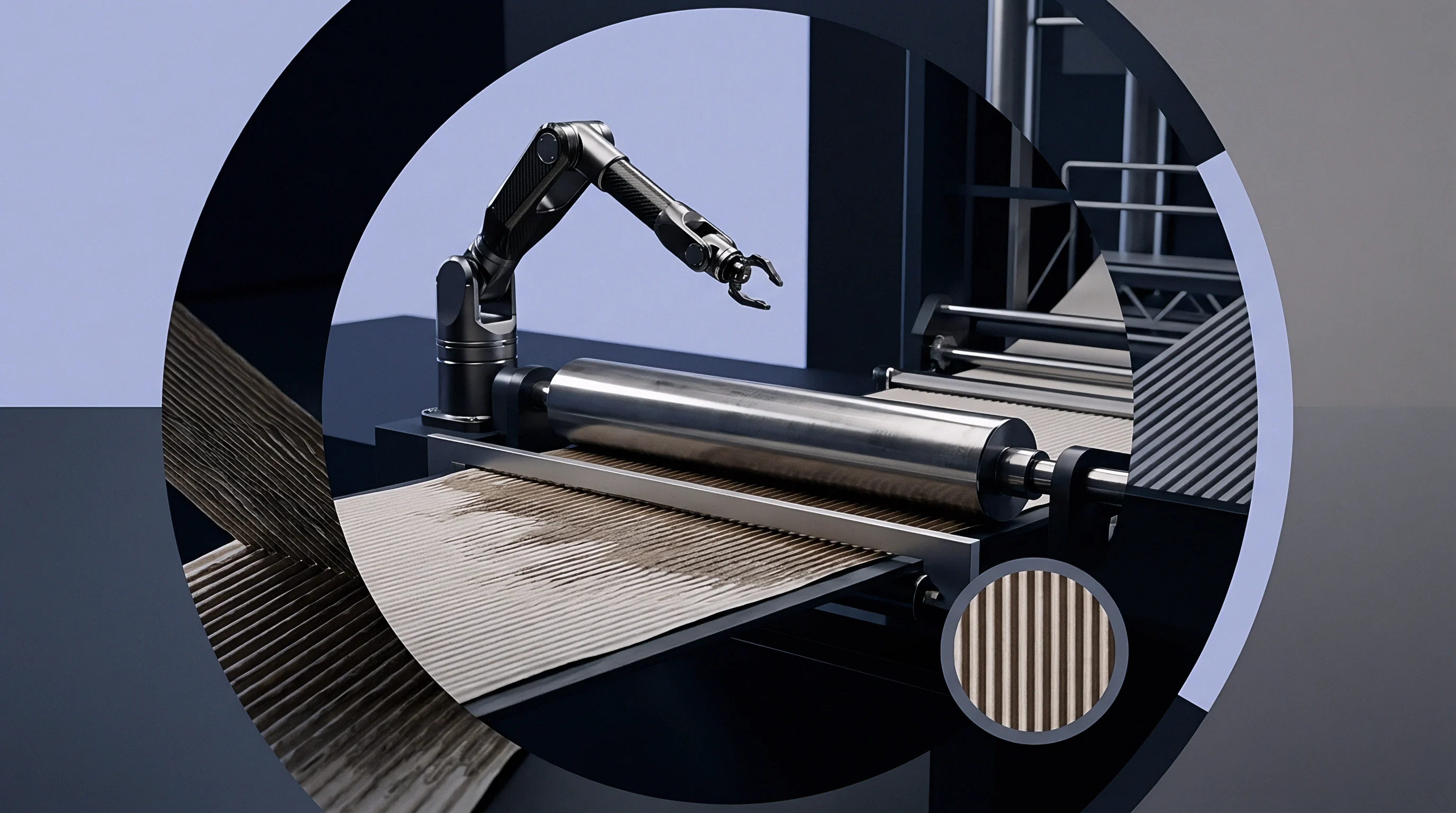
Running containerboard fluting through corrugators at speeds above 350 meters per minute exposes the medium to severe combined stresses. As the flat web feeds into the intermeshing upper and lower corrugating rolls, it faces heavy dynamic compression perpendicular to its surface. At the same time, the roll teeth force the sheet to conform to the flute contour in less than two milliseconds.
That rapid displacement generates high in-plane strain and drives heavy shear along the Z-axis.
Inside the fluting nip, the stress state is triaxial and time-dependent. Transverse compression compresses the fibre matrix, thinning the sheet by up to 35 percent at the roll tooth tip. As the medium wraps the tip radius, tensile forces pull at the outer face while compression bears on the inner surface.
This steep strain gradient forces differential slip through the thickness of the sheet, concentrating peak Z-directional shear stress directly at the mid-plane ~ often the weakest zone in the structure.
Virgin semi-chemical fluting exhibits an internal bond failure threshold exceeding 350 Joules per square meter under standard ISO 187 conditioning.
At these line speeds, the dynamic strain rate on the Z-axis exceeds 1,000 reciprocal seconds. Cellulosic fibre networks are heavily rate-sensitive: when loaded this fast, viscoelastic relaxation across individual fibres and bond sites cannot dissipate the stored mechanical energy in time. The effective shear modulus climbs, leaving the sheet stiffer but noticeably more brittle under out-of-plane shear.
Once local stress breaks through the dynamic failure envelope, micro-delamination begins.
Failure along the Z-axis presents distinct mechanical signatures depending on the stress interaction during contact:
- Pure compression failure occurs when localized nip peak pressures exceed the out-of-plane crushing resistance of the fibre wall, leading to permanent web thickness collapse without structural fibre separation.
- Pure shear delamination develops when speed differentials across the roll profile generate enough surface traction to overcome internal cohesion, cleanly parting plies along structural boundaries.
- Mixed-mode shear fracture sets in under heavy dynamic compression coupled with sharp bending strain, causing irregular inter-ply cracking, fibre tearing, and micro-buckling along the flute shoulder.
- Impact spalling occurs at extreme velocities when compressive shockwaves reflect off the back roll surface, setting up an instantaneous out-of-plane tension that tears the core apart.
In-plane shear strength and Z-tensile strength are coupled rather than independent variables. Under dynamic compression, the ultimate Z-shear threshold shifts according to the stress balance below:
Tau_fail = Tau_0 + mu Sigma_z
In this relation, Tau_0 represents the intrinsic zero-load shear strength of the fibre network, mu is the internal friction coefficient between bonded fibre layers, and Sigma_z is the dynamic compressive stress applied normal to the sheet plane. Moderate compressive loads initially help by increasing friction between interlocking fibres, but excessive compression crushes the hydrogen-bonded network, dropping Tau_0 to zero. With Tau_0 gone, any residual shear stress tears the sheet open immediately.
Underestimating the dynamic stress tensor inside the fluting zone causes internal micro-delamination that goes unnoticed until finished board edge crush strength drops by up to 25 percent.

Delamination
Internal network structure governs how paperboard behaves under dynamic shear. Fluting medium ~ whether made from virgin semi-chemical hardwood pulp or 100 percent recycled old corrugated containers (OCC) ~ is essentially a compressed mat of cellulosic fibres. The web holds together through mechanical entanglement and hydrogen bonding where fibres cross, with wet-end starch and surface sizing added to strengthen those bonds.
In multi-ply recycled medium, structural weakness lies right at the inter-ply interfaces. Multi-ply machines lay down separate stock slurries onto forming wires before pressing them together. The boundary zone between plies ends up with fewer entangled long fibres and a greater concentration of fines, fillers, and shortened, recycled fibres.
Under dynamic Z-shear, cracks propagate almost entirely along these weaker planes.
Micro-fractures along the Z-axis manifest as localized web bubbling prior to complete interlaminar shear failure at the corrugating roll tip.
Virgin Neutral Sulphite Semi-Chemical (NSSC) fluting is a single-ply sheet with high native lignin content. That lignin gives the sheet stiffness and moisture resistance, but leaves it reluctant to yield. Under rapid shear, NSSC fibres hold their ground until reaching a critical stress limit, at which point the sheet breaks cleanly across inter-fibre hydrogen bonds ~ a brittle snap rather than the progressive ply peeling seen in recycled furnish.
The mechanical sequence leading to internal structural collapse follows a distinct structural pathway:
- Elastic matrix distortion deforms the fibre network within its reversible limits, storing strain energy directly in the hydrogen bonds.
- Micro-crack initiation starts at internal voids or weak fibre intersections where local stress surpasses intrinsic bond strength.
- Inter-ply crack propagation draws micro-cracks together into a continuous front along the path of least resistance through the core of the sheet.
- Catastrophic structural delamination occurs as the running crack severs the core matrix, splitting the outer plies apart.
In surface-sized recycled medium, how deep the starch penetrates decides where the shear yield plane forms. Size press applications of modified corn or wheat starches are intended to bind the core, but when starch stays near the surfaces it creates stiff outer shells over an unreinforced middle. Under dynamic compression, that stiffness gradient funnels shear stress straight into the softer core, speeding up failure.
Fibre orientation relative to the machine direction sets directional shear limits. Forming fabrics line up more fibres along the machine direction (MD) than across it (CD). While high MD orientation lifts in-plane tensile stiffness, it weakens out-of-plane shear resistance across the CD.
Because corrugating forces fibres to shear across their length, highly oriented webs show lower dynamic shear thresholds when run through tight flute profiles at high speed.
Adding wet-end starch improves internal bonding up to the point where void spaces fill completely, after which the sheet simply turns brittle.

Velocity
Corrugator speed directly drives Z-directional shear failure. Production lines routinely run between 350 and 450 meters per minute, with newer installations targeting 500 meters per minute. At those speeds, sheet dwell time in the nip drops below one millisecond, pushing paper behavior deep into the non-linear viscoelastic regime.
At lower line speeds, cellulosic fibres cope with stress through molecular relaxation and bond realignment, allowing localized stress concentrations to bleed off into the surrounding network. At high speeds, the load hits faster than the cellulose-lignin matrix can relax. Because energy cannot dissipate in time, internal shear stress builds quickly toward the fracture point.
Pre-conditioning steam showers warm the incoming web to 85-95 degrees Celsius right before the nip, raising surface moisture to 7-9 percent. Heat and moisture plasticize the sheet by lowering the glass transition temperature of hemicellulose and lignin. This gives fibres enough flexibility to wrap the tooth radius under less load, lowering the dynamic elastic modulus while expanding shear strain capacity before rupture.
Applying too much steam produces an uneven moisture profile across the thickness. The surface plies turn compliant while the core remains cool and dry. When the fluting rolls bite, the soft skins deform immediately and transfer nearly all rotational shear into that rigid inner core, setting off deep delamination.
| Furnish Type | Grammage (g/m²) | Scott Bond (J/m²) | Dynamic Z-Shear Threshold (kPa) | Optimum Moisture (%) | Max Runnability Speed (m/min) |
|---|---|---|---|---|---|
| Virgin NSSC Hardwood | 120 | 380 | 425 | 7.2 – 8.0 | 500 |
| Semi-Chemical Hybrid | 130 | 310 | 360 | 7.0 – 7.8 | 440 |
| Recycled OCC Surface-Sized | 140 | 240 | 280 | 7.5 – 8.5 | 380 |
| High-Yield Uncoated Recycled | 150 | 170 | 195 | 6.8 – 7.5 | 320 |
Temperature also changes how the bonds give way. At ambient temperatures, fibre-to-fibre bonds snap cleanly. Inside a heated nip, softened hydrogen bonds let fibres pull out intact instead of breaking.
That fiber pull-out raises total strain capacity, though it lowers the absolute load the web can carry.
Roll profile geometry complicates the speed effect. Fine flutes like E and F have tight tip radii and many teeth per meter, producing sharper compression spikes and steeper shear gradients than coarse A or C flutes. Taking fine flutes above 400 meters per minute leaves almost no operating margin, making sheet moisture and internal bond strength critical.
Increasing basis weight does not automatically prevent high-speed fluting cracks; internal moisture and starch gradients can cause heavy sheets to delaminate under fast bending strains just as easily.


Assessment
Testing out-of-plane properties under conditions that reflect actual converting lines requires the right instruments. Standard laboratory tests generally measure static or slow-rate tensile strength. Pulling a specimen apart slowly in a conventional Z-tensile rig reveals very little about how the sheet handles rate-dependent shear in a high-speed nip.
Paper mills rely primarily on the Scott Internal Bond test (ISO 16260 / TAPPI T 569) to track interlaminar strength. The method uses a pendulum to strike an angle bracket taped to the sample, recording the total energy absorbed during rapid delamination. Although dynamic, the test registers total rupture energy rather than a discrete shear failure stress, and it applies no normal compressive load during impact.
ISO 16260 specifies internal bond strength measurement via energy absorption during pendulum impact on paperboard conditioned at 23 degrees Celsius and 50 percent relative humidity.
More thorough characterization relies on dynamic mechanical testing and high-rate test rigs. Instrumented drop towers and modified split-Hopkinson bars can deliver combined dynamic compression and out-of-plane shear at strain rates matching commercial corrugators. These setups generate complete stress-strain curves up to failure, isolating dynamic shear limits under known normal loads.
| Property Metric | Standard Reference | Test Type | Loading Rate / Velocity | Operational Correlation |
|---|---|---|---|---|
| Internal Bond Strength | ISO 16260 / TAPPI T 569 | Dynamic Pendulum Impact | 2.5 to 3.0 m/s | Moderate indicator of ply adhesion |
| Z-Directional Tensile | ISO 1924-2 / TAPPI T 541 | Quasi-Static Uniaxial Pull | 12.5 mm/min | Poor indicator of dynamic runnability |
| Short Span Compression (SCT) | ISO 9895 / TAPPI T 826 | In-Plane Compression | 1.0 mm/min | High correlation with edge crush strength |
| High-Rate Dynamic Z-Shear | Custom Laboratory Rig | Combined Compression-Shear | 5.0 m/s | Direct indicator of fluting failure limit |
Ultrasonic testing provides a non-destructive way to assess out-of-plane properties on the run. The velocity of an ultrasonic pulse through the sheet thickness correlates directly with the out-of-plane elastic modulus, C33. Monitoring C33 across the paper machine web catches weak internal bonding well before a roll ever ships to a converting plant.
Are Dynamic Z Shear Limits Measurable at Line Speeds Exceeding Four Hundred Meters per Minute?
Measuring Z-shear stress directly inside a running corrugator nip is hindered by tight clearances and operating heat. Instead, high-speed optical strain mapping and piezoresistive sensors embedded in experimental rolls provide indirect readings of nip forces. These measurements help calibrate finite element models, linking standard Scott Bond values to realistic line-speed ceilings.
Test results are sensitive to specimen conditioning. Pulling samples straight from an unconditioned mill roll often gives inflated bond values compared to paper tested after proper acclimation. Reliable comparisons require conditioning to ISO 187 standards at 23 degrees Celsius and 50 percent relative humidity.
Standards bodies have yet to establish a combined dynamic stress method to replace static Z-tensile testing for high-speed fluting qualifications.
Specification
Procuring containerboard for high-speed fluting involves an ongoing compromise between fiber cost and machine runnability. Paper choices dictate corrugator uptime, web breaks, and finished box strength; buying strictly on basis weight and flat crush leaves open the risk of rolls delaminating under dynamic shear at speed.
Procurement specifications need explicit out-of-plane thresholds. For lines running past 400 meters per minute, 100 percent recycled medium requires a Scott Bond of at least 220 Joules per square meter. Virgin NSSC fluting should target at least 300 Joules per square meter, alongside a cross-direction Short-span Compression Test (SCT) value of at least 2.2 kiloNewtons per meter.
Each furnish option carries distinct operational and cost trade-offs:
- Virgin NSSC Fluting delivers high shear resistance and dependable operation up to 500 meters per minute; the higher price per tonne is partially offset by lighter basis weights and better thermal stability.
- Semi-Chemical Hybrid Grades blend virgin and recycled fibers for intermediate shear strength, offering a practical compromise on lines running up to 420 meters per minute.
- Surface-Sized Recycled Medium relies on starch pickup for compression strength; it meets basic structural targets at reasonable cost but requires strict steam management to avoid core delamination.
- Uncoated Recycled Medium has the lowest purchase cost but weak shear strength, capping machine speeds below 340 meters per minute and increasing break frequency.
The commercial trade-off shows clearly in a plant producing 50 million square meters of C-flute board annually. Choosing between a 120 g/m² virgin NSSC medium at 780 Euros per tonne and a 140 g/m² surface-sized recycled medium at 620 Euros per tonne highlights the split. The virgin NSSC runs at 450 meters per minute with a 0.5 percent web break rate.
The recycled grade limits line speed to 360 meters per minute to prevent shear fracture, pushing the break rate to 1.8 percent.
Raw paper cost works out to 4.68 Euros per 1,000 square meters for the virgin NSSC versus 4.34 Euros for the recycled grade. However, the 20 percent drop in line speed and extra downtime from breaks add 0.52 Euros per 1,000 square meters in overhead and lost throughput. Net production cost ends up favoring the virgin sheet by 0.18 Euros per 1,000 square meters.
Elevated steam shower pressure softens the outer fiber layers and shifts the dynamic shear plane deeper into the core of recycled containerboard.
Receiving inspections need firm roll acceptance rules. Out-of-round rolls, wet streaks, and edge cracks amplify local stresses and reduce dynamic shear tolerance. Mill test certificates should report Scott Bond and cross-direction SCT values tied to cross-machine reel positions.
Purchase agreements should stipulate that any roll lot falling below 220 Joules per square meter under ISO 16260 conditioning faces immediate rejection or a price adjustment covering the operational cost of slowing the corrugator.