Quantifying Unresolved Interfacial Shear Stress Decay Rates in Recycled Paperboard under Cyclic Microclimates
Cyclic microclimates degrade recycled paperboard inter-ply shear strength through moisture expansion mismatch and starch bond mechanical fatigue.
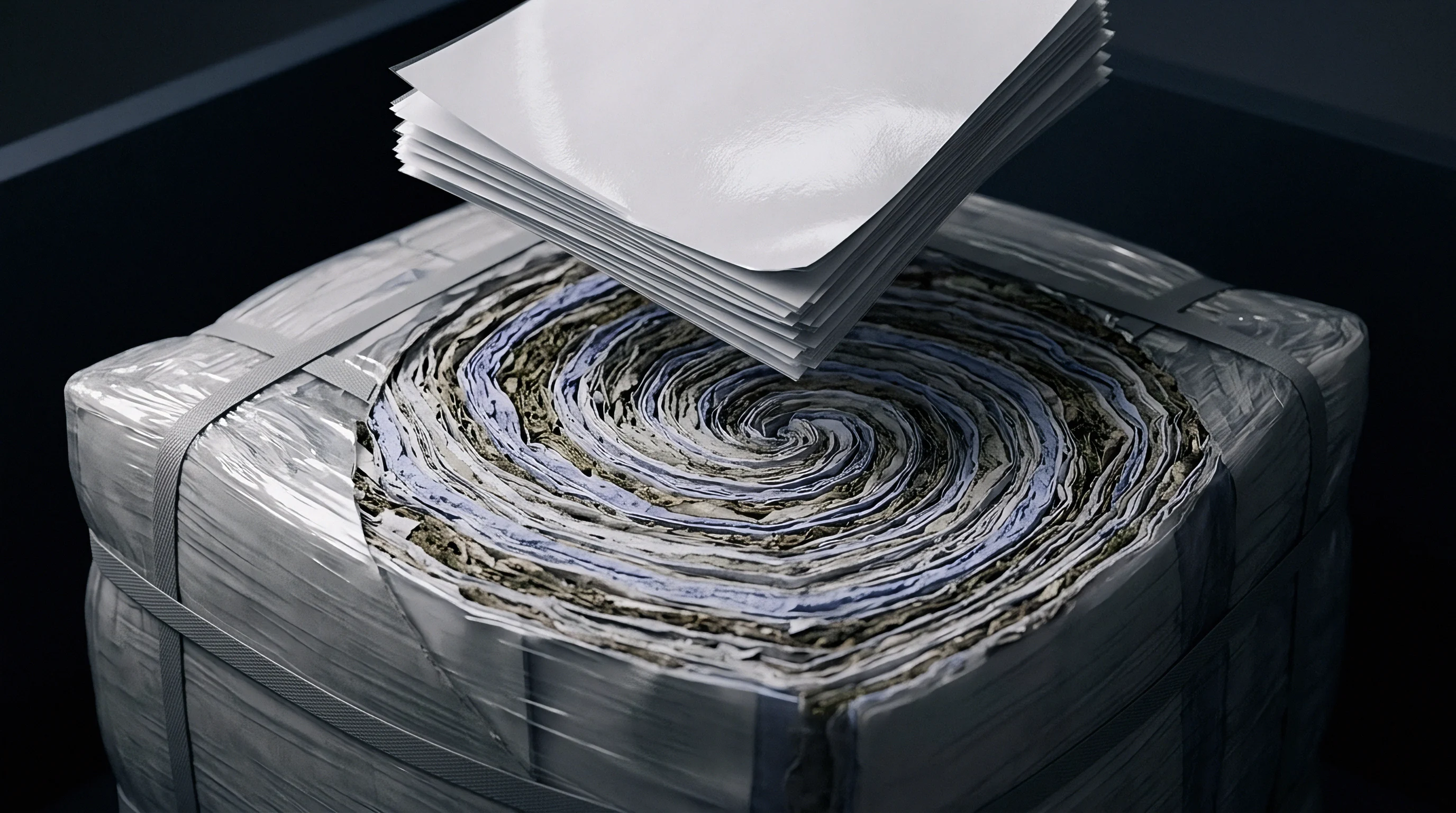

Ply
Recycled boxboard sheets rely on layered wet-end deposition, coalescing individual fiber networks under press nip pressures. In multi-layer coated recycled board (CRB) and uncoated recycled board (URB), structural performance hinges on cohesion between distinct plies. Primary web formation introduces mechanical variations between top liners, inner filler plies, and back liners.
Top layers normally incorporate bleached virgin chemical pulp or high-grade secondary furnish to retain surface smoothness and printability. Internal layers utilize lower-grade post-consumer mixed waste containing high proportions of short, hornified fibers and mineral fillers.
Cellulosic bonds created during wet pressing determine initial cross-machine shear integrity. When wet webs meet on the cylinder machine or multi-wire former, water removal drives inter-fiber hydrogen bonding across the contact zone. Chemical additives, notably native or cationic starch sprayed between webs at the couch roll, reinforce this internal junction.
Starch gelatinization occurs in the dryer section, forming continuous polymeric bridges across fiber-fiber boundaries, and the density of these bridges dictates initial z-directional tensile strength and in-plane shear resistance.

Multi-Ply Fiber Geometry and Starch Distribution
Modern cylinder and multi-fourdrinier forming systems consolidate distinct stock suspensions into a unified web structure. Fiber orientation distributions differ drastically between plies due to headbox jet-to-wire velocity ratios. Top liners exhibit controlled anisotropy to balance tensile stiffness, whereas core plies frequently show random orientation with lower overall web consolidation.
Interfacial regions exist as porous transition zones rather than discrete two-dimensional planes. Starch spray application rates typically range from 2.0 to 5.0 grams per square meter per interface. Inadequate starch slurry dispersion yields dry spots with diminished internal cohesion, while excessive spray application creates brittle inter-layer planes susceptible to micro-cracking under flexural strain.
Inter-ply starch distribution variations above ten percent across the machine width generate localized mechanical shear gradients under uniform bending moments.
Freeness variations within secondary furnish streams worsen interfacial bond heterogeneity. Core plies composed of old corrugated containers (OCC) or mixed paper exhibit Canadian Standard Freeness (CSF) values between 250 mL and 400 mL. Fine particles and fiber fragments, termed fines, accumulate at web interfaces during vacuum dewatering.
High fines concentration increases localized density but limits starch penetration into the bulk web matrix. The resulting interface contains high mineral ash content, which reduces effective hydrogen bonding surface area per unit volume.
| Ply Location | Furnish Type | Density (g/cm³) | Ash Content (%) | Z-Tensile Strength (kPa) |
|---|---|---|---|---|
| Top Liner | Deinked Pulp (DIP) / Virgin SBS | 0.78 | 4.2 | 410 |
| Under Liner | Sorted Office Paper (SOP) | 0.71 | 8.5 | 340 |
| Core Ply 1 | Mixed Waste Paper / OCC | 0.62 | 14.1 | 220 |
| Core Ply 2 | Mixed Waste Paper / OCC | 0.59 | 15.8 | 195 |
| Back Liner | Unbleached Kraft / OCC | 0.68 | 9.0 | 290 |
Stretching Defect Mechanisms in Secondary Fibers
Repeated wetting and drying during reclamation cycles alter the internal pore network of recovered papermaking furnish. Fiber hornification reduces lumen collapse capacity and diminishes outer cell wall conformability. Secondary fibers exhibit lower micro-fibrillar flexibility compared to virgin pulps, limiting the total contact area available for hydrogen bonding at inter-ply junctions.
When recycled paperboard undergoes mechanical conversion, converting operations induce localized tension across ply boundaries. Creasing and scoring dies apply heavy shear forces through the board thickness. If internal interfacial bond strength is deficient, micro-delamination initiates before the boxboard enters the folding gluer, propagating as finished cartons encounter environmental fluctuations in transit channels.
- Hornified fiber stiffness reduces conformability along inter-ply contact zones, diminishing effective contact surface area for starch adhesion.
- High mineral ash fraction creates inert boundary layers that impede direct cellulose-to-cellulose hydrogen bonding across web boundaries.
- Interfacial fines accumulation blocks starch slurry migration into the fiber matrix, producing localized brittle starch films.
- Differential web shrinkage during cylinder drying generates residual internal shear stress pre-loading the inter-ply interface.
Although a wet-end starch spray regime adjusted for high fines content restores baseline internal bond metrics under ambient room conditions, it cannot prevent environmental performance degradation caused by altered furnish stiffness.


Shear
Mechanical loading along the plane of paperboard creates sliding forces between internal web layers. In-plane interfacial shear stress represents the primary stress vector resisting carton panel bulging, fluting collapse, and scoreline separation. When packaging structures undergo stacking loads, outer faces sustain compressive and tensile stresses while internal interfaces carry critical shear loads.
Quantifying this internal stress distribution demands constitutive modeling that accounts for the orthotropic viscoelastic behavior of secondary fiber matrices.
Cellulosic networks exhibit non-linear elastic-plastic behavior under shear deformation. Shear modulus values along the machine direction (Gxz) and cross-machine direction (Gyz) differ significantly from the z-directional tensile modulus (Ez). Interfacial failure occurs when accumulated local shear strain exceeds the yield capacity of the inter-ply starch-fiber interphase ~ a boundary governed under static loading by structural density and chemical bonding density across the junction.

Constitutive Equations for Interfacial Stress Distribution
Translational force transfer across adjacent fiber webs depends on the complex modulus of inter-ply adhesive bonds. Modeling shear strain energy density requires isolating the contribution of inter-ply starch layers from the surrounding bulk web. Assuming a linear elastic-viscoelastic continuum, the shear stress τxz across an inter-ply interface is governed by:
τxz(t) = Gint(t) · γxz + int0t Y(t – ξ) fracdγxz(ξ)dξ dξ
where Gint represents the instantaneous interfacial shear modulus, γxz is the engineering shear strain, and Y(t) is the viscoelastic relaxation kernel of the starch-cellulose matrix. The relaxation kernel decays exponentially over time, accelerated by moisture content increases within the board matrix.
A twelve percent shift in equilibrium moisture content under 1.2 kN/m constant edge shear load doubles the interfacial stress relaxation rate within twenty minutes.
Consider a worked calculation for a 450 gsm coated recycled board panel subjected to a flexural load generating an internal shear force of 1.50 kN/m along the cross-machine direction. Assume a total board thickness (h) of 0.60 mm, with an internal core-to-liner inter-ply thickness (hi) of 0.02 mm. The baseline shear modulus (Gxz) of the dry interface at 50% relative humidity (23°C) is measured at 120 MPa.
Under these assumptions, the initial interfacial shear strain is calculated:
γxz = fracτxzGxz = frac1.50 N/mm0.60 mm · 120 MPa = frac2.50 MPa120 MPa = 0.0208 rad
When atmospheric relative humidity rises from 50% to 85%, the localized moisture content increases from 6.5% to 11.8%. This moisture uptake depresses the interfacial shear modulus Gxz from 120 MPa down to 38 MPa due to plasticization of the inter-ply starch layer. Re-calculating shear strain under the identical 1.50 kN/m load yields:
γxz,humid = frac2.50 MPa38 MPa = 0.0658 rad
The resulting shear strain exceeds the critical strain limit of 0.045 rad established for recycled fiber interfaces, triggering progressive micro-yield delamination along the core ply boundary.
Testing Interfaces under Dynamic Shear Loads
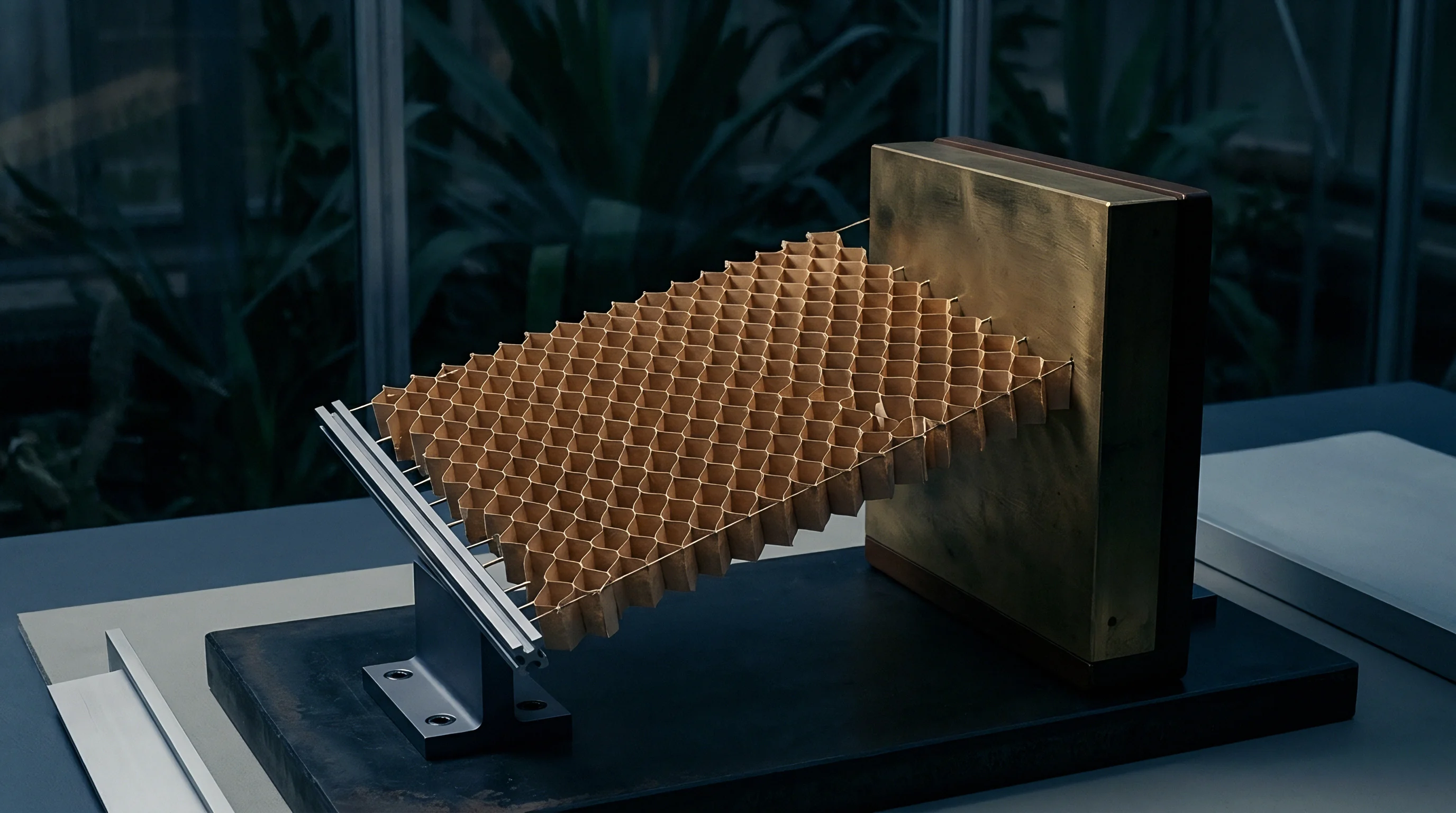
Standardized mechanical trials evaluate internal bonding through localized tensile or torsional specimen deformation. TAPPI T 541 (z-directional tensile strength) measures normal force required to separate plies, but omits in-plane shear forces entirely. Modified lap-shear configurations (based on ASTM D1002 applied to paperboard) and internal shear testing protocols (ISO 11093-7) isolate pure in-plane shear parameters.
Dynamic mechanical analysis (DMA) conducted in shear sandwich mode allows precise tracking of storage modulus (G’) and loss modulus (G”) under cyclic load application.
Laboratory measurements under static standard atmospheres fail to capture actual failure modes experienced in transit. Standard test protocols conditioning samples at 23°C and 50% RH produce artificial mechanical baseline readings that overstate interfacial durability by up to forty percent compared to dynamic microclimate conditions.
Meeting standard z-directional tensile strength specification limits does not guarantee adequate field performance across varying transport humidity profiles.

Cycle
Relative humidity variations in global logistics environments drive continuous moisture exchange within paperboard materials. Freight containers traversing climate zones experience diurnal humidity oscillations ranging from 20% to 95% relative humidity (RH). Recycled paperboard absorbs and desorbs water vapor rapidly due to its porous structure and high content of hydrophilic fines.
This continuous moisture flux creates transient moisture gradients across the board thickness, inducing localized differential expansion between individual plies.
Hygral expansion coefficients (β) differ radically between virgin top liners and recycled core plies. Chemical pulps used in top liners possess well-aligned crystalline cellulose fibers that exhibit low cross-machine expansion (βCD ≈ 0.06 % / % M.C.). In contrast, core plies made from secondary fibers with high hemicellulose degradation and damaged wall structures expand rapidly upon moisture uptake (βCD ≈ 0.14 % / % M.C.).
When relative humidity cycles rapidly, adjacent plies expand and contract at unequal rates, generating high interfacial shear stresses independent of externally applied loads.
Hygral Expansion and Moisture Sorption Isotherms
Cellulosic structures swell nonlinearly as ambient water vapor enters free volume spaces within web structures. Moisture sorption isotherms display pronounced hysteresis between adsorption and desorption limbs. During adsorption, water molecules enter the amorphous regions of cellulose fibers and break inter-chain hydrogen bonds, plasticizing the matrix.
In multi-ply boards, top liners absorb ambient moisture first, swelling outwards while the inner core remains relatively dry. This transient condition forces the inter-ply interface into heavy forward shear strain.
During the subsequent drying phase, outer plies desorb moisture and shrink rapidly while the core retains elevated moisture. The directional orientation of the shear stress vector reverses completely. This cyclic stress reversal constitutes a mechanical fatigue mechanism that selectively degrades the starch-cellulose bond network at the ply junction.
| Humidity Cycle Range | Cycle Frequency (1/h) | Initial Shear Strength τ0 (MPa) | Decay Constant k (10-3 cycle-1) | Retained Strength at 100 Cycles (%) |
|---|---|---|---|---|
| 30% RH – 50% RH (Control) | 0.25 | 2.85 | 0.82 | 92.1 |
| 30% RH – 75% RH | 0.25 | 2.80 | 3.45 | 70.8 |
| 30% RH – 90% RH | 0.25 | 2.78 | 8.12 | 44.4 |
| 50% RH – 90% RH (Step Shock) | 1.00 | 2.75 | 12.40 | 28.9 |

Does Cyclic Humidity Accelerate Interfacial Shear Loss?
Experimental data confirms that fluctuating relative humidity environments induce progressive micro-mechanical fatigue at ply boundaries. The accumulated interfacial shear decay follows a first-order exponential degradation model driven by cycle count (N) and humidity amplitude (Δ RH):
τshear(N) = τ0 · expleft( -k · Δ RHα · N right)
where τ0 is the unconditioned interfacial shear strength, k is the empirical decay constant governed by furnish composition, and α is the moisture sensitivity exponent (α ≈ 1.65 for recycled furnish matrices). High cycle frequency limits time available for internal moisture equilibration, steepening localized internal gradients.
- Baseline Equilibrium Conditioning saturates samples at 23°C and 30% RH for 24 hours to set uniform initial moisture distribution.
- Rapid Moisture Adsorption Phase ramps environmental chamber relative humidity to 90% within 15 minutes, holding for two hours under zero external load.
- Desorption Creep Phase drops chamber humidity to 30% RH over 30 minutes, driving reverse hygral contraction across outer plies.
- Dynamic Mechanical Shear Evaluation measures residual interfacial shear capacity via high-frequency torsional displacement after 25, 50, 75, and 100 complete cycles.
Micro-fissures develop along the inter-ply boundary long before visible structural delamination appears on carton corners, causing packaging designs that pass conventional static crush tests to fail in field distribution chains from unresolved accumulation of interfacial micro-damage.
DIN 55437-1 dictates that containerboard internal bond strength trials under static equilibrium environments do not cover structural degradation caused by microclimatic relative humidity cycling above seventy-five percent.
What fundamental chemical modifications to wet-end starch formulations can arrest the moisture-induced loss of interfacial shear modulus without compromising repulpability under European Packaging and Packaging Waste Regulation (PPWR) recyclability mandates?
Tension
Internal stress gradients accumulate across laminated paperboard thickness when external compression meets fluctuating ambient conditions. Stacking loads on corrugated and solid board shipping containers produce vertical sidewall compression. Box compression strength (BCT) calculations traditionally rely on the McKee formula, which incorporates edge crush test (ECT) values and flexural stiffness (Dx, Dy).
However, classical BCT models assume that individual plies remain perfectly bonded until global buckling occurs. In recycled board structures subjected to moisture cycling, interfacial shear failure occurs at load levels far below theoretical elastic buckling thresholds.
When interfacial shear stress decays, flexural stiffness drops catastrophically. The flexural stiffness of a multi-ply composite web depends on the distance of each ply from the neutral axis, scaled by the efficiency of shear transfer across internal interfaces. Complete interfacial shear failure reduces a unified 500 gsm board sheet to a stack of independent, unbonded thin layers.
Flexural stiffness falls by up to seventy percent when internal shear adhesion dies, triggering immediate panel bulging and stack collapse.
Delamination Kinetics in Transport Packaging
Structural box failure under field conditions frequently originates from sub-critical interface cracks rather than gross panel compression failure. Pallet loads stored in non-climate-controlled warehouses sustain static creep loads under continuously shifting microclimates while freight containers trap humid air. Night-to-day temperature drops induce dew point condensation on package surfaces, causing localized moisture saturation on top liners.
As the top liner absorbs condensed liquid, its elastic modulus drops toward zero while its hygral expansion peaks. The core ply beneath remains stiffer and dry, creating extreme localized shear stress at the interface. Micro-cracks initiate at structural imperfections, such as scorelines or die-cut edges, and propagate inwards under sustained pallet weight.
- Interfacial Shear Fatigue resulting from diurnal relative humidity cycles weakens internal starch-cellulose bonds prior to pallet loading.
- Transient Hygral Mismatch during rapid humidity ramps creates localized shear stress spikes exceeding static bond capacity.
- Creep-Fatigue Interaction accelerates sub-critical crack growth along core ply boundaries under continuous vertical stacking weight.
- Scoreline Delamination Spreading propagates internal inter-ply separation along crease folds into adjacent main panel structures.

Verification Frameworks for Supply Chain Exposure
Converting operations and brand owners quantify structural performance margins by establishing rigorous laboratory validation sequences. Evaluating board integrity requires moving past static ambient testing to protocol structures that reflect actual distribution hazard profiles. Procurement specifications that omit interfacial shear decay limits expose buyers to uncompensated cargo losses and customs compliance disputes.
| Test Method | Primary Mechanics | Sensitivity to Moisture Cycling | Suitability for Recycled Grades |
|---|---|---|---|
| TAPPI T 541 (Z-Tensile) | Pure Out-of-Plane Tensile | Low (Detects broad bond loss only) | Moderate (High variance on high-ash core) |
| ISO 11093-7 (In-Plane Shear) | Pure In-Plane Layer Shear | High (Tracks inter-ply slip accurately) | High (Isolates starch film degradation) |
| ASTM D1002 (Modified Board Shear) | Lap Shear Under Compression | Very High (Captures creep-shear interface) | High (Requires rigid substrate mounting) |
| FEFCO No. 9 (Edge Crush ECT) | Combined Buckling / Compression | Moderate (Blends bulk and edge defects) | High (Standard global trade metric) |
| Method suitabilities established through accredited laboratory comparative testing across 300-600 gsm recycled board substrates. | |||
- Verify Material Data Sheets to confirm that inter-ply z-tensile and in-plane shear values are stated for both 50% RH and 85% RH conditioning states.
- Audit Mill Furnish Declarations to establish secondary fiber percentage, ash content, and inter-ply starch application rates per unit area.
- Execute Cyclic Humidity Shock Testing per ISO 2233 conditioning profiles before signing off on commercial paperboard grade substitutions.
- Insert Shear Decay Threshold Clauses into boxboard purchase orders to shift structural failure liability back to the board mill when secondary furnish degrades under transit conditions.
Customs holds freeze unverified cargo.
Failure to specify inter-ply shear decay tolerances in recycled paperboard procurement contracts leaves the buyer carrying total financial loss when pallet stacks collapse in humid transit zones.
Dossier
Technical compliance files for converted paperboard packaging compile detailed material specifications alongside accredited test reports. Regulatory framework changes under the European Packaging and Packaging Waste Regulation (PPWR) enforce strict design-for-recyclability criteria alongside mandatory minimum recycled content thresholds. As recycled content percentages rise toward eighty or ninety percent in primary and secondary boxboard, maintaining interfacial mechanical integrity becomes both a structural necessity and a regulatory compliance obligation.
When inter-ply shear decay leads to delamination, functional surface coatings applied to paperboard break down. Barrier coatings preventing mineral oil aromatic hydrocarbons (MOAH) and mineral oil saturated hydrocarbons (MOSH) from migrating out of secondary fiber cores into food products rely on a stable, non-delaminating substrate. Substrate shear failure causes micro-cracking in aqueous dispersion coatings or extruded biopolymer linings, rendering the functional barrier ineffective and breaching EU Regulation 1935/2004 compliance obligations.
Audit Documentation for Moisture Sensitive Packaging
Regulatory inspectors verify structural claim integrity by tracing mill test certificates back to batch-level manufacturing logs. Certificates of Analysis (CoA) must carry documented evidence of internal bond performance tested in accordance with recognized international standards. A mill certificate stating basic grammage, caliper, and dry burst strength provides no protection against customs enforcement or regulatory delisting if functional barrier integrity fails due to interfacial separation.
Chain of custody verification schemes, including FSC Recycled (FSC-STD-40-004) and PEFC Recycled (PEFC ST 2002), validate the physical fiber origin but do not certify mechanical performance under transport microclimates. Importers of record must maintain dedicated compliance dossiers containing both sustainability chain-of-custody documentation and physical test evidence verifying structural stability under dynamic humidity regimes.

Chain of Custody and Functional Recycled Content Claims
Customs authorities and market surveillance agencies demand strict traceability for secondary material declarations. Claims made under ISO 14021 self-declared environmental terms require verified technical documentation supporting both the declared recycled percentage and physical fitness for intended use.
If a recycled paperboard container suffers structural collapse due to uncompensated interfacial shear decay, market surveillance agencies may classify the packaging as non-compliant with basic safety and structural suitability provisions. The resulting product recalls and border holds create substantial financial liabilities that pass directly to the brand owner listed on the packaging artwork.
Standard commercial supply agreements operating under ISO 12647 and EN 13430 incorporate standard defect clauses stating that board delivered meeting static ambient tensile thresholds satisfies contractual quality requirements unless explicit cyclic microclimate endurance metrics are incorporated into the master specification dossier.