Calculating Paperboard Caliper and Apparent Bulk from Grammage Metrics
Apparent bulk equals caliper divided by grammage, defining the physical thickness and carton yield delivered per purchased metric tonne of paperboard.


Arithmetic
A digital micrometer anvil descends onto a 300 gram folding boxboard sample with exactly 100 kilopascals of static pressure. The digital readout freezes. The display shows 450 micrometres of sheet thickness, establishing an apparent density of 0.67 grams per cubic centimetre.
When the same operator places a 300 gram solid bleached sulphate sample into the measuring gap, the anvil settles at 360 micrometres, revealing a density of 0.83 grams per cubic centimetre. Both sheets register identical weight on an analytical balance, yet they behave like entirely different engineering structures when folded into a carton. Specifying paperboard by basis weight without governing thickness invites catastrophic failure on high-speed cartoning equipment.

Metric Formulations for Thickness and Density
Direct mathematical formulas link basis weight, sheet height, and volumetric mass within the international metric system. Grammage denotes the mass of paperboard per unit surface area, expressed in grams per square metre. Caliper represents the perpendicular distance between the two principal surfaces of the sheet, measured in micrometres according to ISO 534 conditioning protocols.
Apparent bulk defines the specific volume of the material, calculated as caliper divided by grammage:
Apparent Bulk (cm³/g) = Caliper (µm) / Grammage (g/m²)
Apparent density represents the mathematical reciprocal of apparent bulk, indicating the mass contained within a cubic centimetre of consolidated board structure:
Apparent Density (g/cm³) = Grammage (g/m²) / Caliper (µm) = 1 / Apparent Bulk (cm³/g)
The ISO 534 apparent bulk testing method standardises single-sheet evaluation under a static 100 kilopascal load across a two-square-centimetre contact face. The resulting bulk figure of 1.55 cubic centimetres per gram for virgin mechanical pulp board rests on the TAPPI T 411 calibration protocol published in 2017, evaluated across five separate micrometer drops across three distinct sheet zones. A change in ambient humidity from 50 percent to 65 percent relative humidity swells the cellulose network, expanding thickness by 4.2 percent and invalidating the supplier certificate.
Structural design requires absolute stability across both axes of the equation.
At a standard testing atmosphere of 23 degrees Celsius and 50 percent relative humidity, a solid bleached sulphate sheet at 300 grams per square metre with a thickness of 360 micrometres yields an apparent bulk of exactly 1.20 cubic centimetres per gram.
| Substrate Classification | Fibre Furnish Construction | Nominal Grammage (g/m²) | Nominal Caliper (µm) | Apparent Bulk (cm³/g) | Apparent Density (g/cm³) |
|---|---|---|---|---|---|
| Solid Bleached Sulphate (SBS) | 100% Bleached Chemical Virgin Pulp | 250 | 300 | 1.20 | 0.83 |
| Solid Bleached Sulphate (SBS) | 100% Bleached Chemical Virgin Pulp | 350 | 420 | 1.20 | 0.83 |
| Folding Boxboard (FBB) | Chemical Liners with CTMP Middle Plies | 250 | 390 | 1.56 | 0.64 |
| Folding Boxboard (FBB) | Chemical Liners with CTMP Middle Plies | 350 | 560 | 1.60 | 0.63 |
| White Lined Chipboard (WLC) | Recycled Fibre with Chemical Top Liner | 250 | 325 | 1.30 | 0.77 |
| White Lined Chipboard (WLC) | Recycled Fibre with Chemical Top Liner | 350 | 455 | 1.30 | 0.77 |
| Solid Unbleached Board (SUB) | Unbleached Kraft Chemical Pulp | 300 | 390 | 1.30 | 0.77 |

Imperial Conversions and Caliper Points
North American packaging specifications measure thickness in points, where one point equals one thousandth of an inch. Converting points to metric micrometres requires multiplying the point value by 25.4. A 16-point board measures 406.4 micrometres.
Grammage in the imperial system appears as basis weight per ream, calculated across 3,000 square feet for paperboard or 1,000 square feet (MSF) in corrugated converting. Converting pounds per thousand square feet to grams per square metre requires multiplying by 4.8824. A buyer purchasing 60-pound board per thousand square feet receives a 293 gram sheet.
Converting lines stall when technicians confuse metric bulk with imperial yield factors, creating mismatches between die dimensions and carton wall tolerances.
ISO 534 clause 8.2 specifies dead-weight micrometer contact pressure between 90 and 110 kilopascals across a two-square-centimetre anvil face, converting supplier measurement disputes into verified gauge records.

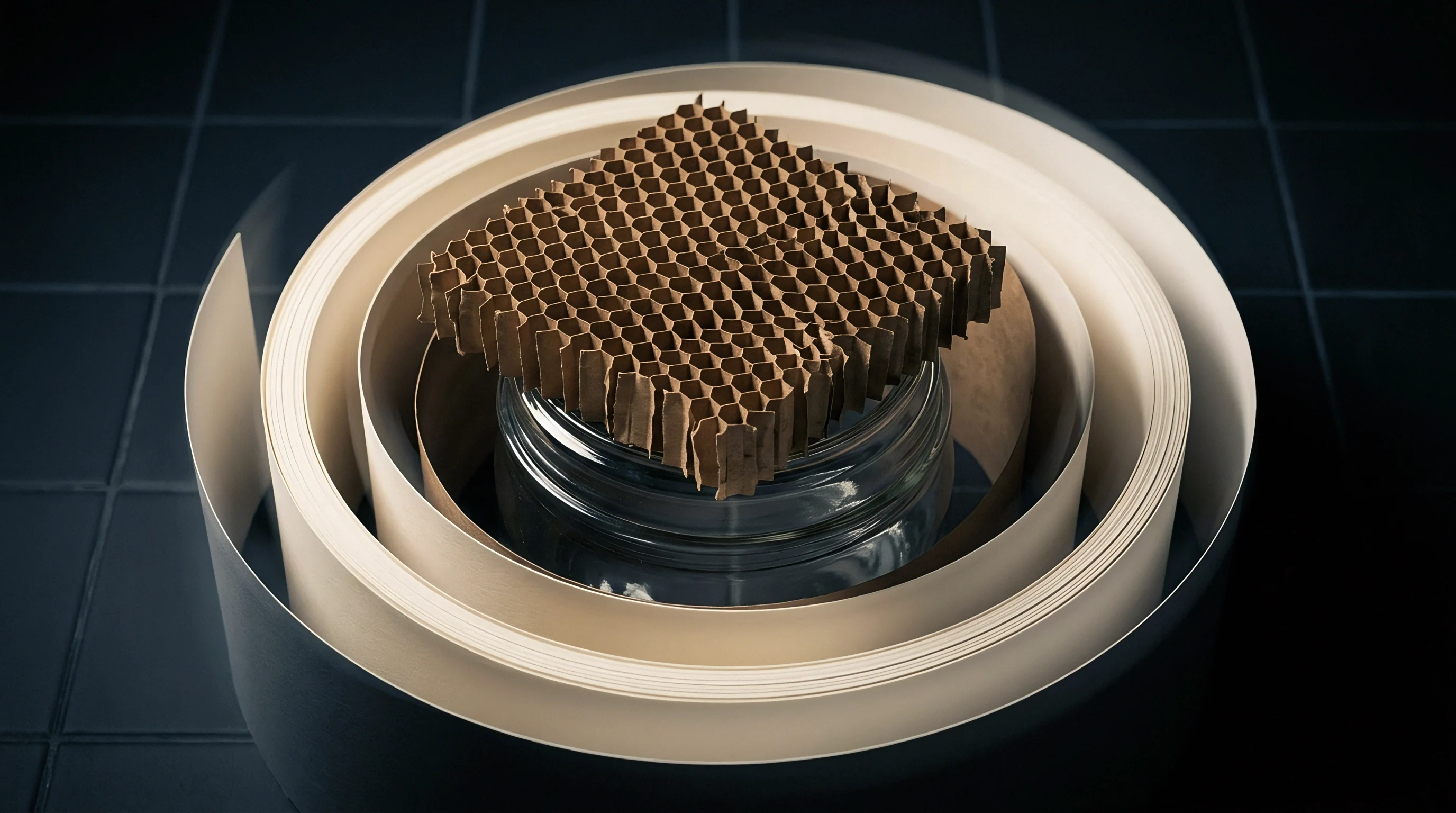
Furnish
Cellulose selection directly dictates the volume of void space inside the finished substrate. Chemical kraft pulping strips lignin away from the plant matter, leaving flexible, pure cellulose strands. These fibres collapse into flat ribbons during drainage and wet pressing on the fourdrinier wire.
Chemical pulp yields dense sheets. Hydrogen bonding pulls the flattened strands together, closing internal voids and reducing thickness per unit mass. This tight matrix delivers smooth printing surfaces and exceptional tensile strength, but limits bulk to values between 1.15 and 1.25 cubic centimetres per gram.

Fibre Morphology in Multi-Ply Formations
Mechanical pulping methods preserve lignin, producing stiff, cylindrical fibres that resist compression. Chemi-thermomechanical pulp (CTMP) retains the natural tubular morphology of wood cells. These rigid fibres act like structural struts inside the wet web.
Mechanical pulp builds volume. During drying, these cylindrical fibres create an open network packed with microscopic air pockets, driving apparent bulk past 1.60 cubic centimetres per gram. Multi-ply forming vats place thin, smooth chemical pulp on the outer surfaces while concentrating aerated CTMP in the internal plies.
The resulting board matches the bending stiffness of a much heavier solid chemical sheet.
Recycled fibre furnish behaves entirely differently due to hornification. Secondary fibres lose their internal swelling capacity after repeated wetting and drying cycles. Recycled furnish packs tightly.
Secondary fibres fragment during repulping, creating fine fragments that fill the voids between larger fibres. White lined chipboard achieves lower bulk than virgin mechanical board, hovering between 1.25 and 1.35 cubic centimetres per gram while carrying mineral fillers that add dead weight without building structural height.
- Chemical virgin fibre collapse eliminates internal air pockets, producing high density and maximum ply bond strength.
- Mechanical pulp fibre stiffness props open the internal web matrix, generating extreme bending resistance per gram of purchased weight.
- Recycled pulp hornification limits re-swelling during papermaking, causing denser sheet consolidation and lower caliper retention.
- Mineral coating application adds significant surface mass through calcium carbonate and clay, lowering apparent bulk without contributing structural integrity.
The sales agent promised that higher basis weight would compensate for the missing sheet thickness on the creasing line.

Crush
Passing a high-bulk board through production machinery permanently reduces its cross-sectional height. Every nip station on an offset press or gravure line applies vertical compressive stress. Printing blankets compress the web.
The spongy mechanical core absorbs this energy, collapsing internal voids. While high bulk lowers raw material purchase costs, it leaves the substrate vulnerable to permanent mechanical deformation during downstream converting operations. Solid bleached sulphate resists rolling nip compression due to its uniformly dense cellulose matrix, losing less than three percent of its total height across four print units.
Folding boxboard can lose up to nine percent of its caliper under identical impression pressure.

Blanket Pressure and Nip Depression
Civil engineers dimensioning steel I-beams separate the outer flanges from the central web to resist bending deflection with minimal mass. Multi-ply cartonboard replicates this mechanical geometry by placing dense chemical pulp on the outer liners while filling the core with aerated groundwood. Compressing the central core diminishes the separation between outer liners, degrading bending stiffness according to a cubic relationship.
Bending stiffness scales with the third power of thickness. A five percent loss in caliper during printing strips fourteen percent of the board’s original bending resistance before the sheet reaches the die-cutting platen.
Dense sheets resist nip flattening during print passes, while aerated sheets lose thickness that foil stamping dies cannot recover.
A measured caliper compression loss of 28 micrometres under a 3.5 megapascal flatbed embossing strike rests on laboratory durometer tests conducted on 350 gram solid bleached sulphate in 2021 across forty production blanks. Running the platen fifty degrees hotter softens the sizing agents, driving the compression loss past 40 micrometres and fracturing the top coating layer. Heated dies collapse internal voids.
High-speed roll lamination introduces further complications through tension and nip heat. Single-sided film lamination pulls moisture out of the top ply while mechanical nip rollers squeeze the base board, permanently setting the reduced caliper into the finished composite structure.
| Pass Sequence | Converting Operation | Applied Line Pressure | Exit Caliper (µm) | Net Caliper Loss (%) | Final Bulk (cm³/g) |
|---|---|---|---|---|---|
| Pass 0 | Raw Sheet Unwind (Conditioned) | 0 kPa | 480 | 0.0% | 1.60 |
| Pass 1 | Six-Colour Sheetfed Offset Print | 1.8 MPa | 458 | 4.6% | 1.53 |
| Pass 2 | Flood UV Varnish (Anilox Nip) | 1.2 MPa | 452 | 5.8% | 1.51 |
| Pass 3 | Flatbed Hot Foil Stamping | 3.8 MPa (at 130°C) | 436 | 9.2% | 1.45 |
| Pass 4 | Rotary Window Film Patching | 0.8 MPa | 431 | 10.2% | 1.44 |
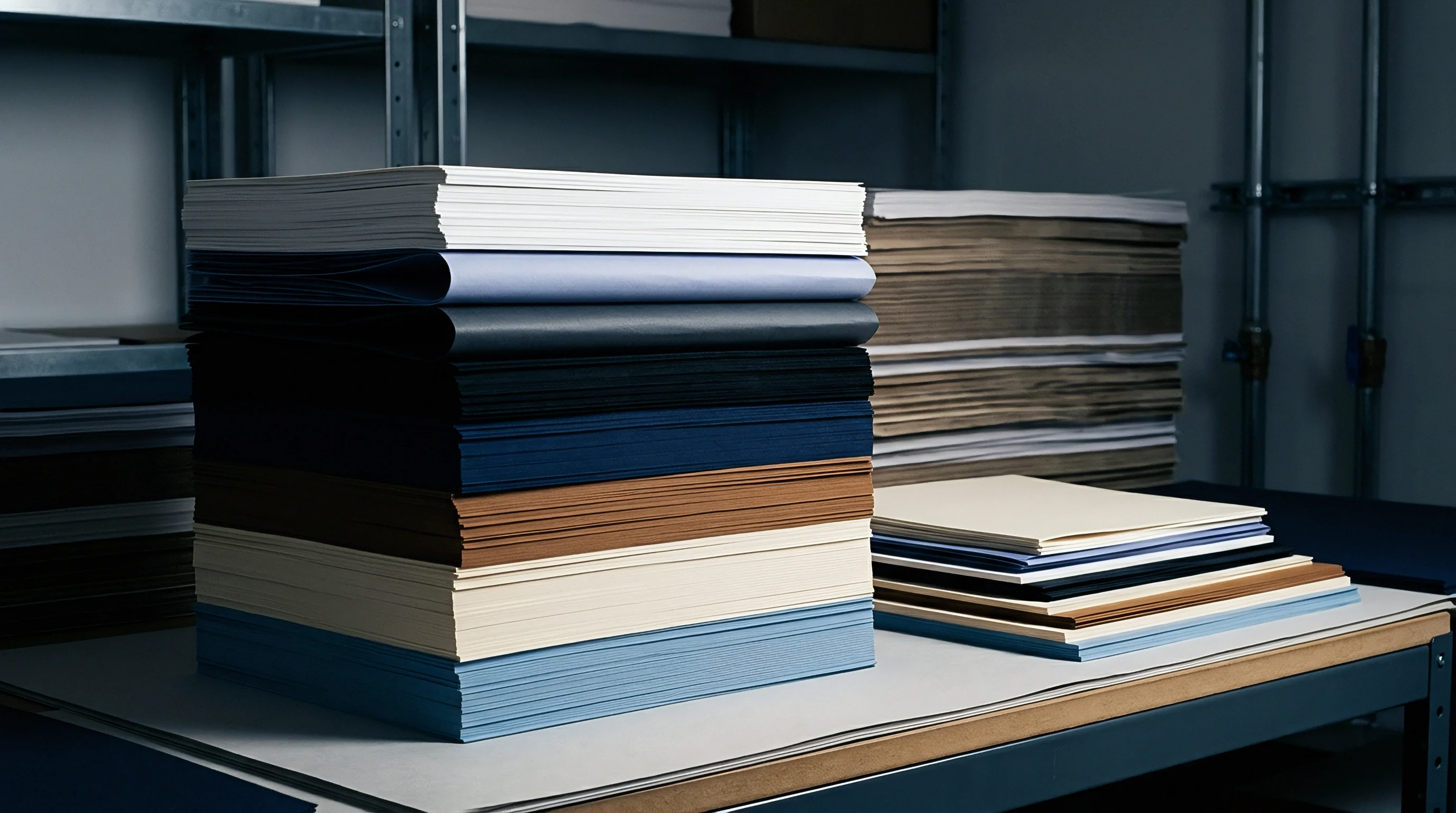
Embossing Resistance across Variable Density Grades
Embossing dies demand controlled plastic deformation of the board plies. Dense substrates distribute the tensile stresses generated by male and female dies evenly across the sheet. Virgin fibres sustain repeated deflection.
Aerated folding boxboard cores shear internally when female die shoulders plunge into the stock. High bulk boards exhibit delamination between the chemical liner and the mechanical core under sharp tooling radii, producing unsightly fractures along the embossed contours. Converting plants adjust make-ready counter-dies using compressible calibration papers to dampen peak pressures, sacrificing embossing crispness to preserve the mechanical cohesion of low-density middle plies.
- Verify raw sheet caliper across fifty points per master pallet using a digital micrometer set to 100 kilopascals contact pressure.
- Record coating absorbency via sixty-second Cobb testing under ISO 535 to confirm moisture resistance before wet ink transfer.
- Measure caliper immediately following the printing impression cylinder to quantify mechanical web compression.
- Inspect internal ply bonding using a Huygen internal bond tester to verify the board survived lamination nip shear.
Soft middle plies sacrifice finished carton wall height whenever printing blankets run too tight.


Tooling
Die-cutting platens turn flat sheets into precision packaging blanks through coordinated cutting and scoring action. Die cutters register off caliper. The cutting rule shears the board completely, while the rounding score rule indents the substrate into a counter-channel matrix.
The depth and width of this creasing channel must match the physical thickness of the board, not its nominal grammage. Selecting a matrix based purely on a 350 gram rating fails when switching from high-bulk folding boxboard to dense bleached sulphate. The folding boxboard requires a wider groove to accommodate its expanded physical volume without rupturing the surface liner.

Die Clearance and Scoring Rule Selection
Creasing geometry follows standard mechanical calculations linking paperboard thickness directly to channel dimensions. The steel scoring rule pushes the board into the matrix channel, delaminating the internal plies in a controlled manner to create an internal hinge. Crease matrix width governs folding.
The standard calculation establishes channel width as the thickness of the creasing rule plus 1.5 to 1.7 times the caliper of the paperboard for folding boxboard, or 1.4 times caliper for dense bleached kraft:
Channel Width = Rule Thickness + (Caliper × Substrate Factor)
Channel depth corresponds directly to the board’s measured height, typically calculated as caliper multiplied by 1.05 to prevent rule-bottoming. Mill datasheets commonly cite a twelve percent springback expansion after rotary creasing, yet published laboratory data fails to verify this exact percentage under varying ambient humidity. A prudent buyer specifies physical crease stiffness testing on first-off blanks at the press rather than relying on unverified catalogue springback coefficients.
When channel width runs too narrow, the score rule pinches the board, cracking the external print surface. When the channel runs too wide, the crease rolls loosely, causing carton skew on automated folder-gluers.
DIN 55437 specifies crease channel width as the sum of rule thickness and paperboard caliper multiplied by a furnish factor, penalising dies cut for nominal rather than delivered sheet thickness.
- Scoring rule profile choice balances edge radiusing against liner cracking, requiring a two-point rule for calipers below 450 micrometres and a three-point rule above that boundary.
- Counter-matrix material selection dictates channel wear rates, with milled steel matrices outlasting polymer channels during multi-million sheet pharmaceutical packaging runs.
- Crease depth calibration controls folding resistance, demanding thirty to fifty percent reduction in raw bending stiffness to ensure jam-free machine feeding.
The unresolved problem remains whether rotary converting dies can maintain uniform score bead geometry when bulk swings ten percent within a single reel.

Ledger
Paperboard mills invoice their material by the metric tonne, but packaging plants sell cartons by individual unit count. Tonnage buyers pay for air. A procurement team calculating unit costs on a weight basis overlooks the direct economic yield provided by apparent bulk.
High bulk board yields more packaging blanks per purchased tonne because each sheet achieves the target structural thickness at a substantially lower surface weight. Moving from a 350 gram solid bleached sulphate board to a 280 gram folding boxboard preserves the identical 420-micrometre wall thickness, delivering a twenty percent increase in cut blanks per delivered tonne of stock.
Yield Discrepancies and Surface Area Purchasing
Calculating the true cost of paperboard requires determining the surface area purchased per unit of currency. Metric yield defines the area in square metres obtained from one metric tonne of board:
Yield (m²/tonne) = 1,000,000 / Grammage (g/m²)
Consider a practical manufacturing scenario. A converter produces 500,000 cosmetic cartons measuring 100 millimetres by 150 millimetres, yielding 40 blanks per master sheet measuring 800 by 1200 millimetres. The job requires 12,500 net sheets, representing 12,000 square metres of board.
Adding a standard seven percent waste factor covers make-ready and converting spoilage, bringing total procurement to 12,840 square metres. Evaluating two substrates illustrates the commercial impact:
| Procurement Parameter | Option A: Solid Bleached Sulphate (Dense) | Option B: Folding Boxboard (High Bulk) | Operational Variance |
|---|---|---|---|
| Target Structural Caliper | 400 µm | 400 µm | 0 µm (Equivalent Wall Rigidity) |
| Required Grammage | 335 g/m² | 250 g/m² | -85 g/m² (-25.4% Basis Weight) |
| Apparent Bulk | 1.19 cm³/g | 1.60 cm³/g | +0.41 cm³/g (+34.5% Void Space) |
| Metric Yield per Tonne | 2,985 m²/tonne | 4,000 m²/tonne | +1,015 m²/tonne (+34.0% Surface Yield) |
| Order Mass Required | 4.301 tonnes | 3.210 tonnes | -1.091 tonnes (-25.4% Tonnage) |
| Base Mill Price per Tonne | 1,450 EUR | 1,550 EUR | +100 EUR (+6.9% Surcharge for Bulk) |
| Total Substrate Material Cost | 6,236 EUR | 4,976 EUR | -1,260 EUR (-20.2% Total Material Spend) |
| Pallet Weight per 2,000 Sheets | 643 kg | 480 kg | -163 kg (-25.3% Freight Mass) |
Fibre orientation dictates bending resistance. The tabular arithmetic proves that paying a higher price per tonne for high-bulk board yields substantial net savings on the total job ledger. Coating layers add mass rapidly.
When converters neglect to reconcile caliper, apparent bulk, and grammage on raw material delivery orders, they gamble with production stability. High-bulk options reduce raw material spend and shipping freight, yet they increase pallet stack height, filling transport trailers by volume long before reaching maximum legal road weight limits.
Carton yield drops whenever a converter buys paperboard by weight but sells structural volume to packaging lines.
The moisture content of stored pallets shifts the balance point of this ledger. Sheets stored in unconditioned warehouses absorb moisture through unsealed outer wraps, gaining two to three percent in mass without adding usable thickness. Moisture shifts the calibration point.
When production runs operate on fixed weight settings, waterlogged pallets deliver fewer cartons per tonne, inflating unit packaging costs. Rigorous incoming material inspection cross-references bone-dry basis weight against micrometer caliper readings, preventing mills from invoicing excess moisture as billable cellulose tonnage.
Specifying grammage alone yields cartons that bow outward on high-speed cartoning lines, stopping production and triggering distributor chargebacks across entire shipping runs.