Dynamic Mechanical Analysis Yield Stress Calibration for Coated Paperboard Converting
Calibrating paperboard yield stress via oscillatory mechanics prevents score line cracking by matching die channel dimensions to dynamic coating strain limits.
Crease
Scored carton blanks running through high-speed folder-gluers at four hundred meters per minute frequently split along their hinge lines despite meeting static burst and tensile specifications. Tensile testing machines measure stress responses across seconds, whereas a die-cutting rule impacts paperboard within eight to fifteen milliseconds. The discrepancy between quasistatic lab tests and line converting speeds masks the rate-dependent mechanics of the mineral coating and bleached top liner.
High-speed score creation forces the sheet into extreme shear and localized tension. When the material response shifts toward glassy brittleness at elevated strain rates, the outer coated plies fracture before the internal core can delaminate cleanly.
Bending resistance drops immediately.
Dynamic mechanical analysis measures the real-time viscoelastic properties of paperboard under cyclic deformation across specified frequency and temperature sweeps. Calibrating the yield stress through oscillatory mechanics establishes the exact energy threshold where paperboard transitions from reversible elastic deformation to permanent plastic reorganization. Multi-ply cartonboard structures rely on deliberate internal delamination during scoring.
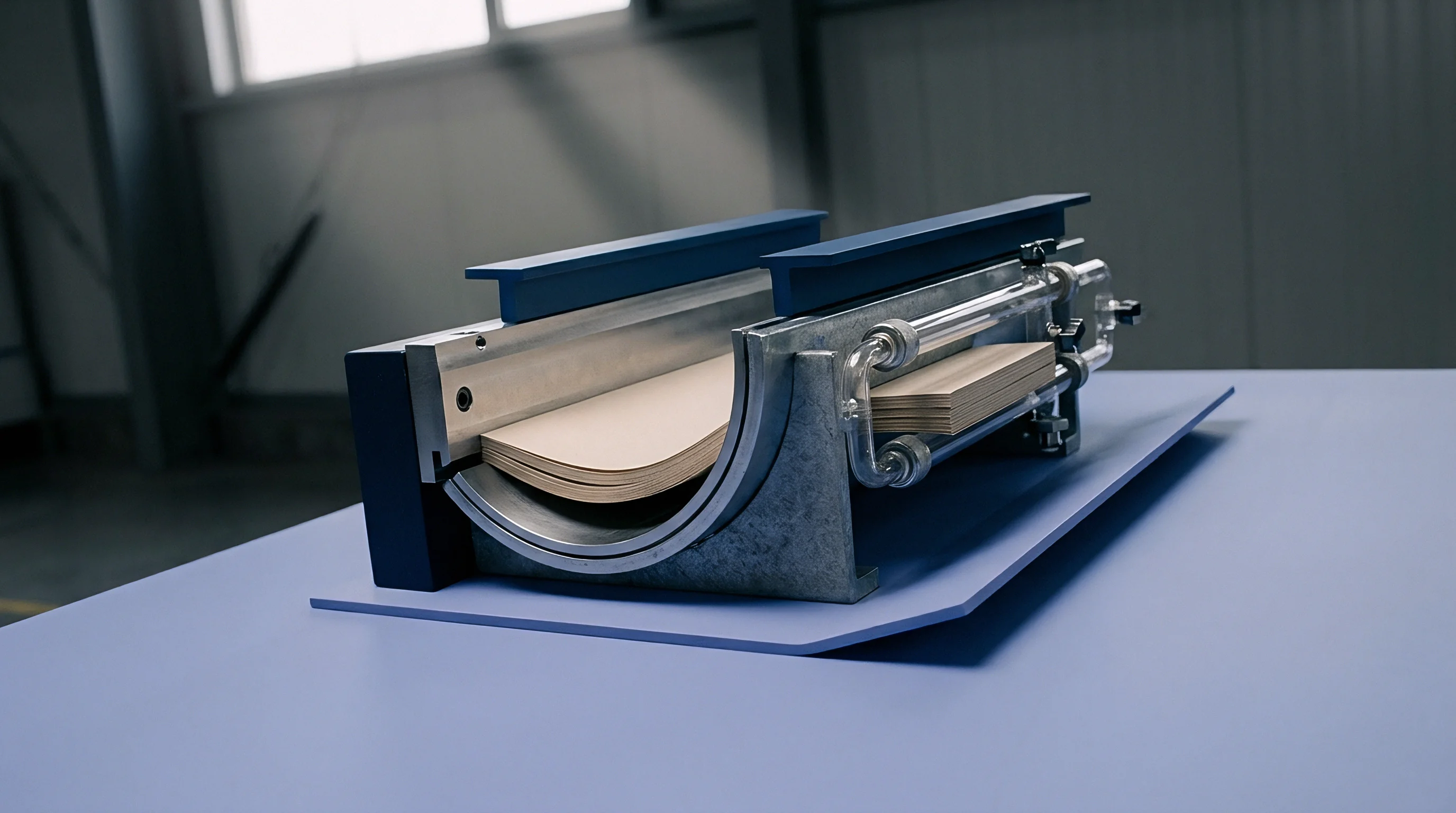
The male creasing rule pushes the board into the female channel, generating inter-ply shear stress that breaks internal fiber bonds while preserving the tensile integrity of the top and bottom liners. The score line functions as an intact composite hinge only if the top mineral coating withstands tensile extension while the core plies separate.
A sound crease requires internal ply delamination before the external coated liner reaches its tensile strain limit.
Viscoelastic Strain in Multi-Ply Cartons
Mechanical response across paperboard plies varies systematically by fiber composition, refining level, and chemical additive distribution. Solid bleached sulfate boards behave as relatively homogeneous viscoelastic structures, whereas folding boxboard combines dense chemical pulp liners with high-bulk mechanical pulp centers. Bleached chemical pulp liners exhibit high elongation at break and pronounced viscoelastic dissipation under tensile loads.
Mechanical pulp centers contain stiff, lignin-rich fiber bundles that resist compression and fracture abruptly when shear stress exceeds the matrix threshold.
Fibers shear under compression.
Application of mineral pre-coats and top coats alters surface mechanical behavior. Coating layers comprise inorganic pigments such as calcium carbonate and kaolin clay bound within a synthetic polymer latex matrix. Below the glass transition temperature of the latex binder, the coating behaves as a brittle solid with minimal plastic yield.
High pigment volume concentrations reduce binder mobility, concentrating tensile stress across microstructural defects. Dynamic mechanical analysis tracks storage modulus and loss modulus across oscillating strains, revealing the precise strain amplitude where the coating network begins to yield plastically without micro-cracking.
Failure Modes across the Folding Matrix
Defects appearing during rotary or flatbed carton scoring stem from mismatches between material yield properties and mechanical tool geometry.
- Coating flaking sheds microscopic mineral clusters along the outer hinge radius when pigment volume concentration restricts polymer chain extension under rapid elongation.
- Liner burst splits the outer fibrous layer when high creasing rule penetration drives local tensile strains beyond the ultimate elongation of the bleached chemical pulp.
- Delamination failure leaves the score hinge excessively stiff when insufficient inter-ply shear allows core plies to resist separation, driving high folder-gluer jam rates.
- Flute crushing flattens internal structural geometries in micro-flute corrugated containers during scoring nips, eliminating package stacking strength.
Surface decoration passes amplify these failure risks. Solid spot colors, flood-applied matte dispersion varnishes, and hot-stamping foils deposit crosslinked polymeric films directly onto the mineral coating. These additional layers change the depth of the neutral axis during ninety-degree carton erection.
Moving the neutral axis deeper into the sheet increases outer surface elongation during folding, demanding higher coating ductility to prevent cosmetic rupture.
Converting lines that run uncalibrated board stock endure severe edge crazing, high sorting costs, and catastrophic rejection of assembled pharmaceutical and cosmetic cartons at automated packaging lines.

Modulus
Oscillatory deformation tests separate the elastic energy stored within the fibrous network from the viscous energy dissipated through polymer binder relaxation. The storage modulus represents the elastic spring-like stiffness of the board composite, while the loss modulus captures viscous heat dissipation within the latex binder and hemicellulose amorphous regions. The ratio of loss modulus to storage modulus defines the loss factor, tangent delta.
Tracking tangent delta peaks across temperature sweeps establishes the dynamic glass transition temperature under specific oscillatory frequencies.
Dynamic loss peaks reveal relaxation.
Linear viscoelastic region measurements dictate testing boundaries. At low strain amplitudes, storage modulus remains independent of applied strain, confirming the material network stays intact. Elevating the dynamic strain amplitude forces polymer binder chains and inter-fiber hydrogen bonds past their reversible elasticity.
The critical strain marking the end of the linear viscoelastic plateau indicates the onset of microstructural yielding. In coated paperboard, two distinct yield points emerge: first, the shear yielding of the mineral coating layer at low strain amplitudes, followed by the progressive shear breakdown of internal pulp plies at higher strain levels.
A 350-micrometer folding boxboard at 23 degrees Celsius and 50 percent relative humidity exhibits a dynamic shear yield threshold of 14.8 megapascals at 10 hertz.
Linear Viscoelastic Limits in Mineral Coatings
Formulations containing styrene-butadiene or styrene-acrylic latexes exhibit yield points heavily dependent on pigment packing and binder film formation. When pigment volume concentration exceeds critical thresholds, particle-to-particle mineral contact dominates mechanical behavior. Storage modulus rises sharply, but the linear viscoelastic limit contracts to narrow strain boundaries.
Subjecting such brittle surfaces to high-speed creasing induces shear banding across the coating thickness. Dynamic mechanical analysis measures this structural change through amplitude sweeps at converting-relevant frequencies.
Brittle coatings shatter on impact.
Synthetic latex binders supply the necessary compliance to bridge mineral pigment grains. Dynamic mechanical analysis tests conducted in tension mode isolate free coating films, separating coating layer rheology from the fibrous base board. Increasing the binder ratio from eleven parts per hundred pigment to fourteen parts per hundred expands the linear viscoelastic region by seventy percent, raising the yield strain from 0.8 percent to 1.5 percent.
This increase in yield strain prevents surface crazing when cartons fold around tight score radii.
| Layer Designation | Basis Weight | Storage Modulus | Loss Modulus | Tangent Delta | Yield Stress |
|---|---|---|---|---|---|
| Double Mineral Top Coat | 22 g/m² | 4.2 GPa | 0.31 GPa | 0.074 | 12.4 MPa |
| Bleached Chemical Top Liner | 45 g/m² | 6.8 GPa | 0.48 GPa | 0.071 | 28.6 MPa |
| Mechanical Pulp Middle Plies | 180 g/m² | 2.1 GPa | 0.19 GPa | 0.090 | 9.2 MPa |
| Bleached Chemical Back Liner | 38 g/m² | 5.9 GPa | 0.41 GPa | 0.069 | 24.1 MPa |
| Testing conducted on single-layer micro-samples isolated by precision microtome sectioning; conditioned per ISO 187 standards. | |||||
Latex Binder Mobilization under Rapid Shear
Binder distribution through the thickness of the coating layer directly influences converting yield mechanics. Uneven binder migration during coating consolidation creates latex-depleted zones adjacent to the base paperboard, with latex-rich skins forming at the extreme surface. The latex-depleted zone possesses a low loss modulus and minimal yield strain capacity.
Under creasing nips, localized shear concentrates inside this weak boundary, causing total coat-to-board delamination.
Shear delamination preserves the surface.
Dynamic mechanical thermal analysis identifies binder mobilization thresholds across operating temperature bands. Shifts in converting plant ambient temperatures from sixteen degrees Celsius in winter shifts to thirty-two degrees in summer change the mechanical response of styrene-butadiene systems. Running board below the binder glass transition temperature turns ductile coatings into glassy, crack-prone shells that flake during high-speed scoring passes.
Material sales representatives often claim that coat cracking stems solely from incorrect male rule depths chosen by the converter rather than low binder compliance in the delivered mill lot.

Oscillation
Bench rheometers execute mechanical tests at cyclic frequencies rarely exceeding one hundred hertz. High-speed folding box machines creasing board at ten meters per second subject score lines to strain pulses equivalent to mechanical frequencies between five hundred and fifteen hundred hertz. Directly probing paperboard response at kilohertz frequencies on standard mechanical clamping rigs induces machine frame resonances and clamp-slippage artifacts.
Converting engineers bridge this gap between bench characterization and plant-floor dynamics through the time-temperature superposition principle.
The time-temperature superposition principle treats temperature increases as equivalent to shifts toward longer time scales or lower frequencies. By conducting dynamic mechanical analysis frequency sweeps from 0.1 to 100 hertz across a stepped temperature series from minus forty degrees Celsius to plus eighty degrees, technicians construct master curves at a chosen reference temperature. Applying the Williams-Landel-Ferry equation to the polymer binder phase shifts high-temperature, low-frequency bench data into equivalent high-frequency converting predictions at ambient room temperature.
High converting rates amplify stiffness.
A similar superposition relationship governs acoustic damping in automotive multi-layer glass laminates, where polymer interlayers face sonic frequencies beyond direct actuator displacement limits. Applying the same mathematical shift to coated paperboard allows converting engineers to forecast high-speed scoring stresses from accessible low-frequency bench sweeps. Dynamic mechanical analysis master curves accurately project the expansion of storage modulus and the corresponding upward shift in yield stress at millisecond strain rates.
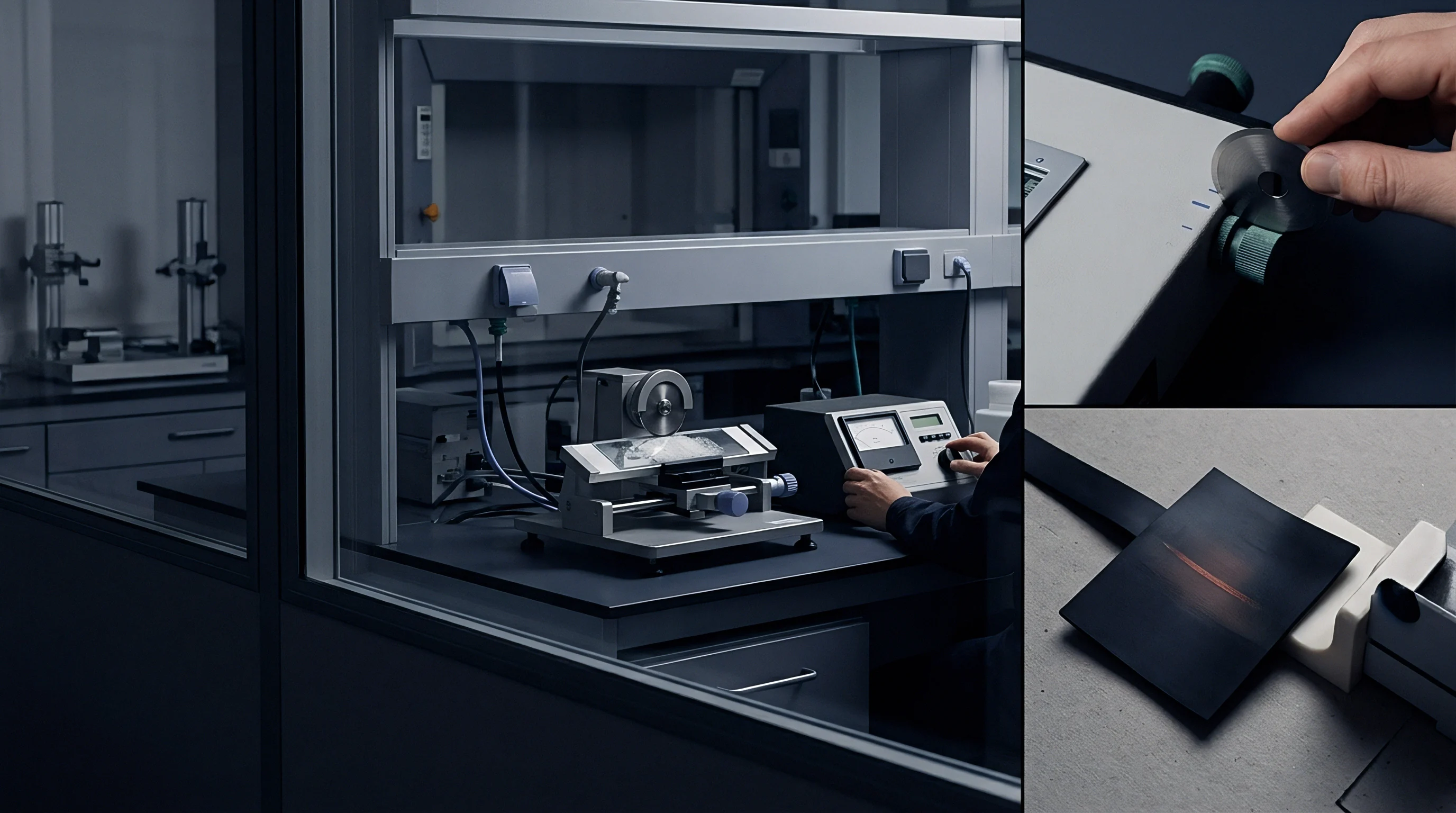
Can Amplitude Sweeps Isolate Delamination Energy?
Strain amplitude sweeps run at fixed reference frequencies track the breakdown of structural bonds inside the fibrous core. Incrementally escalating oscillatory strain amplitude from 0.01 percent to 10 percent induces progressive micro-rupture within the test specimen. Plotting storage modulus against oscillation strain amplitude identifies two critical thresholds: the linear limit marking the onset of irreversible plastic damage, and the crossover point where loss modulus exceeds storage modulus, signaling extensive structural liquefaction and inter-ply separation.
Integrating the area beneath the stress-strain hysteresis loop up to the crossover point defines the specific energy required for inter-ply delamination. If the delamination energy of the mechanical pulp core exceeds the tensile yield threshold of the top mineral coating, the outer surface cracks before the interior plies can split. Balancing these mechanical values allows converters to audit incoming board lots before setting up rotary creasing stations.
High-Frequency Master Curves for High-Speed Converting
Constructing reliable master curves for heterogeneous, anisotropic fibrous materials demands rigid testing constraints.
- Atmospheric equilibrium stabilizes test specimens at 23 degrees Celsius and 50 percent relative humidity per ISO 187 prior to thermal sweeping.
- Tension-film geometry isolates coating specimens on dynamic mechanical analysis clamps to prevent baseline slip during amplitude ramps.
- Frequency domain selection restricts test sweeps between 0.5 and 50 hertz to eliminate clamp inertial distortion while capturing viscoelastic relaxation.
- Strain linearity verification ensures preliminary testing stays within the linear viscoelastic region during thermal step progressions.
- Shift factor calculation fits horizontal translation values to the Williams-Landel-Ferry model to plot master curves across five logarithmic decades of frequency.
Master curve projections indicate that a board showing ductile behavior at 1 hertz will double its storage modulus and reduce its failure strain by half when converted at 1000 hertz equivalent rates. This rate-induced embrittlement explains why cartons that fold cleanly by hand during structural design evaluation often fail completely on commercial folder-gluers running full production volumes.
Whether humidity-induced plasticization of amorphous hemicelluloses shifts high-frequency master curves proportionally across varied fiber orientations remains an unresolved question in dynamic paperboard rheology.

Tooling
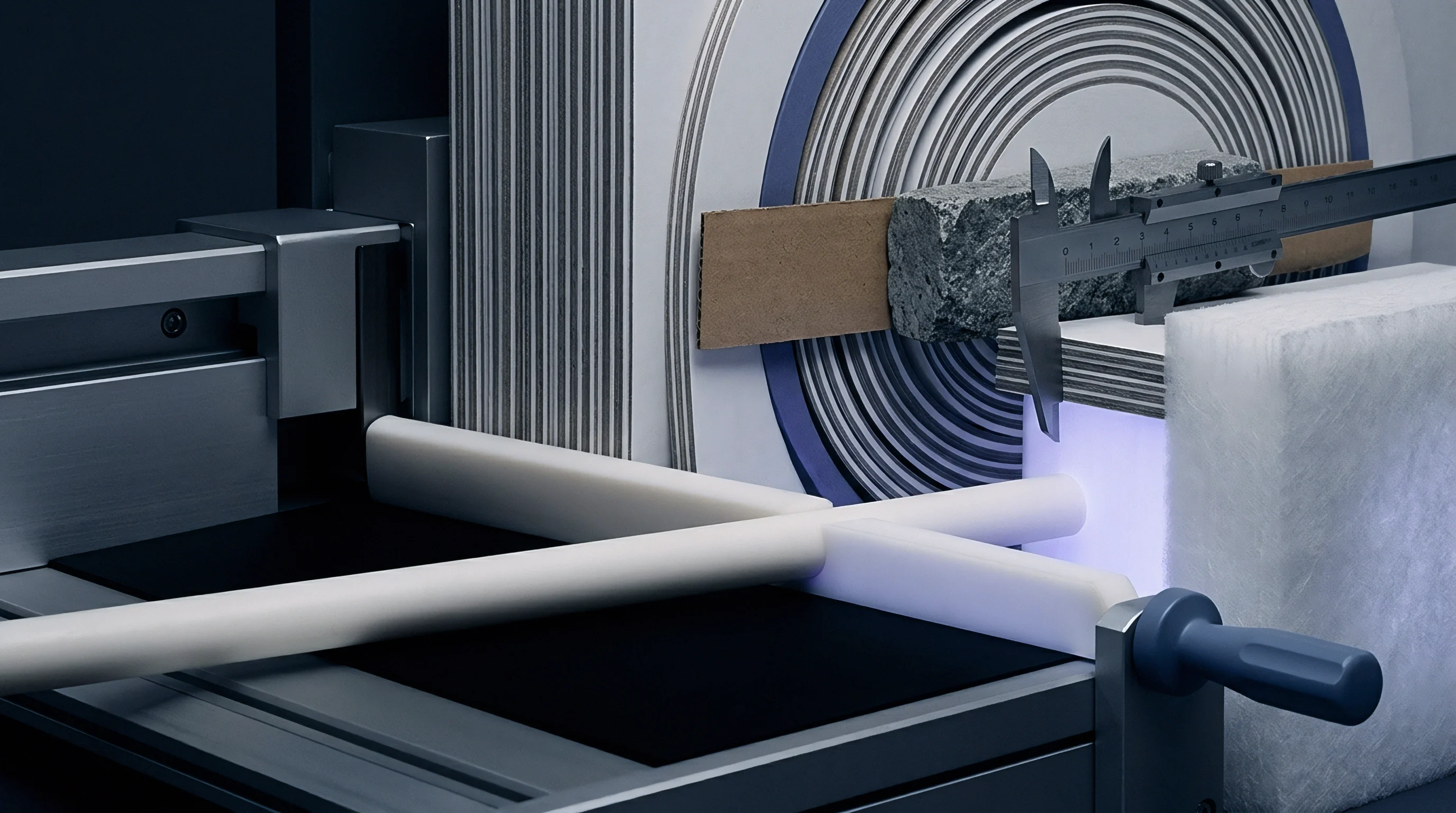
Steel rule dies press into paperboard against pertinax or milled steel counters to establish a controlled delamination hinge. Matching tooling geometry to the viscoelastic yield stress of the board prevents outer surface cracking while achieving uniform crease recovery angles. The creasing rule width, the counter channel width, and the channel depth represent interdependent variables governed by board caliper and dynamic material properties.
When converting coated board grades with high elastic storage moduli, standard geometric rules of thumb yield incorrect crease profiles.
Creasing rules crush paperboard cells.
Tooling penetration depth determines the shear strain experienced by internal mechanical plies. If the counter channel width is too narrow, the board faces intense compressive pinch rather than clean shear bending, elevating tensile strain on the top coated liner. Dynamic mechanical analysis yield calibration provides the exact strain threshold that the outer coating can tolerate before microcracking initiates.
Tooling engineers use this yield strain value to calculate the minimum permissible counter channel width, protecting delicate mineral coatings, barrier dispersion layers, and metallic foils from tensile rupture.
Under DIN 55437-3 visual grading protocols, any score line displaying microcracks wider than 50 micrometers constitutes an automatic lot rejection for barrier-coated cartons.
Could Thermal Sweeps Prevent Coating Microcracking?
Dynamic mechanical analysis thermal sweeps provide exact data regarding the glass transition regions of latex binders and barrier polymers. Operating folder-gluer creasing sections at ambient plant temperatures below the binder glass transition temperature guarantees surface fracture. Pre-heating the paperboard web or warming scoring rules directly transforms the mechanical response of the coating, moving binder polymers into their compliant rubbery plateau where dynamic yield stress drops and elongation at break rises substantially.
The fold angle reaches ninety degrees.
Heated creasing tools operating at fifty to sixty-five degrees Celsius elevate the local temperature of the scored hinge during the eight-millisecond contact dwell. This localized thermal injection shifts the outer coating well above its dynamic glass transition temperature, lowering the storage modulus by up to forty percent during the precise instant of maximum deformation. Coatings that fracture at sixteen degrees Celsius convert smoothly under moderate tool heating without requiring alterations to base board chemistry.
| Substrate and Surface Finish | Dynamic Yield Strain | Rule Width | Channel Width | Channel Depth | Folding Angle |
|---|---|---|---|---|---|
| SBS with Water-Based Overprint Varnish | 2.8% | 0.71 mm | 1.30 mm | 0.40 mm | 180° |
| FBB with High-Gloss UV Varnish | 1.4% | 0.71 mm | 1.45 mm | 0.38 mm | 90° |
| FBB with Soft-Touch Matte Laminate | 3.6% | 1.05 mm | 1.60 mm | 0.42 mm | 180° |
| WLC with Cold Foil and Cast Gloss Coat | 0.9% | 0.71 mm | 1.55 mm | 0.36 mm | 90° |

Matrix Depth Selection from Dynamic Yield Thresholds
Selecting counter channel depths requires balancing core shear with liner tensile strain. If the female channel is cut too shallow, the male rule cannot push the board deep enough to generate sufficient inter-ply shear, leaving the crease hinge unseparated. The resulting unseparated hinge requires excessive torque during folder-gluer folding, causing carton panel bowing and erratic glue line alignment.
Setting the counter channel too deep stresses the top liner beyond its dynamic yield point, initiating deep crazing lines that sever barrier coatings.
Pertinax channels wear over long runs.
Finished packaging specifications increasingly govern allowable surface cracking along creased edges. Contractual terms based on ISO 12647-2 print criteria combined with ASTM D5264 rub resistance standards dictate that any fracture exposing raw cellulose fibers through decorative print or barrier coats constitutes non-conformance, shifting rework costs entirely to the converting facility.

Tolerance
Converting facilities carrying high-speed carton lines absorb substantial financial write-offs when microcracking along hinge boundaries escapes pallet inspection. Flaked mineral pigment fouls folder-gluer optics, accumulates on glue application wheels, and contaminates interior carton surfaces meant for direct pharmaceutical contact. Quantifying material yield stress via dynamic mechanical analysis eliminates costly press trial-and-error routines, allowing packaging engineers to align board selection, coating formulations, and tooling geometry prior to mounting dies on high-speed equipment.
Inspection tables miss microcracking.
Consider a commercial converting run producing five hundred thousand luxury cosmetic cartons from 350 g/m² folding boxboard finished with a spot UV gloss varnish pass. Standard mill specification sheets list tensile strength at 14.5 kilonewtons per meter and Parker Print-Surf roughness at 1.1 micrometers, figures that provide zero visibility into dynamic shear performance. Setting up standard tooling without dynamic mechanical analysis yield calibration produces a baseline three percent waste rate across make-ready and high-speed running, dominated by score line flaking discovered during glue station quality checks.
Waste mounts during folder bring-up.
Calibrating tooling to the dynamic yield strain of the UV-varnished board reduces total defect rates dramatically. Expanding the counter matrix channel from 1.35 millimeters to 1.48 millimeters based on the measured 1.2 percent yield strain of the cured varnish layer keeps tensile elongation below the fracture threshold. The operational bring-up time drops from four hours to ninety minutes, eliminating multiple die shimming cycles and saving thousands of sheets of printed, coated board stock.
| Operational Cost Category | Empirical Baseline Setup | Calibrated Tooling Setup | Net Variance |
|---|---|---|---|
| Make-Ready Waste Sheets | 2,400 sheets ($1,920) | 600 sheets ($480) | -$1,440 |
| Running Waste from Score Cracking | 15,000 cartons ($7,500) | 1,500 cartons ($750) | -$6,750 |
| Make-Ready Press Downtime | 4.2 hours ($1,680) | 1.5 hours ($600) | -$1,080 |
| Die and Matrix Rework Expenses | $850 | $0 | -$850 |
| Total Direct Production Cost | $11,950 | $1,830 | -$10,120 |
Waste Arithmetic across Added Finishing Passes
Added finishing passes alter the unit economics of converting scrap. A basic printed folding carton blank carries raw board and ink costs. Passing that same sheet through secondary passes for foil stamping, matte dispersion priming, and tactile spot UV varnishing multiplies the financial value embedded in every running waste sheet.
When a carton splits at the score line on the folder-gluer, the financial loss encompasses the base substrate, the energy and labor of four separate machine passes, and the consumed specialty coatings.
Tooling clearance dictates crease recovery.
The unit cost of waste escalates steeply across multi-pass operations. In high-value retail packaging, sorting pallets to remove cracked cartons costs more than the total margin generated by the production run. Incorporating dynamic mechanical analysis calibration into the initial material specification process ensures that finishing passes enhance package presentation without compromising structural integrity at the creasing matrix.
Commercial Boundary for Offline Crease Rheology
Dynamic mechanical analysis instruments represent specialized capital equipment costing between eighty thousand and one hundred fifty thousand dollars. Packaging converters handling short-run, unvarnished commercial packaging cannot justify maintaining an in-house rheology suite. For these converters, utilizing accredited external testing laboratories to establish baseline master curves for core board grades provides the necessary yield data at manageable expense.
High-volume converting groups running dedicated lines across pharmaceutical, tobacco, and food sectors recover the capital investment of in-house dynamic mechanical analysis systems rapidly. Avoiding a single bulk shipment rejection from an automated high-speed filling line pays for an entire year of laboratory testing overhead. Predicting how board coatings perform under millisecond converting impacts transforms box making from an intuitive craft into a predictable mechanical science.
Clean carton folds emerge where internal shear yields before outer tensile stress tears the surface.