Optimizing Female Crease Channel Width for Coated Boards
Selecting female crease channel width using board caliper and coating stretch prevents outer liner fracture while preserving folding torque accuracy.


Width
Male rule thickness combined with board caliper dictates the volumetric displacement inside the female impression zone. When converting coated packaging substrates, female crease channel width establishes whether the top mineral coating layers stretch smoothly over the crease radius or fracture under localized tensile stress. The fundamental geometrical calculation for female crease channel width balances rule thickness, sheet caliper, and substrate elongation capability.
Standard creasing formulas calculate clearance by multiplying sheet thickness against empirical factors derived from pulp yield. For solid bleached sulphate boards, channel width equals male rule width plus 1.4 to 1.6 times board caliper. Folding boxboards with mechanical pulp cores require wider channels, typically rule width plus 1.6 to 1.8 times caliper, accommodating inner ply shear without rupture.
Coated recycled boards with lower fiber bond strength demand channel widths up to rule thickness plus 1.9 times caliper to prevent internal shear failure from tearing outer liners.
| Board Grade | Caliper Range (mm) | Rule Thickness (pt / mm) | Target Width Formula | Calculated Width (mm) |
|---|---|---|---|---|
| Solid Bleached Board (SBB) | 0.30 to 0.40 | 2 pt / 0.71 mm | W = 0.71 + 1.50 t_b | 1.16 to 1.31 |
| Folding Boxboard (FBB) | 0.40 to 0.55 | 2 pt / 0.71 mm | W = 0.71 + 1.70 t_b | 1.39 to 1.65 |
| Coated Recycled Board (CRB) | 0.50 to 0.70 | 3 pt / 1.07 mm | W = 1.07 + 1.85 t_b | 2.00 to 2.37 |
| Poly-Coated Barrier Board | 0.35 to 0.50 | 2 pt / 0.71 mm | W = 0.71 + 1.60 t_b | 1.27 to 1.51 |

Rule Thickness and Board Caliper Multipliers
Shear stress causes delamination. Outer coatings resist stretch. Selecting an incorrect female channel width forces the male rule to crush board fibers against the counter matrix edge rather than inviting controlled internal delamination.
If the channel is too narrow, board fibers cannot form the symmetrical bulge into the female cavity needed to relieve surface tension. The top mineral coating layer fractures, showing unsightly white lines or flaking pigment along folded package edges.
The relationship between male creasing rule width and female counter channel width governs the shear angle during stroke entry. A standard 2-point rule measuring 0.71 mm penetrating a board of 0.45 mm caliper creates high localized pressure if pushed into a 1.20 mm channel. Expanding that channel to 1.48 mm shifts the strain distribution across a broader fold arc, keeping outer coating elongation below its rupture limit of 1.8 percent.
Excessive channel clearance compromises fold squareness before the inner liner splits.

Shear Strain Distribution across Outer Coatings
Top layers containing kaolin clay or calcium carbonate binders exhibit minimal elongation before surface rupture occurs. During the 90-degree or 180-degree folding sequence, outer coating layers endure severe tension while inner plies undergo compressive buckling. Properly sized female channels allow middle pulp layers to delaminate into distinct, unbonded leaf structures.
This internal ply separation reduces the bending moment, protecting fragile outer coatings from tensile rupture.
Converting lines running under-sized female channels produce cartons with high initial creasing stiffness, causing automated cartoning machine feed jams. Tight channel clearance crushes board fibers excessively, creating rigid crease shoulders that resist clean 90-degree squaring during high-speed blank folding. Sub-optimal channel widths generate asymmetric creases when the die-cutter operates slightly off-center, leading to misaligned glued cartons and expensive filling line stoppages.
Depth
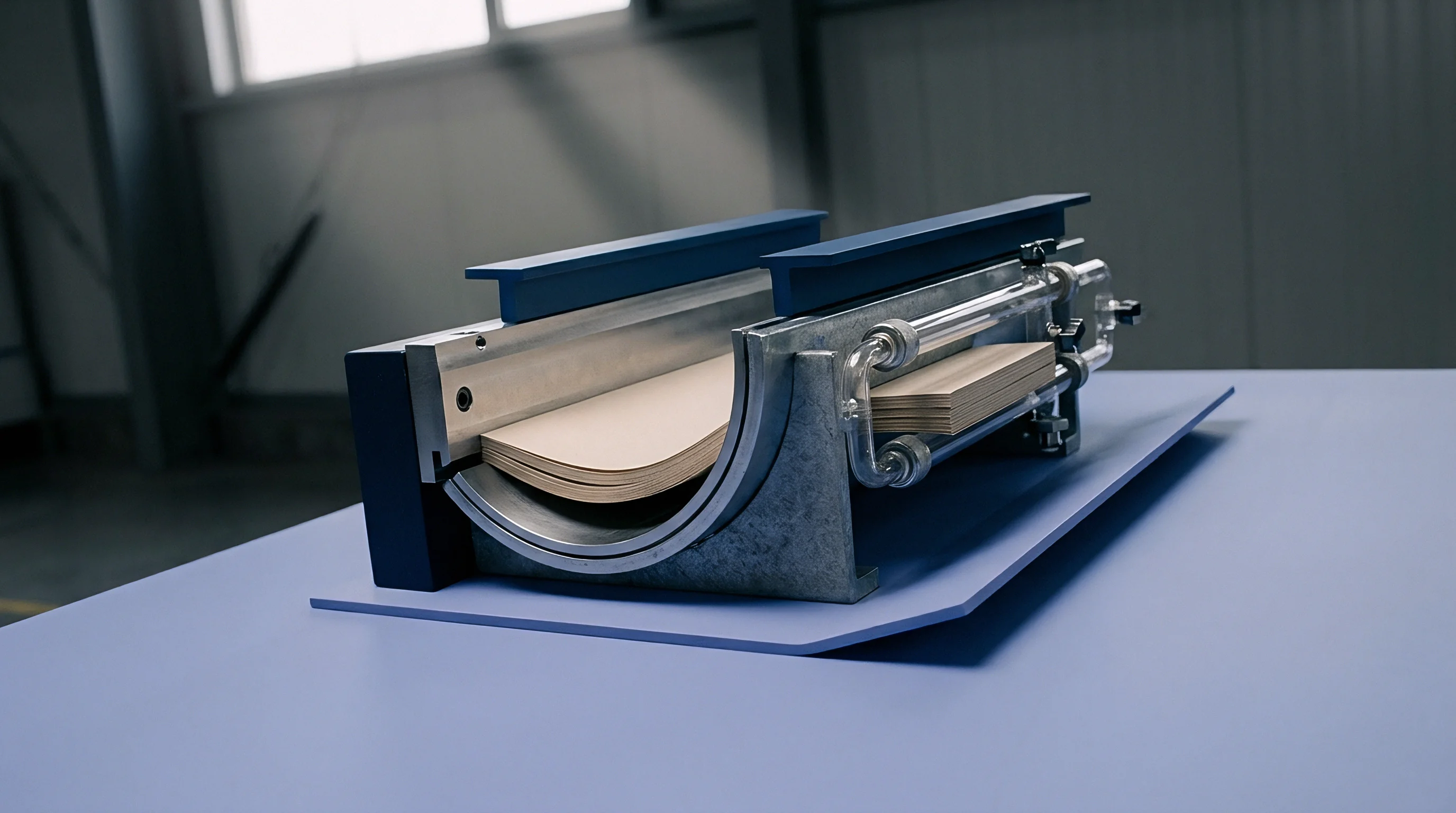
Female groove bed selection establishes the vertical dimension required to accommodate displaced fiber structures during stroke impact. Counter matrix channel depth directly impacts the degree of internal ply separation achieved during the die-cutting stroke. If the channel depth exceeds board caliper excessively, board fibers are drawn too deep without acquiring sufficient bottom squeeze, yielding weak, ill-defined crease lines.
Standard practice sets creasing matrix channel depth equal to board caliper for solid bleached chemical pulp boards. Bulky folding boxboards with compressible mechanical pulp centers utilize channel depths set at 85 to 90 percent of nominal board caliper. The creasing rule compresses the substrate into the channel, forcing internal delamination while avoiding outer liner rupture from bottoming out against the steel counterplate base.
Groove Vertical Dimensional Ratios
Vertical clearance calculations depend on substrate density and internal void compression. When converting a 0.50 mm folding boxboard with a density of 0.65 g/cm³, a female matrix depth of 0.45 mm provides optimal resistance. This slight compaction forces internal fiber layers to shear laterally into designed delamination planes rather than collapsing vertically without structural definition.
Selecting matrix depth without compensating for compressibility leads to surface splitting or soft creases. Excessive depth allows the board to form a loose, rounded hinge that fails to fold along a precise geometric line. Inadequate depth drives the creasing rule to pinch the board against the bottom of the counter matrix channel, cutting the inner liner and severely weakening carton corner durability.
A ten percent increase in creasing matrix depth reduces board bending stiffness by twelve percent under standard conditioning at twenty-three degrees Celsius.

Make-Ready Squeeze and Matrix Compression
Platen force adjustments balance fiber shearing against proper crease definition. Press make-ready operators fine-tune impression pressure using tissue papers or micrometer-adjusted platen bed settings to achieve clean, repeatable creasing across the entire die-cutting form. Insufficient impress force fails to activate internal delamination, leaving folding torque excessively high for downstream automated packaging machinery.
Incorrect vertical clearances degrade counter matrix walls over extended production runs. Polymeric matrix shoulders collapse under excessive side thrust when male rules press board fibers against misaligned channel walls. Maintaining correct depth ratios preserves tool geometry, avoiding frequent re-matrixing during multi-shift converting jobs.
- Coating Micro-Cracks surface along outer crease edges when insufficient matrix depth prevents complete internal delamination of the fiber core.
- Inner Liner Cutting occurs when excessive male rule penetration pinches board fibers against the hard base of an under-depth channel.
- Fold Misalignment develops on folder-gluers when oversized matrix channels produce wide, poorly defined crease shoulders.
- High Bending Torque persists in finished blanks when incomplete impress squeeze leaves internal ply bonds intact across the crease line.
Tooling vendors frequently attribute outer liner cracking to board moisture variance when channel depth has worn past tolerance.

Substrate
Fiber furnish composition dictates how multi-ply boards absorb bending stresses during conversion. High-grade solid bleached sulphate boards consist entirely of long chemical fibers that yield high tensile strength and superior elongation before breaking. Mechanical pulp layers within folding boxboard provide structural bulk but exhibit lower elasticity, demanding precise female channel matching to avoid liner rupture.
Recycled fiber boards contain shorter, repeatedly processed fibers with diminished hydrogen bonding capacity and reduced ply bond strength. When creasing coated recycled board, female channel widths must expand to prevent the male rule from causing catastrophic shear failure across the entire board cross-section. Coating layers applied to recycled substrates often lack the flexibility seen on virgin fiber boards, compounding cracking risks.

What Mechanical Strain Causes Coating Fracture during Folding?
Tensile forces act on the outer circumference of the fold while compression dominates the inner ply face. When board blanks pass through folder-gluers, the top pigment coating experiences extreme elongation along the outer radius. If internal delamination fails to relieve this tension, surface strain exceeds coating film elongation limits, forming micro-fractures through clay and latex matrices.
The moisture content of the board significantly alters fiber elasticity during creasing passes. Substrates conditioned below 45 percent relative humidity become brittle, losing the internal compliance necessary for clean shear deformation. High-humidity environments soften fiber networks, requiring tighter female channel clearances to maintain crisp crease definition and predictable folding torque values.
| Board Classification | Tensile Elongation Limit (%) | Ply Bond Strength (J/m²) | Recommended Width Multiplier | Recommended Depth Ratio |
|---|---|---|---|---|
| Solid Bleached Board (SBB) | 2.2 to 2.8 | 180 to 240 | 1.5 t_b | 1.00 t_b |
| Folding Boxboard (FBB) | 1.5 to 2.0 | 130 to 170 | 1.7 t_b | 0.90 t_b |
| Coated Recycled Board (CRB) | 1.1 to 1.4 | 90 to 120 | 1.9 t_b | 0.85 t_b |
| Extrusion PE Coated FBB | 3.5 to 5.0 | 140 to 180 | 1.6 t_b | 0.95 t_b |
| Data derived from DIN 55437 creaseability evaluations conducted under ISO 187 atmospheric conditions (23°C / 50% RH). | ||||

Barrier Film Tensile Behavior over Male Rules
Polyethylene extrusion layers stretch across the male rule tip before internal delamination initiates. Plastic films applied over coated boards alter surface friction and localized stress transfer during crease formation. Female creasing channels used for film-laminated or poly-coated boards require smooth, chamfered entry radii to prevent film tearing or boundary layer delamination along the outer crease shoulder.
Dispersion coatings designed for repulpable barrier applications demonstrate lower elongation thresholds than conventional polyethylene films. Press operators converting dispersion-coated board must select channel widths with extreme precision. Excessive channel clearance leads to wide, irregular deformation zones that cause brittle dispersion barriers to flake off, destroying liquid barrier integrity at carton corners.
- Virgin Chemical Pulp tolerates tighter channel widths due to superior fiber length and higher inherent stretch capacity.
- Mechanical Pulp Cores demand wider channel clearances to facilitate clean delamination of stiff, bulky middle plies.
- Recycled Fiber Furnishes require expanded channel dimensions to accommodate low shear resistance and prevent premature ply splitting.
- Polymer Film Overlays bridge surface micro-cracks but require smooth matrix shoulder radii to avoid localized tensile tearing.
Standard quality control specifications invoking ISO 187 conditioning guidelines alter warranty liability when converting plants fail to maintain fifty percent relative humidity in storage halls.

Allowance
Tooling wear and machine thermal expansion alter physical clearances across extended production shifts. Dynamic platen presses operating at speeds exceeding 9,000 sheets per hour generate substantial heat, expanding steel cutting plates and rule holders. Female channels cut into plastic matrix strips or steel counterplates experience continuous lateral stress, causing dimensional drift over high-volume converting runs.
High speed reduces press dwell. At elevated press speeds, the male rule remains inside the female channel for only a fraction of a millisecond. Fiber networks require time to deform and delaminate; reduced dwell time demands tighter dimensional tolerances on both channel width and matrix height to transfer sufficient deformation energy into the moving web.

Press Dwell Mechanics and High Speed Wear
Running platens at maximum speed reduces impression dwell time to milliseconds. Fast press cycles increase the rate of impact stress delivered to creasing matrix walls. Phenolic resin and synthetic matrix materials gradually erode under this repeated lateral thrust, widening channel clearance by up to 0.10 mm over a 50,000-impression production run.
Channel widening alters the crease geometry halfway through a run, converting sharp, well-defined creases into loose, soft folds. Quality managers observe rising folding resistance values on cartoning lines when matrix degradation goes uncorrected. Upgrading to CNC-milled steel counterplates maintains channel width tolerances within 0.01 mm, securing consistent folding behavior across millions of impressions.
Delivery specifications referencing DIN 55437-1 permit a maximum creasing stiffness deviation of fifteen percent across production lots.
Platen Calibration Sequence
Impression calibration establishes uniform creasing force across the entire die cutting table.
- Clean the platen bed thoroughly using solvent cleaner to remove paper dust, oil residue, and old adhesive fragments.
- Mount the cutting and creasing die chase securely into the press locking system, verifying torque settings on all clamping bolts.
- Affix the selected counter matrix strips or steel counterplate to the cutting plate using high-tack positioning tape.
- Perform a light initial impression stroke at 30 percent operating pressure to transfer matrix locator channels precisely onto the steel counterplate base.
- Peel away matrix locator carriers carefully, exposing the female creasing channels and verifying alignment with male creasing rules using a magnifier.
- Increase platen tonnage incrementally while running carbon setup sheets to verify uniform impression squeeze across all die positions.
- Run ten test sheets at target production speed and measure crease bending resistance using an automated bending stiffness tester prior to main run sign-off.
Matrix channels running parallel to the board grain direction require tighter dimensional control than cross-grain creases.


Margin
Consumable unit pricing directly correlates with line downtime caused by premature counter matrix replacement. Selecting cheaper plastic creasing matrix strips reduces initial tooling expenditure on job dockets but escalates operational costs when running large volume orders. Press stoppages to replace worn matrix strips burn valuable machine hours, destroying job profitability faster than tooling savings preserve it.
Milled steel counterplates represent a higher upfront investment but eliminate mid-run dimensional drift. When converting premium double-coated folding boxboard for pharmaceutical or cosmetics packaging, zero-defect requirements mandate exact crease symmetry. Waste rates from cracked coating flaking drop significantly when milled steel counterplates lock female channel geometries in place throughout the run.
| Counterplate Media | Initial Tooling Cost (USD) | Setup Time (Minutes) | Expected Life (Impressions) | Waste Percentage (%) | Landed Cost Per 1,000 Cartons |
|---|---|---|---|---|---|
| Standard PVC Matrix Strips | 45.00 | 25 | 35,000 | 2.8 | 4.12 |
| Phenolic Resin Matrix | 85.00 | 30 | 60,000 | 1.9 | 3.85 |
| Milled Steel Counterplate | 420.00 | 10 | 500,000+ | 0.4 | 2.95 |
| Pertinax Counters | 160.00 | 15 | 120,000 | 1.2 | 3.40 |

Tooling Media Financial Tradeoffs
Initial tooling expenditure dictates long term operational spoilage during repetitive job runs. Phenolic matrix media offer a middle ground between cheap PVC strips and costly steel plates. For production runs between 30,000 and 100,000 sheets, phenolic channels preserve wall geometry effectively, preventing outer liner micro-cracking without incurring the full lead time and expense of CNC steel milling.
Spoilage arithmetic must account for downstream cartoning line failure costs alongside press room scrap rates. A batch of cartons shipped with micro-cracked coating lines generates customer rejection claims, sorting fees, and potential loss of contract accounts. Sourcing practices that standardize on precision-milled channels reduce quality claims, ensuring board performance matches swatch certificate specifications.
Milled steel counterplates eliminate matrix alignment drift during multi-shift production runs.
Spoilage Impact on Extended Production Runs
Waste generation spikes when creasing matrix wear destabilizes folder-gluer indexing accuracy. When female channels widen due to wear, crease placement wanders by fractions of a millimeter across the blank face. This variation causes glue flap misregistration on high-speed folder-gluers, jamming packing lines and forcing manual sorting of finished pallets.
Extended Producer Responsibility fees increasingly penalize non-recyclable composite packaging materials. Selecting correct creasing parameters enables brand owners to specify plastic-free, dispersion-coated boards without risking functional failure along fold lines. Protecting surface integrity during conversion secures compliance with strict recyclability grading schemes while controlling scrap costs across the manufacturing cycle.
The exact point where bio-based dispersion coatings match the elongation capacity of synthetic film laminates during sharp crease displacement remains unquantified across recycled fiber blends.