Calculating Crease Matrix Dimensions for Folding Boxboard Grades
Calculate crease matrix width by multiplying boxboard caliper by 1.5 plus rule width for machine direction, increasing multiplier to 1.7 for cross direction.
Channel
Folding boxboard structural integrity relies on controlled delamination within the central mechanical pulp layer during flatbed die-cutting operations. Multi-ply paperboard grades like GC1 and GC2 contain high-bulk bleached chemi-thermomechanical pulp cores sandwiched between outer layers of fully bleached chemical pulp. When a steel creasing rule strikes the board sheet, force drives material into the open channel of the matrix counter.
This force does not crush the sheet flat. Mechanical action initiates internal shearing along the z-axis, separating the central pulp network into thin, parallel sub-layers. Controlled z-direction delamination creates an internal hinge mechanism.
Outer liner layers stretch around this internal fold without tearing, while inner liner layers collapse inward into a neat crease bead.
Matrix channel geometry determines whether this internal separation occurs smoothly or turns into structural failure. If the matrix channel width is too narrow, compressive forces pinch the sheet against the rigid channel shoulders. Narrow clearances prevent the middle plies from expanding outward, transferring stress to the top chemical pulp liner and causing score cracking.
If the matrix channel is too wide, the steel rule fails to generate sufficient shear strain across the central furnish layer. The board bends loosely without establishing a defined hinge plane, resulting in high fold resistance, distorted panel dimensions, and box corner rollover during automated cartoning.
Bleached chemi-thermomechanical pulp cores experience internal shear delamination when crease matrix width exceeds 1.6 times sheet thickness at 23 C and 50 percent relative humidity.

Layer Deformations
Triple-ply carton board structures contain distinct fiber furnish layers designed to absorb bending moments. Top and bottom plies consisting of long softwood chemical fibers provide high tensile strength on sheet surfaces. The central mechanical pulp core provides spatial separation between these tensile skins, maximizing bending stiffness at minimum basis weight.
Creasing rule penetration induces severe localized shear along the boundary zones separating these dissimilar fiber networks. Successful scoring depends on the mechanical pulp core compressing and splitting internally before surface chemical fibers reach their ultimate tensile strain limit.
Fibers align along the machine axis during sheet formation on the papermaking wire. Fiber orientation creates directional variance in bending resistance and shear behavior. Scoring parallel to the machine direction requires less force to initiate internal layer splitting because fibers roll past one another laterally.
Scoring across the cross direction forces the steel rule to bend stiff transverse fibers over the channel shoulders. Cross direction creasing demands broader matrix channel clearance to allow these rigid fiber bundles to form a clean crease bead without tearing the outer coated liner layer.

Shear Dynamics
Compressive forces applied by the steel rule displace material downward into the recessed counter cavity. The physical displacement creates a distinct crease profile on the reverse side of the board. Proper crease profile height matches the internal volume created by delaminated core plies.
Sheet density governs how easily mechanical pulp plies compress under rule pressure. Low-density folding boxboard grades with bulk values above 1.4 cubic centimeters per gram absorb volume displacement through core compaction. High-density solid bleached boards lack this porous core volume, forcing material outward into the matrix channel walls.
Score cracking occurs when outer liner elongation exceeds the maximum stretch capability of bleached chemical pulp fibers. Standard coated folding boxboard liners accommodate three to four percent elongation before microscopic fracturing begins. Precise channel geometry keeps liner stretch within this elastic band by directing material strain inward toward the delaminated core.
Miscalculated matrix width shifts stress outward, causing surface coatings to crack open and expose raw fibers along the carton crease line.
Uncertainty remains regarding how ultra-low density BCTMP cores manufactured with nano-cellulose additions alter internal shear planes under localized impact creasing.


Calipers
Micrometer measurements under ISO 534 standard testing dictate the foundation for all press tooling calculations. Sheet thickness controls the required channel depth and establishes the baseline multiplier for matrix channel width. Folding boxboard is specified by caliper in micrometers or millimeters rather than basis weight alone because bulk varies significantly across mill runs.
Caliper governs crease geometry. A 400-micrometer GC1 grade with a bulk of 1.5 cubic centimeters per gram exhibits different creasing dynamics than a 400-micrometer recycled solid board with a bulk of 1.1 cubic centimeters per gram. Press operators must verify sheet thickness on every delivered pallet lot using a precision dead-weight micrometer prior to selecting matrix strips.
Board caliper dictates matrix depth directly on a one-to-one ratio under standard converting conditions. A board measuring 0.45 millimeters in caliper requires a matrix strip depth of 0.45 millimeters. Selecting a channel depth less than the sheet caliper crushes the crease bead flat against the matrix base, destroying the internal hinge effect.
Selecting a channel depth greater than sheet caliper allows the board to drop too far into the channel, stretching outer fibers to their breaking point and creating weak, misaligned folds.

Furnish Densities
Bleached chemi-thermomechanical pulp provides higher bulk per unit grammage than pure chemical pulps. Mechanical pulping retains lignin within fiber structures, keeping individual fibers stiff and uncollapsed. The stiff fiber network creates microscopic air voids throughout the middle ply, yielding a resilient core structure.
Board density alters creasing force. Higher core bulk allows larger volumetric compression under the creasing rule, altering the required width expansion factor during matrix sizing.
Coated folding boxboard grades are categorized into European GC1 and GC2 standards based on furnish composition and reverse side treatments. GC1 grades feature a fully bleached chemical pulp layer on the reverse side, while GC2 grades feature a unbleached mechanical or white-lined reverse side. The chemical pulp back of GC1 grades tolerates higher tensile strain during scoring, allowing slightly narrower matrix channel settings without risk of liner splitting.
GC2 grades with mechanical pulp back layers are prone to surface cracking if channel clearances force sharp bending angles.
| Grade Standard | Caliper Band (mm) | Core Furnish | MD Multiplier Factor | CD Multiplier Factor | Matrix Depth Ratio |
|---|---|---|---|---|---|
| GC1 Virgin Board | 0.30 – 0.45 | Bleached BCTMP | 1.4 | 1.6 | 1.0 x Caliper |
| GC1 Virgin Board | 0.46 – 0.70 | Bleached BCTMP | 1.5 | 1.7 | 1.0 x Caliper |
| GC2 Virgin Board | 0.30 – 0.45 | Mechanical / BCTMP | 1.5 | 1.7 | 1.0 x Caliper |
| GC2 Virgin Board | 0.46 – 0.70 | Mechanical / BCTMP | 1.6 | 1.8 | 1.0 x Caliper |

Failure Modes
Incorrect sizing between matrix walls and cutting rule edges generates distinct physical defects in finished carton blanks. Failure mode diagnosis guides the packaging engineer toward corrective dimensional adjustments.
- Liner surface cracking appears as fine fractures along outer printed scores caused by narrow matrix channels or insufficient matrix depth settings.
- Reverse side rupture develops when sharp channel shoulder edges cut through bottom chemical pulp plies under excessive platen pressure.
- Rolled box corners result from wide matrix channels that fail to strain central core fibers, creating loose non-localized fold lines.
- Score displacement skew occurs when loose matrix locating shoulders shift laterally under impact forces during long production runs.
Thicker paperboard grades always demand wider channel clearances to prevent outer liner cracking along score lines.


Rule
Steel creasing strip selection dictates the initial width parameter used in matrix calculation equations. Standard die-making steel rule thickness is classified in printer points, where 1 point equals 0.014 inches or 0.356 millimeters. The most common rule thicknesses used for folding boxboard conversion are 2-point (0.71 mm), 3-point (1.05 mm), and 4-point (1.42 mm).
Rule selection dictates matrix width. Thicker paperboard calipers require wider creasing rules to distribute compressive forces across a larger surface area, preventing rule edges from cutting directly into the top liner.
Matching creasing rule thickness to sheet caliper is mandatory before calculating channel width. As a operating baseline, board calipers up to 0.50 millimeters utilize 2-point steel rule. Board calipers ranging from 0.51 millimeters to 0.85 millimeters utilize 3-point steel rule.
Board calipers exceeding 0.85 millimeters utilize 4-point steel rule. Deviating from these rule thickness standards skews the channel width formula, resulting in incorrect compression ratios within the counter pocket.
Cross direction creases demand wider matrix channels than machine direction creases to prevent outer liner cracking across stiff transverse fibers.

Mathematical Formulations
Standard calculation models establish the channel geometry required for clean ninety-degree carton folds. Matrix channel depth equals sheet caliper. Matrix channel width calculation incorporates sheet caliper, grain direction multiplier, and steel rule thickness.
Formula expression reads: Channel Width equals Sheet Caliper multiplied by Direction Factor plus Crease Rule Width.
Mathematical representation follows:
W = (t f) + d
Where W represents matrix channel width in millimeters, t represents board caliper in millimeters measured under ISO 534, f represents the empirical grain orientation factor, and d represents the physical thickness of the steel creasing rule in millimeters. For machine direction scoring on standard GC1 folding boxboard, the grain orientation factor f ranges from 1.4 to 1.5. For cross direction scoring, f ranges from 1.6 to 1.7.
High-bulk GC2 grades require increasing factor f by 0.1 units to accommodate increased core volume during displacement.

Grain Orientations
Fiber alignment along the paper machine wire creates asymmetric bending resistance in finished boxboard. Machine direction fibers align straight along the production axis, resisting cross-wise compression. Stiff fibers resist folding forces.
Creasing across the grain forces transverse fiber networks to displace into the matrix channel. This physical structural requirement demands distinct calculation pathways for machine direction and cross direction scoring lines on the same cutting die.
Die makers must calculate two distinct matrix channel widths for every carton layout. Machine direction creases run parallel to the paperboard grain and utilize smaller channel widths. Cross direction creases run perpendicular to grain and require wider channels to prevent outer liner rupture.
Standardizing on a single channel width across an entire die layout compromises fold quality on either the machine direction or cross direction scores.
Worked Calculations
Evaluating a 450-micrometer GC1 folding boxboard sheet processed with a 2-point steel scoring blade establishes the base formula application. Nominal board caliper t equals 0.45 millimeters. Steel rule thickness d for a 2-point blade equals 0.71 millimeters.
Calculating the machine direction channel width applies a grain factor f of 1.5.
Machine Direction Calculation:
W_MD = (0.45 mm 1.5) + 0.71 mm
W_MD = 0.675 mm + 0.71 mm = 1.385 mm
Rounding to standard commercially available matrix sizes specifies a 1.40 millimeter channel width. Calculating the cross direction channel width for the same sheet applies a grain factor f of 1.7 to accommodate transverse fiber resistance.
Cross Direction Calculation:
W_CD = (0.45 mm 1.7) + 0.71 mm
W_CD = 0.765 mm + 0.71 mm = 1.475 mm
Rounding to commercial matrix availability specifies a 1.50 millimeter channel width. Matrix depth for both orientations equals sheet caliper, yielding a nominal depth setting of 0.45 millimeters. The complete tooling specification orders 0.45 x 1.40 mm matrix for machine direction lines and 0.45 x 1.50 mm matrix for cross direction lines.
- Measure delivered sheet thickness across five web locations using an ISO 534 dead-weight micrometer to establish average caliper.
- Select steel creasing rule thickness based on board caliper boundaries, matching 2-point rule to calipers below half a millimeter.
- Calculate machine direction channel width using the baseline multiplier of 1.5 applied to measured sheet caliper plus rule thickness.
- Calculate cross direction channel width using the elevated multiplier of 1.7 applied to measured sheet caliper plus rule thickness.
| Scoring Axis | Board Caliper (mm) | Rule Thickness (mm) | Calculated Width (mm) | Target Matrix Size (mm) | Matrix Depth (mm) |
|---|---|---|---|---|---|
| Machine Direction | 0.45 | 0.71 (2 pt) | 1.385 | 0.45 x 1.40 | 0.45 |
| Cross Direction | 0.45 | 0.71 (2 pt) | 1.475 | 0.45 x 1.50 | 0.45 |
| Machine Direction | 0.45 | 1.05 (3 pt) | 1.725 | 0.45 x 1.75 | 0.45 |
| Cross Direction | 0.45 | 1.05 (3 pt) | 1.815 | 0.45 x 1.80 | 0.45 |
Tooling vendors frequently claim that universal crease matrix profiles eliminate the need for sheet-specific channel recalculations across varying board bulks.

Tooling
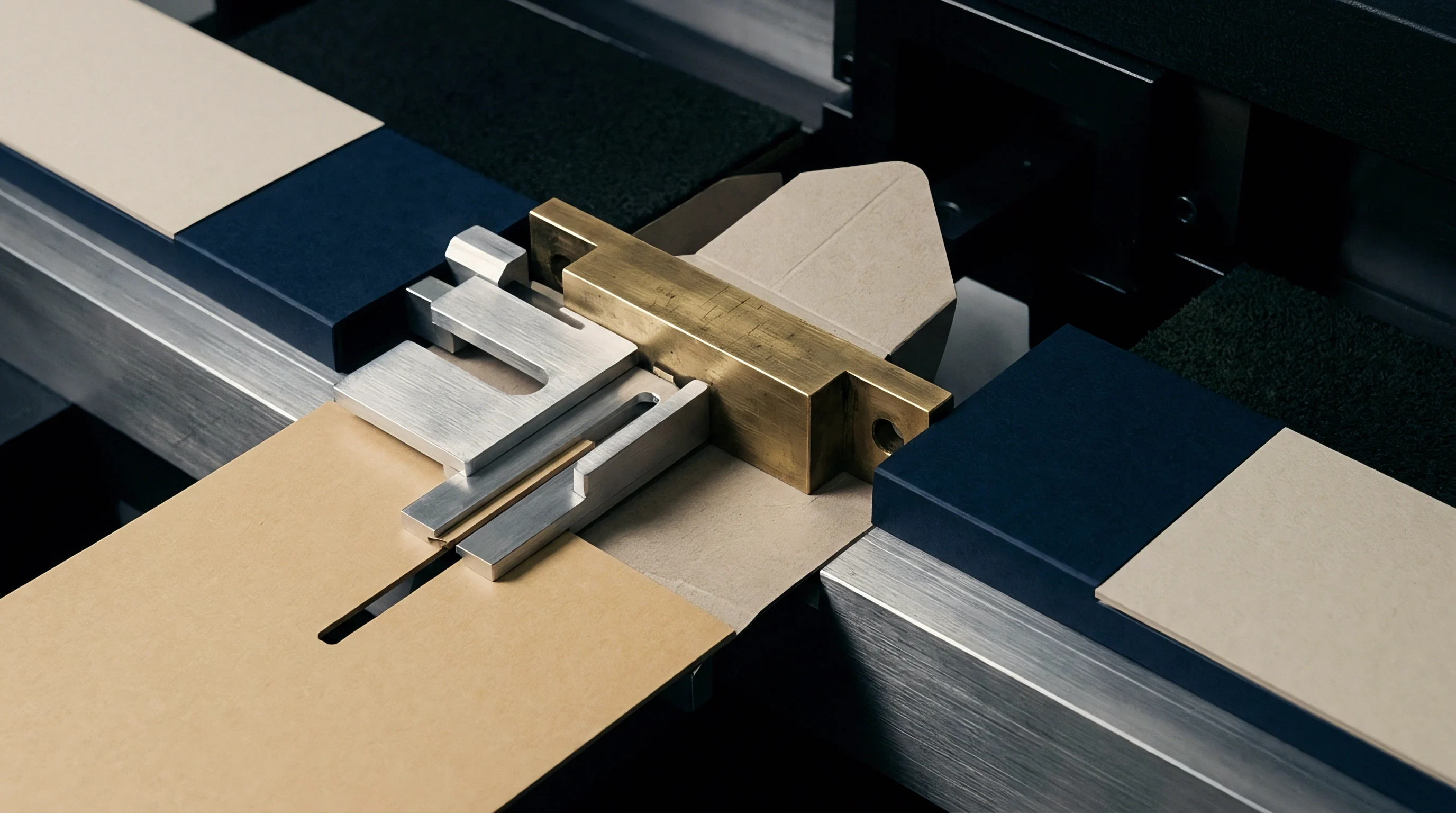
Die-cutting press setups require precise alignment between the steel cutting die and the creasing counter system. Matrix channel strips feature a plastic locator ridge that fits over the steel scoring rule. The operator removes adhesive backing tape, lowers the press platen to bond matrix bases to the steel cutting plate, and removes the plastic locator.
Matrix stability prevents channel movement during high-speed production runs. Loose channels alter effective channel width, generating inconsistent scoring profile across printed sheets.
Platen impression depth tuning alters creasing force without requiring matrix replacement. Excessive impression pressure crushes matrix shoulders, narrowing effective channel width and splitting board liners. Insufficient pressure prevents the steel rule from driving board material into the channel base, creating incomplete internal layer delamination.
Press operators adjust platen pressure until crease bead height matches calculated board displacement metrics.
DIN 19303 grade definitions require dimensional stability verification for folding boxboard under ambient humidity shifts to prevent channel misregistration during long press runs.

Matrix Materials
Polyvinyl chloride channel strips offer fast press preparation for short folding carton conversion runs. Synthetic matrix profiles flex easily, allowing quick application along curved or complex crease lines. Polyvinyl chloride shoulders deform under sustained platen impact forces.
Press runs exceeding fifty thousand impressions cause channel wall spreading, widening effective channel width and reducing crease sharpness.
Milled phenolic counter-plates and vulcanized fiber channels provide dimensional stability for long production runs. Phenolic matrices resist channel wearing. Solid phenolic sheets are CNC-milled to create custom channel networks matching exact die CAD drawings.
Milled counters eliminate matrix shoulder flexing, preserving precise channel width tolerances across hundreds of thousands of carton impressions.
- Press run volume dictates substrate choice, pushing jobs over one hundred thousand sheets toward milled phenolic counter-plates.
- Crease line geometry forces complex curved profiles onto flexible synthetic matrix channels to avoid manual counter-plate trimming.
- Platen temperature stability restricts plastic matrix usage on high-speed presses where heat causes adhesive backing migration.
- Sheet caliper variations demand vulcanized fiber counter materials capable of absorbing minor basis weight drift across raw board lots.

Press Clearance
Platen pressure adjustments modify the effective depth of the score line during high-speed production. Cutting press make-ready requires patching under the cutting plate to equalize impression force across the entire sheet layout. Die pressure requires precise balance.
Localized pressure spikes flatten matrix channel walls, causing board tearing along isolated carton panels. Balanced impressional force ensures uniform core delamination across all carton impressions.
Ambient humidity shifts inside unconditioned press rooms alter folding boxboard moisture content within hours. Board moisture alters board stiffness rapidly. Paperboard absorbs environmental water, increasing caliper and reducing core shear strength.
A 1.5 percent increase in sheet moisture increases effective board caliper, causing calculated matrix depths to pinch the swollen board. Press operators must monitor warehouse relative humidity and adjust matrix channel depth specifications when converting board stored in non-conditioned environments.
| Matrix Channel Deviation | Effective Channel Width | Fold Resistance Impact | Linear Crack Risk | Max Press Speed (sheets/hr) |
|---|---|---|---|---|
| Minus 0.10 mm | Too Narrow | Extremely High (+40%) | Severe Surface Cracking | 4,500 |
| Nominal Spec (0.00 mm) | Calculated Optimum | Standard Target Range | Zero Failure | 9,000 |
| Plus 0.10 mm | Too Wide | Low Hinge Stiffness (-30%) | Corner Rollover Risk | 8,500 |
| Plus 0.20 mm | Excessive Clearance | Undefined Hinge Location | Loose Panel Alignment | 6,000 |
Standard purchase terms referencing ISO 12647-7 tolerance specifications allow buyers to reject delivered matrix lots whose channel width deviates by more than five percent from nominated sizing.


Waste
Converting efficiency drops rapidly when score line failure causes automatic cartoning machinery to jam. Score strength preserves package shape. Packaging lines feeding flat folded blanks into automated erecters depend on consistent fold resistance across all four corner scores.
If miscalculated matrix channels produce asymmetric crease stiffness, blank feeding mechanisms misalign cartons during high-speed insertion. Jammed cartoning machinery creates immediate production line downtime, destroying unit yield metrics.
Inconsistent fold force forces packaging line operators to slow down automatic cartoning machinery. A filling line rated for four hundred cartons per minute drops to two hundred and fifty cartons per minute when handling sheets scored with worn or improperly sized crease matrix channels. The financial cost of reduced cartoning speed far exceeds the initial material outlay required for high-precision counter tooling.
Excessive creasing matrix depth forces rule penetration into inner liner layers, generating loose fiber dust that clogs downstream packaging automation lines.
Blank Spoilage
Unintended carton ruptures during high-speed gluing operations create immediate production downtime. Outer liner tension creates cracks. Cracked score lines expose raw mechanical pulp fibers along folded carton edges.
Exposed fibers absorb ambient humidity, causing structural warping along glued carton seams. Uncoated cracks split open when subjected to top-load compression during pallet stacking, invalidating container integrity certificates.
Blank spoilage rates climb exponentially when raw paperboard caliper fluctuates beyond initial matrix design assumptions. Mill caliper drift exceeding plus or minus five percent causes nominal matrix sizing to alternate between pinching and loose scoring states across a single paperboard reel. Establishing rigorous goods-in caliper inspection protocols prevents out-of-spec paperboard lots from reaching die-cutting presses.

Economic Consequences
Tonnage loss from improperly scored folding boxboard spreads beyond raw paperboard costs into converted blank rejections. A die-cutting press running at eight thousand sheets per hour generates thousands of ruined blanks before score cracking is detected at goods-out inspection. Scrap paperboard retains minimal value through recycling channels compared to the landed cost of printed, foil-stamped, and die-cut packaging stock.
Calculating precise crease matrix dimensions for folding boxboard protects raw material investment by maximizing converting yield. Correct tool sizing enables high-speed flatbed die-cutting, maintains tight carton fold tolerances, and prevents liner cracking on automated packaging lines. Rigorous dimensional calculation bridges raw substrate specifications and high-speed packaging performance.
Miscalculated matrix dimensions produce weak hinge lines that cause automatic packaging machines to miss suction pick-up cycles, stopping high-speed filling lines and invalidating converted lot acceptance.