Evaluating Short Span Compression Index Variations in Recycled Boxboard Plies
Short span compression index variations across recycled boxboard plies directly determine box stacking strength and dictate structural downgauging limits.
Clamp
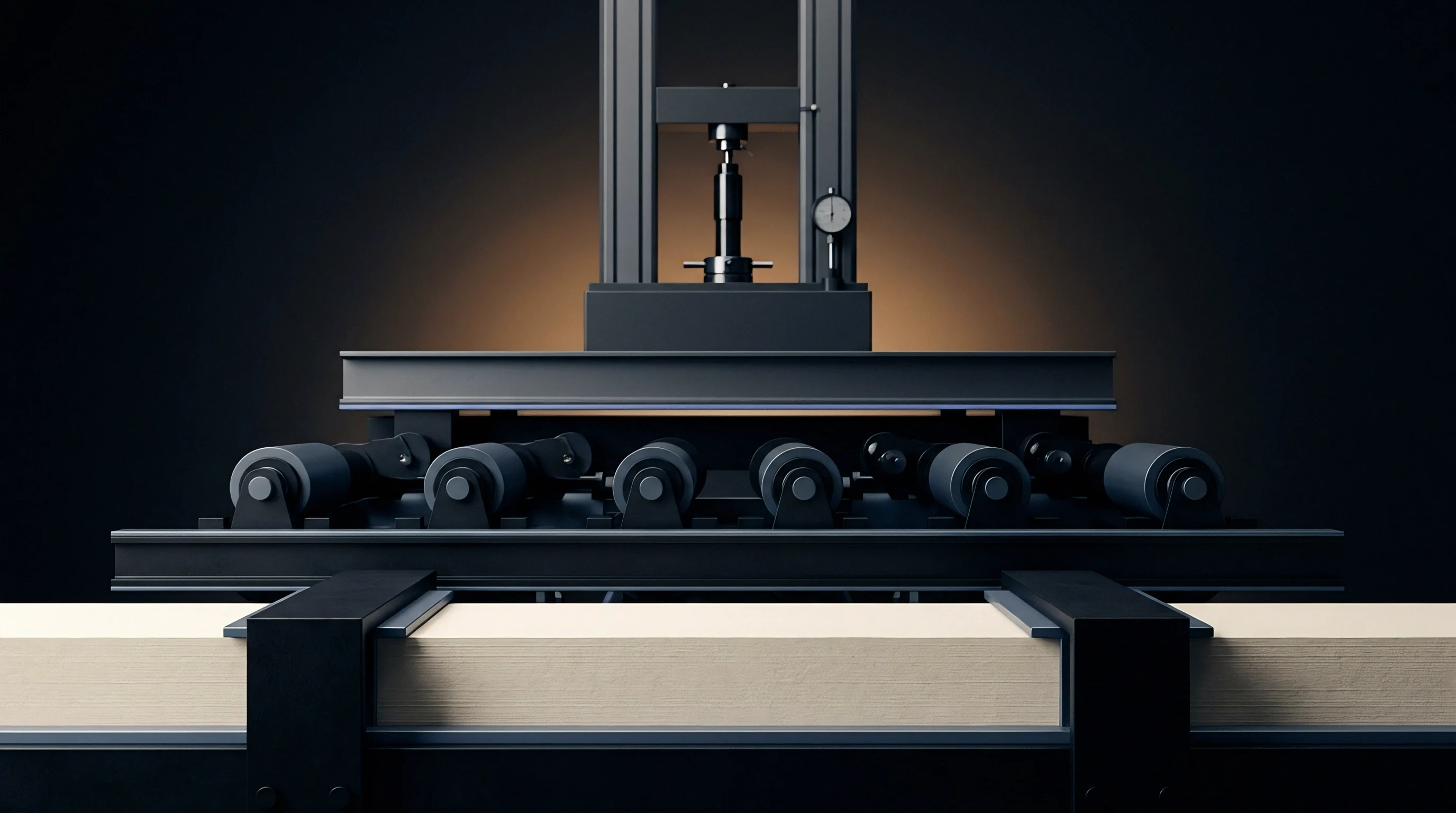
Testing the compressive force of paperboard across tiny physical distances requires extreme mechanical precision. Short span compression testing evaluates sheet strength by clamping a specimen between two pneumatic jaws separated by a free span of exactly 0.70 millimeters. This narrow gap prevents the paperboard from buckling globally under axial load, forcing the specimen to fail purely in structural compression.
In recycled boxboard plies, compressive failure occurs through localized fiber micro-buckling and cell wall collapse rather than tensile rupture. Measuring this ultimate compressive force per unit width yields the short span compressive strength, expressed in kilonewtons per meter. Dividing this value by the sheet basis weight produces the short span compression index, expressed in newton-meters per gram.
Standardized laboratory testing relies on strict mechanical tolerances to maintain valid failure modes. ISO 9895 and TAPPI T 826 define the international requirements for short span compression testing of paper and board. Standard jaw clamping forces must balance two opposing failure conditions.
Insufficient clamping pressure allows the specimen to slip within the jaws, recording an artificially low compressive force. Excessive clamping pressure crushes the cross-sectional structure of porous recycled plies, creating stress concentrations along the clamp boundary that cause premature compression shear breakdown.

Testing Standard Parameters and Measurement Mechanics
Standardized laboratory procedures define the physical gap between holding jaws at 0.70 millimeters with an allowable tolerance of 0.05 millimeters. This precise geometry keeps the slenderness ratio of the tested specimen low enough to suppress Euler bending failure. The clamping jaws apply a nominal clamping force of 2300 kilonewtons per meter of specimen width, translated through precision pneumatic actuators.
A deformation rate of 3.0 millimeters per minute compresses the sheet until ultimate load capacity is reached. Short span testing avoids specimen buckling.
| Parameter | ISO 9895 Specification | TAPPI T 826 Specification | SCAN-P 46 Specification |
|---|---|---|---|
| Free Span Gap | 0.70 ± 0.05 mm | 0.70 ± 0.05 mm | 0.70 ± 0.05 mm |
| Specimen Width | 15.0 ± 0.2 mm | 15.0 ± 0.2 mm | 15.0 ± 0.1 mm |
| Clamping Force | 2300 ± 500 N/m | 2300 ± 500 N/m | 2300 ± 200 N/m |
| Testing Speed | 3.0 ± 1.0 mm/min | 3.0 ± 0.5 mm/min | 3.0 ± 0.5 mm/min |
| Relative Humidity | 50 ± 2 percent | 50 ± 2 percent | 50 ± 2 percent |
| All standardized tests mandate conditioning at 23 degrees Celsius according to ISO 187 atmospheric standards. | |||

Micro Buckling Mechanics and Compression Shear Breakdown
Axial loads applied to short paperboard specimens force individual cell walls into structural yield. In recycled fibers, previous pulping, refining, and drying cycles create localized cell wall dislocations and micro-folds. These structural defects reduce the inherent axial stiffness of individual wood fibers.
Compressive forces collapse individual fiber walls. When compressed, recycled plies fail through a combination of intra-fiber micro-buckling and inter-fiber bond failure.
Porous middle plies containing high fractions of mixed waste paper exhibit lower compressive resistance than dense outer plies. Higher void fractions in recycled furnishes allow individual fibers room to buckle laterally under load. Increasing sheet density through mechanical wet pressing improves the short span compression index by restricting lateral fiber displacement and raising inter-fiber contact area.
Standard conditioning at 23 degrees Celsius and 50 percent relative humidity establishes a baseline free span clamping gap of 0.70 millimeters.
Mill technical representatives often attribute early compressive failure to ambient moisture fluctuations rather than jaw pressure misalignment during laboratory testing.
Stratification
Multi-ply recycled boxboards possess distinct layer compositions engineered for specific structural and surface duties. Coated Recycled Board and White Lined Chipboard utilize multi-cylinder or multi-gap former paper machines to construct sheets ranging from three to five distinct plies. The structural compression strength of the complete multi-ply sheet equals the direct summation of the individual compressive capacities of each ply.
While bending stiffness depends on placing high-modulus material at the outer surfaces, short span compressive strength operates additively across the entire basis weight profile.
Furnish quality varies substantially across the cross-section of a recycled boxboard sheet. Top liner plies consist of bleached virgin kraft or high-grade deinked pulp to achieve brightness and printability. Underliner plies use clean office waste or unprinted post-industrial shavings.
Middle plies comprise the thickest bulk fraction, utilizing lower-grade recycled stock such as Old Corrugated Containers, mixed paper, and newsprint. Back liner plies rely on recycled unbleached kraft or OCC to provide balanced moisture expansion and scuff resistance.

Differential Compressive Performance across Plies
Outer liner layers utilize cleaner, less degraded fiber fractions to preserve surface integrity and tensile resistance. Middle filler plies contain shorter fibers subjected to multiple recycling loops, high ash contents, and elevated levels of fine material. Hornification occurring during repeated drying cycles stiffens recycled fiber walls but impairs hydrogen bonding capability.
Consequently, individual plies exhibit drastically different short span compression indices when isolated and tested separately.
To evaluate ply contributions, consider a worked engineering construction of a 350 g/m² Coated Recycled Board sheet split into four structural layers. Top liner plies maintain higher individual compression indices due to superior fiber length and bonding density. Middle plies present lower compression indices but supply over half the total sheet mass.
Liner layers maintain structural stiffness.
| Ply Definition | Furnish Type | Grammage (g/m²) | Caliper (µm) | Isolated SCT Index (N·m/g) | Absolute SCT Strength (kN/m) |
|---|---|---|---|---|---|
| Top Liner | Bleached Deinked Pulp | 45 | 41 | 24.5 | 1.10 |
| Underliner | Sorted White Ledger | 35 | 35 | 22.0 | 0.77 |
| Middle Filler | Mixed Waste / OCC | 220 | 264 | 14.2 | 3.12 |
| Back Liner | OCC Furnish | 50 | 50 | 18.0 | 0.90 |
| Composite Sheet | Recycled Boxboard | 350 | 390 | 16.83 | 5.89 |
The middle filler ply accounts for 220 g/m² of the 350 g/m² total basis weight, representing 62.8 percent of the board mass. Although its isolated compression index lands at a modest 14.2 N·m/g, the middle ply contributes 3.12 kN/m of absolute compressive strength, representing 53 percent of the total 5.89 kN/m sheet capacity. High filler loads in middle plies lower the weighted average compression index of the total board construction.
Middle plies carry substantial filler loads.
Structural Failure Modes in Multi Ply Boxboard Compression
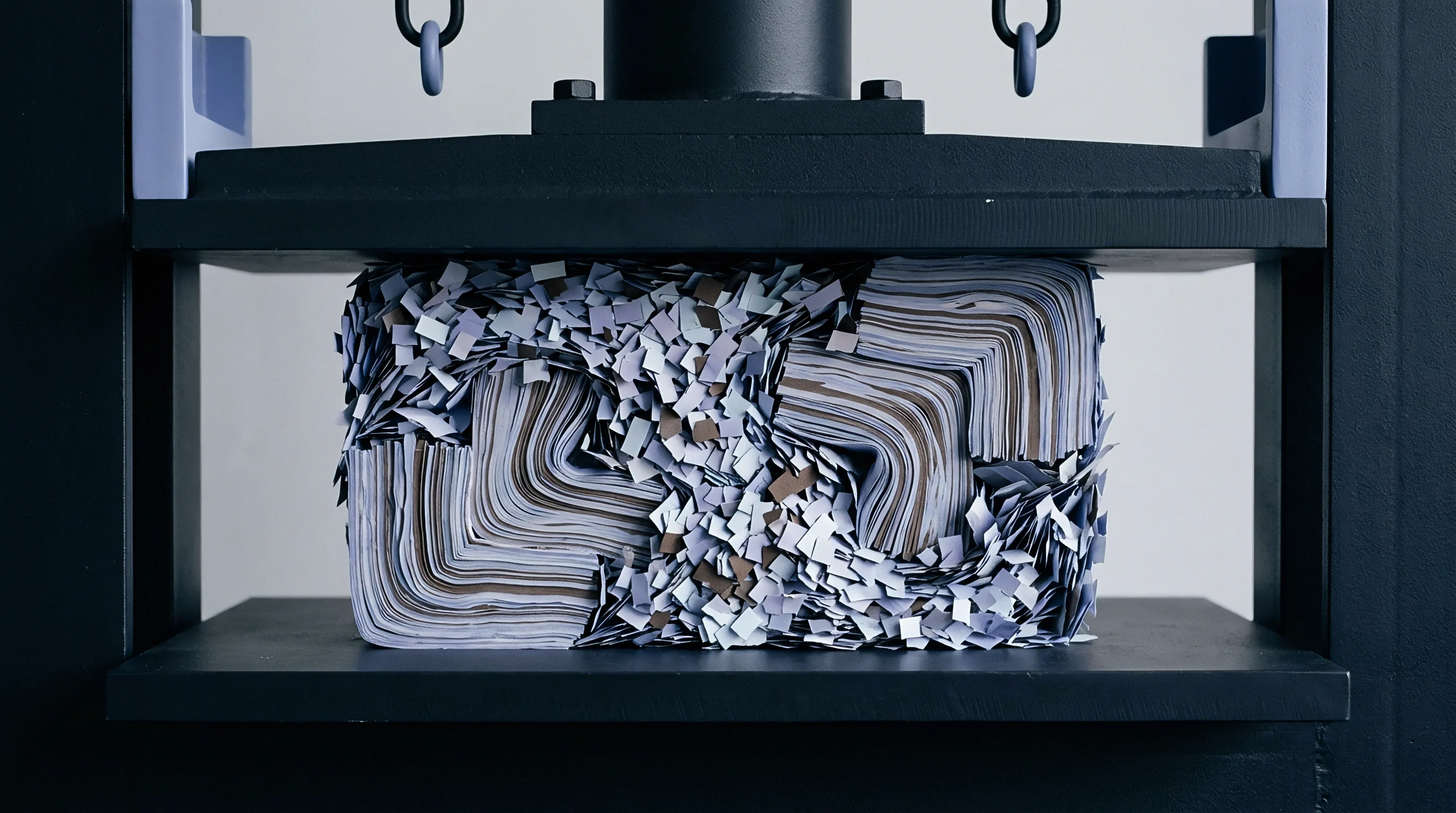
Shear stresses generated during loading frequently expose weaknesses along internal ply bond boundaries. When a multi-ply boxboard experiences high axial compressive loads, the lower elastic modulus of recycled middle plies causes them to strain faster than stiff outer liners. This strain mismatch generates internal shear forces along the ply interface.
Poor inter-ply bonding causes microscopic delamination before maximum compressive strength is reached in the outer layers.
- Interface shear delamination occurs when high compressive loads exceed intra-ply cohesive bond strength.
- Micro-buckling of damaged fibers accelerates structural collapse under lower load thresholds.
- Fines concentration at ply boundaries creates weak inter-ply bonding zones during pressing.
- Z-direction density gradients force non-uniform strain distribution across the sheet thickness.
Chemical additives help restore compressive capacity in recycled middle plies. Starch application at the wet end or size press reinforces inter-fiber hydrogen bonds damaged by recycling hornification. Spraying cationic starch between former wires enhances ply bond strength, preventing premature shear failure along ply boundaries during compressive loading.
ISO 9895 specifies a maximum clamp force deviation of 5 percent to prevent premature micro-buckling or local crushing along jaw edges.
Neglecting ply-specific compressive contributions leads to over-specifying total basis weight, inflating freight costs and increasing end-of-life recycling fees.


Hygroexpansivity
Cellulose networks absorb moisture directly from the surrounding atmosphere, altering their dimensions and internal strain states. Water molecules penetrate amorphous regions of cellulose fibers, breaking hydrogen bonds between adjacent polymer chains. Recycled fibers absorb water rapidly.
The introduction of water reduces the elastic modulus and yield stress of individual fiber walls. In short span compression testing, elevated equilibrium moisture content causes a steep, non-linear reduction in measured compression force.

Moisture Absorption and Recycled Fiber Hysteresis
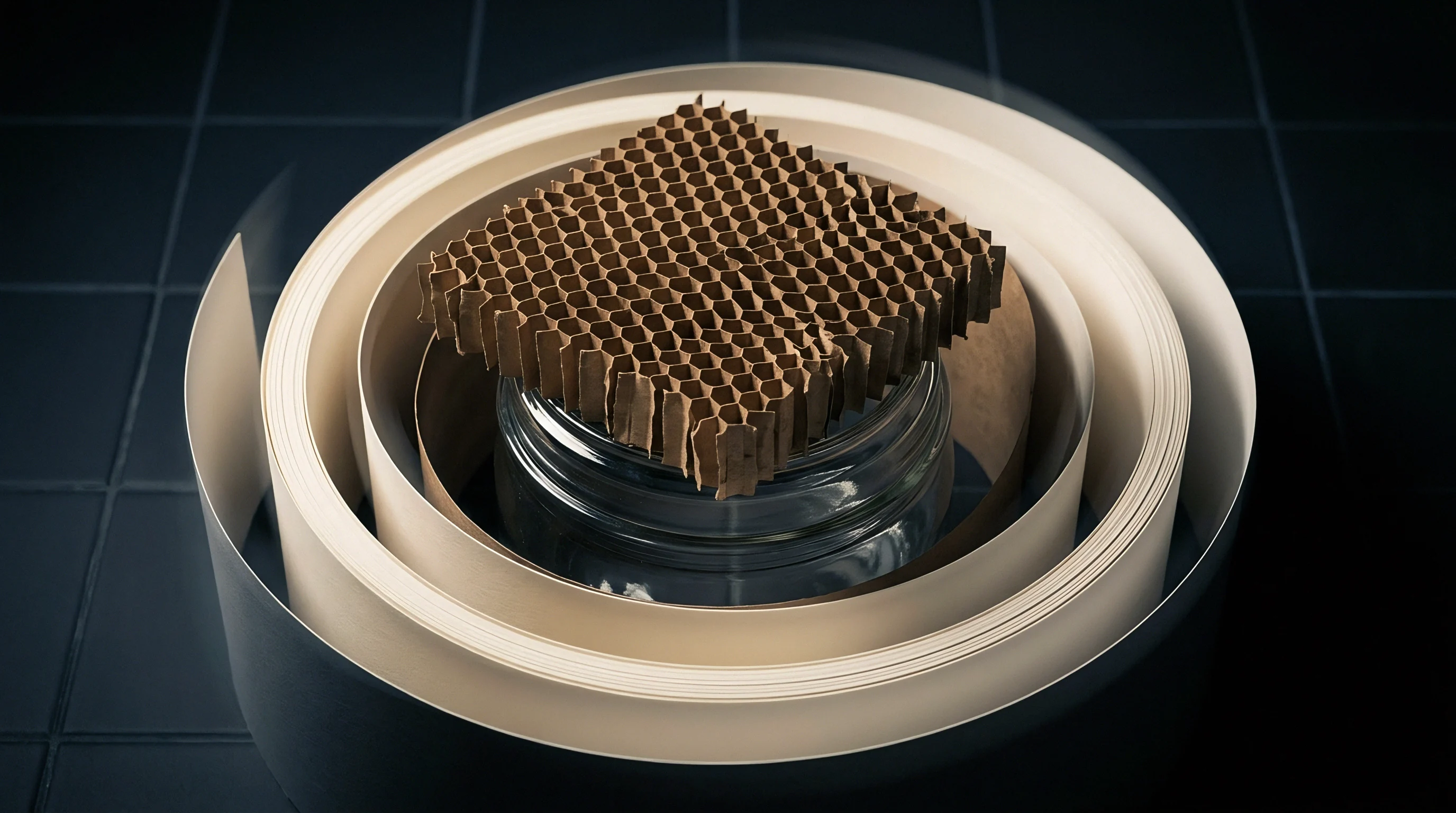
Repeated wetting and drying cycles during paper recycling alter the swelling capacity of cellulose cell walls. Hornified recycled fibers absorb moisture differently than virgin pulps, exhibiting severe compressive strength degradation at high relative humidity levels. Equilibrium moisture content varies depending on whether a sheet approaches equilibrium from a dry state or a wet state, an effect known as moisture hysteresis.
Hydrogen bonds weaken under humidity.
Relative humidity shifts directly impact short span compression metrics. Between 20 percent and 50 percent relative humidity, compressive strength drops linearly. Above 60 percent relative humidity, plasticization of hydrogen bond networks accelerates, causing rapid decay in compressive yield capacity.
Moisture absorption reduces compressive yield strength.
Recycled plies containing elevated levels of hemicellulose and fine particles demonstrate heightened moisture sensitivity. Middle plies formulated from mixed paper waste absorb atmospheric water faster than dense kraft outer liners. Unconditioned storage of boxboard reels allows moisture to penetrate reel edges, creating localized compression strength deficits that ruin converting performance.
Elevated ambient moisture weakens recycled fiber networks far faster than virgin kraft networks due to damaged inter-fiber bonds.
The exact molecular mechanism governing permanent loss of compressive stiffness in multiply-recycled fibers under dynamic humidity cycling remains under active investigation.

Variance
Production across wide paper machine webs introduces continuous fluctuations in sheet properties. Cross-machine direction compression variations stem from stock distribution variations across the headbox, uneven press nip pressures, and non-uniform drying profiles across the cylinder bank. Because boxboard boxes fail along their weakest panel region, understanding cross-machine direction compression distribution is vital for predicting structural package performance.
Are Cross Direction Compression Fluctuations Predictable across Web Profiles?
Headbox stock delivery controls determine local basis weight variations across the full manufacturing width. Thermal expansion of headbox slice lip actuators creates narrow zones of varying mass, directly altering short span compression readings. Jet-to-wire speed ratios govern fiber alignment during initial sheet forming.
Fiber orientation alters the ratio of machine direction compression strength to cross-machine direction compression strength. Edge crush tests confirm panel stability.
Anisotropy ratios typically range from 1.8 to 2.5 in multi-ply recycled boxboard machines. High machine speeds align fibers predominantly in the machine direction, boosting machine direction compression strength while weakening cross-machine direction resistance. Because container panels experience vertical compression along the cross-machine direction during stacking, unmanaged orientation drift severely compromises box load limits.
Cross direction strength governs box stacking.
Cross Machine Profile Verification Protocol
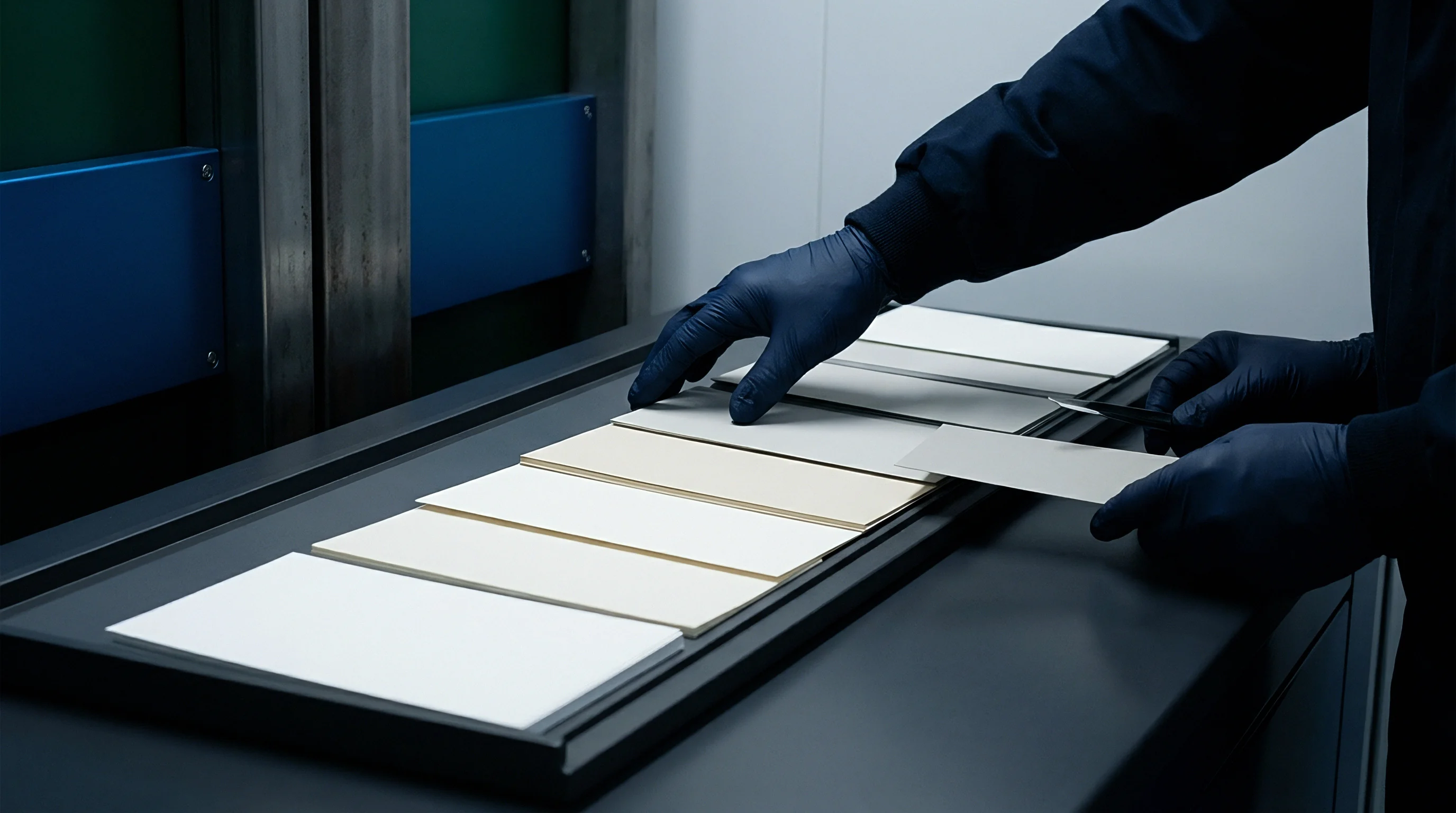
A systematic reel sampling program identifies systematic strength deficits prior to converting operations.
- Extract test strips at five equidistant points across the full machine width.
- Condition all specimens at 23 degrees Celsius and 50 percent relative humidity for 24 hours per ISO 187.
- Execute ten valid short span compression tests in the cross direction for each web position using ISO 9895 parameters.
- Calculate the mean compression strength, standard deviation, and coefficient of variation for each cross-machine location.
- Reject reel lots where cross-machine compression variations exceed seven percent of the certified target index.
| Web Position | Basis Weight (g/m²) | Cross Direction SCT (kN/m) | Cross Direction SCT Index (N·m/g) | MD/CD Anisotropy Ratio |
|---|---|---|---|---|
| Front Edge | 354 | 5.21 | 14.72 | 2.25 |
| Front Center | 349 | 5.62 | 16.10 | 1.98 |
| Center | 351 | 5.78 | 16.47 | 1.92 |
| Back Center | 348 | 5.59 | 16.06 | 2.01 |
| Back Edge | 356 | 5.18 | 14.55 | 2.31 |
Edge web positions routinely display lower compression indices coupled with higher orientation anisotropy. Rapid drying along web edges causes transverse sheet shrinkage, creating frozen-in strains that reduce compressive load capacity. Proper sampling prevents batch rejection costs.
Cross machine directional variation in compression strength directly governs box stacking failure rates in humid transit environments.
Standard procurement contracts incorporating ISO 9895 cross-machine variance limits grant buyers the right to reject entire mill shipments when cross-web compression deviations exceed eight percent.

Yield
Converting folding boxboard into load-bearing packaging depends on translating raw material strength into finished box resistance. Box Compression Test formulas rely heavily on short span compression performance and flexural stiffness to predict ultimate stacking strength. The widely cited McKee formula demonstrates that container stacking resistance scales directly with the cross-machine direction short span compression value of the substrate.
Box Compression Stacking Strength Models
Modified engineering formulas combine short span strength with plate bending stiffness to calculate maximum container load capacity. Increasing the short span compression index allows packaging engineers to reduce total sheet basis weight while maintaining identical stacking performance. Structural downgauging reduces raw material mass requirements per box, lowering landed freight expenses and reducing end-of-life producer responsibility fees.
Stacking performance drives packaging integrity.
Consider a downgauging scenario comparing a standard 400 g/m² recycled board against an optimized 360 g/m² multi-ply board. By improving middle ply refining and starch application, the mill increases the cross-direction short span compression index from 15.0 N·m/g to 16.7 N·m/g. The absolute cross-machine compressive strength remains stable at 6.0 kN/m despite a 10 percent basis weight reduction.
Sourcing specifications dictate strict target values.
Downgauging ten percent reduces material tonnage costs proportionately. On a 500-tonne packaging order, downgauging saves 50 tonnes of substrate without sacrificing container load limits. Board density directly influences compression resistance.
Commercial Specification and Mill Quality Tolerances
Sourcing contracts establish precise baseline figures and acceptable deviation limits for delivered reels. Purchasing recycled boxboard based purely on caliper or basis weight exposes buyers to performance failures caused by inferior furnish compression indices. Converting floors demand constant material properties.
- Target compression index thresholds specify minimum acceptable N·m/g values for cross direction performance.
- Moisture sensitivity limits restrict compressive yield drops under elevated humidity conditions.
- Ply grammage distribution audits verify that high-strength outer plies meet specified caliper fractions.
- Statistical profile tolerances bound acceptable cross-machine variance to maintain converting stability.
Higher bending stiffness in outer plies protects box geometry, while cross-directional compressive index determines actual stacking resistance.