Mechanical Pulp Freeness Adjustments for Multi-Ply Paperboard Caliper Stability
Adjusting mechanical pulp freeness between 450 and 550 mL CSF balances middle-ply specific volume against inter-ply bonding to lock in final paperboard caliper.
Ply
In paperboard middle layers, mechanical pulp furnish governs how much thickness can be achieved for a given basis weight. Folding boxboard relies on thermo-mechanical pulp or bleached chemi-thermo-mechanical pulp to form a thick central core between outer plies of fully bleached chemical pulp. The bulk of the board comes directly from the high specific volume of this core, which operators tune at the refiners by adjusting the Canadian Standard Freeness level.
Mechanical Pulp Morphologies and Freeness Metrics
Operational control of multi-layer boxboard begins right at the refiner discharge valve. Under ISO 5267-1, Canadian Standard Freeness measures how fast a dilute fiber suspension drains through a wire mesh. Values above five hundred milliliters denote stiff, coarse fibers whose lumen walls remain intact, alongside low fines content.
Once freeness drops below three hundred fifty milliliters, the pulp shows heavy fibrillisation, fiber shortening, and substantial fines generation.
Refining physically reshapes the wood fibers. Unrefined softwood chemi-thermo-mechanical pulp holds onto a tubular cross-section that resists flattening under press nips. With higher specific refining energy, mechanical shearing strips the outer walls and produces broad micro-fibrils that pack into inter-fiber voids.
Shifting freeness changes the specific volume of the middle ply furnish immediately. Coarser pulp with high drainage rates forms an open mat full of internal voids, yielding the highest sheet thickness per dry gram of fiber. More refining eliminates those voids, packing the network together and dragging down finished board caliper.
Operating protocols therefore have to strike a balance between holding onto thickness and developing internal ply cohesion.
Coarser mechanical fibers preserve internal sheet bulk under wet pressing by resisting structural collapse at high nip impulse.
Bundle fragments in unrefined mechanical pulp can push through surface coatings, compromising sheet smoothness. Pulp mills run tertiary refiners specifically to break up these shives without letting total freeness plummet. Balancing intact long fibers against fibrillated fines ultimately dictates the compromise between bulk preservation and print uniformity.
Bulk Generation Mechanics in Middle Layers
Overall sheet rigidity depends on the physical distance between the top and bottom chemical pulp liners. That spacing is decided by the specific volume of the core, with bleached chemi-thermo-mechanical pulp typically measuring between one point eight and two point four cubic centimeters per gram under ISO 534 conditions.
Fiber shortening caused by refining lowers the aspect ratio of mechanical stock, impairing its ability to build a three-dimensional network. When freeness falls from five hundred fifty to four hundred Canadian Standard Freeness, specific volume drops by roughly twelve percent under standard wet pressing loads.
Drifting outside the operating window for middle-ply mechanical pulp produces several clear failure modes:
- Lumen Wall Collapse occurs when aggressive refining pushes pulp freeness below three hundred fifty Canadian Standard Freeness, flattening the spring-like cross-section of the fibers.
- Inter-Ply Delamination stems from poor hydrogen bonding between coarse mechanical fibers and outer chemical sheets when freeness climbs past six hundred Canadian Standard Freeness.
- Fines Accumulation chokes drainage on the forming wire, causing localized moisture pockets that crush under press nip pressure.
Evaluating middle-ply furnish involves preparing standard handsheets according to ISO 5269-1 and measuring caliper under ISO 534. Table 1 outlines how freeness shifts affect the mechanical properties of softwood chemi-thermo-mechanical pulp under controlled laboratory conditions.
| BCTMP Freeness (mL CSF) | Schopper-Riegler (°SR) | Specific Volume (cm³/g) | Tensile Index MD (N·m/g) | Scott Bond Energy (J/m²) |
|---|---|---|---|---|
| 600 | 14 | 2.35 | 18.5 | 85 |
| 520 | 17 | 2.10 | 24.0 | 115 |
| 450 | 22 | 1.88 | 31.5 | 145 |
| 380 | 28 | 1.68 | 39.0 | 180 |
| 300 | 36 | 1.52 | 46.5 | 220 |
| Data generated using ISO 5267-1 freeness testing, ISO 534 bulk determination, ISO 1924-2 tensile testing, and TAPPI T 569 internal bond strength. | ||||
Where micro-cracking actually initiates in high-freeness middle plies during tight-radius folding remains a subject of ongoing mill trial work.


Wire
Dewatering on multi-former machines establishes the consolidation gradient through the thickness of the board. High-speed multi-ply units lay down the chemical liners and the mechanical core on separate formers, where drainage rates across the wire determine the solids content of the wet web entering the press section.
Dewatering Resistance across Ply Interfaces
Suction box vacuum governs how quickly water leaves the newly laid fiber mat. High-freeness mechanical pulp drains freely, consolidating quickly to reach wet solids of twelve to fifteen percent ahead of the couch roll. If refiners slip and freeness drops, drainage resistance through the forming zone climbs non-linearly.
Fines gathering at the interface between the mechanical core and the chemical surface ply build a hydraulic barrier. Any water pressed out of the core has to migrate through this fine-dense boundary layer, where elevated hydraulic backpressure can disrupt the fiber structure and degrade caliper profile uniformity.
Vacuum levels across forming boxes must adjust to compensate for stock freeness swings. When freeness slips, operators pull harder at the couch to hit target solids, but pulling too much vacuum pins the wet web hard against the fabric, flattening bulk before the sheet ever reaches the presses.

Cross-Machine Caliper Stability and Basis Weight Drift
Cross-machine caliper uniformity in finished reels depends heavily on headbox slice consistency. Variations in refiner load quickly show up as uneven drainage across the wire width; streaks of lower freeness drain sluggishly, enter the press section wetter, and suffer greater compaction under the rolls.
Automated cross-profile systems track basis weight with radiometric gauges and measure thickness using contacting micrometers. If stock freeness drifts across the slice, dilution valves alter local flows to adjust mass, but using basis weight to chase freeness-driven caliper errors ends up inducing cross-direction weight variations.
A deviation exceeding five percent in cross-machine caliper variation across a jumbo reel invalidates the high-speed runnability warranty for automated carton packing lines.
To check for cross-machine thickness drift and stabilize caliper when middle-ply freeness wanders, machine crews follow a defined response sequence:
- Couch Vacuum Monitoring avoids uneven sheet consolidation by keeping dewatering capacity aligned with freeness swings across the refiners.
- Headbox Dilution Adjustments correct cross-direction weight profiles before local caliper deviations carry through into the parent roll.
- Press Nip Load Balancing protects wet middle plies from structural crushing while securing target solids into the dryer section.
Does Freeness Drift Directly Cause Converting Crease Failure?
On packaging lines operating at six hundred cartons per minute, subtle structural variations cause immediate runnability issues. If middle-ply freeness drops, the resulting loss of bulk lowers the board’s moment of inertia just as male creasing rules indent the substrate to define fold axes.
A thinner middle ply draws the outer liners closer together, disrupting the bending stiffness ratio and preventing the board from forming a clean hinge. Under ninety-degree folding, the outer liner splits in tension whenever the core lacks the bulk needed to take up internal shear.
Seasonal timber moisture variations complicate tight control over refiner energy input and target freeness.

Swell
How well caliper holds up after calendering depends on the viscoelastic recovery of the fibers. While pressing and calendering consolidate the multi-ply structure to build surface smoothness, mechanical fibers retain elastic memory, recovering thickness as moisture balances out after drying.
Calender Nip Densification and Elastic Recovery
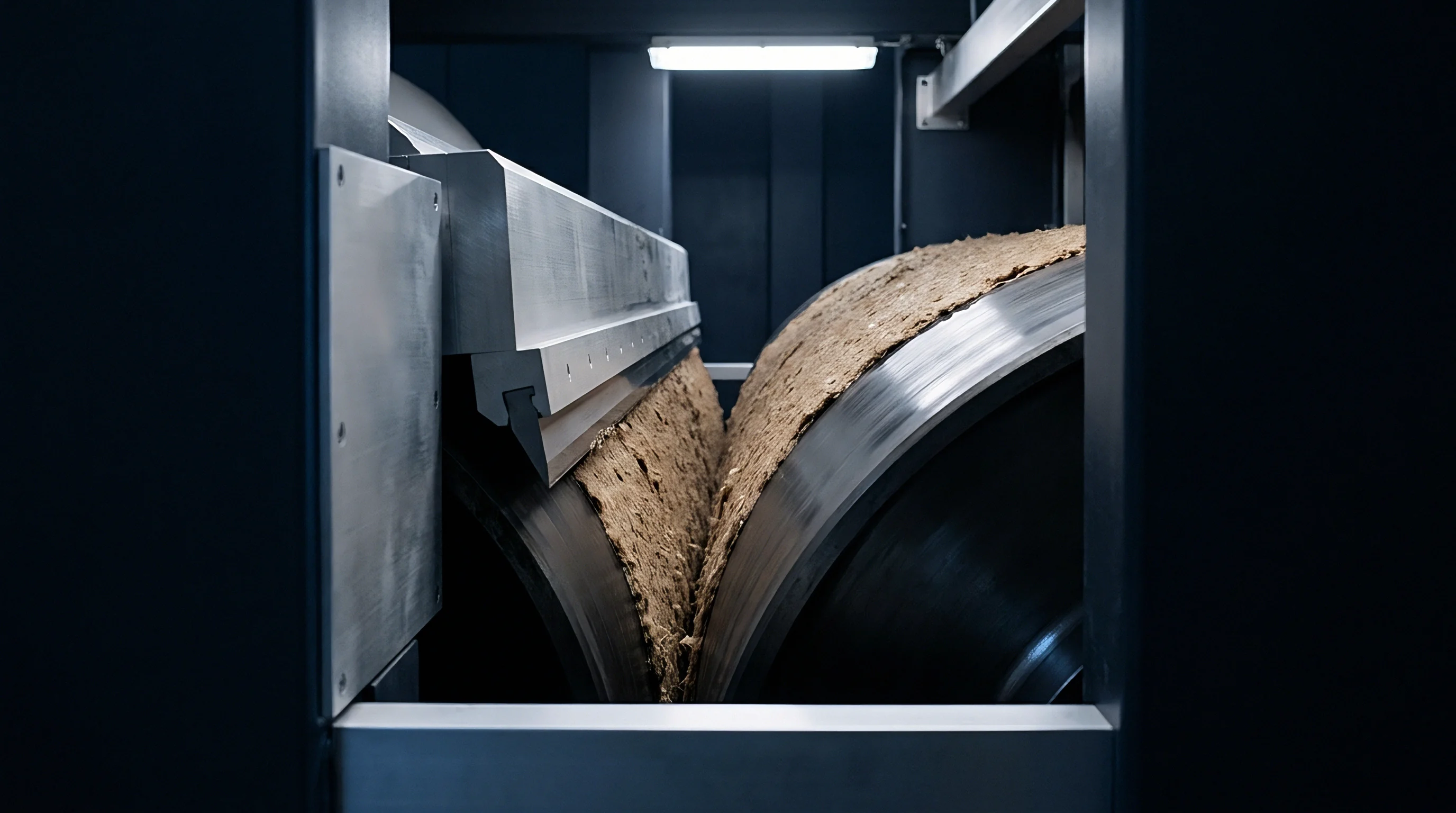
Hard-nip calenders smooth surface topography under high compressive stress. High-freeness mechanical stocks exhibit strong elastic recovery: coarse, stiff fiber lumens deform under nip pressure but spring back once they leave the nip.
Over-refining shifts that behavior toward permanent plastic deformation. Fibrillated, flexible fibers flatten irreversibly under the rolls, locking the board into a permanently denser state. While heavier refining yields a smooth surface at modest calender loads, it destroys the internal void volume that provides bending stiffness.
Table 2 outlines the interaction between calender line load, core freeness, and caliper recovery measured forty-eight hours post-manufacture under ISO 187 standard atmosphere.
| Calender Line Load (kN/m) | Middle Ply Freeness (mL CSF) | Initial Exit Thickness (µm) | Thickness Swell After 48h (µm) | Net Caliper Change (%) |
|---|---|---|---|---|
| 20 | 550 | 410 | +18 | +4.39 |
| 20 | 420 | 380 | +8 | +2.11 |
| 50 | 550 | 385 | +22 | +5.71 |
| 50 | 420 | 355 | +9 | +2.54 |
| 80 | 550 | 365 | +25 | +6.85 |
| 80 | 420 | 335 | +10 | +2.99 |
Hygroexpansivity and Post Pressing Thickness Decay
In unconditioned storage, moisture uptake redistributes internal stresses throughout multi-ply board. Mechanical fibers are hygroscopic because of residual lignin and accessible hemicelluloses; as humidity rises, water penetrates the cell walls and disrupts the hydrogen bonding network.
Unrefined fibers swell primarily across their diameter upon taking up moisture, translating directly into z-directional sheet expansion. Pulps refined to low freeness have denser inter-fiber bonding that constrains this thickness swelling, venting the strain instead as in-plane expansion and dimensional curl.
Quantifying hygroexpansive thickness changes in the laboratory relies on a strict conditioning cycle:
- Condition unprinted board samples at twenty-three degrees Celsius and fifty percent relative humidity for twenty-four hours in accordance with ISO 187.
- Record baseline thickness at ten marked points across the sheet using a dead-weight micrometer under ISO 534 specified foot pressure.
- Transfer the specimens to an environmental chamber held at eighty-five percent relative humidity and twenty-three degrees Celsius for forty-eight hours.
- Re-measure caliper at the same coordinates immediately upon removal to determine z-directional swelling.
Conditioning multi-ply board at twenty-three degrees Celsius and eighty-five percent relative humidity increases middle-ply caliper by four point two percent when freeness drops below four hundred Canadian Standard Freeness.
Preserving higher mechanical pulp freeness improves elastic springback out of the calender, helping board maintain its specified thickness through converter storage.
Sheet
Board rigidity depends fundamentally on separating the two outer tensile plies as far as possible. At constant ply moduli, bending stiffness increases with the third power of total thickness; middle-ply freeness controls this separation, determining the structural capacity of the finished packaging substrate.
Bending Stiffness Optimization via I Beam Architecture
Mechanically, boxboard functions like an I-beam: the outer plies handle tensile and compressive stresses, while the middle ply carries shear. Highly refined chemical pulp skins provide high elastic moduli, while the bulky mechanical core acts as a low-density spacer keeping them apart.
Minor shifts in core caliper lead to outsized changes in bending resistance. A five percent drop in core thickness cuts total board stiffness by around fourteen percent. When a machine increases refiner energy to address linting or dusting, the resulting core compaction can easily push finished stiffness below packaging specifications.
Composite stiffness formulas sum the contributions of each individual layer:
S_b = E_top I_top + E_core I_core + E_bottom I_bottom
Here S_b represents bending stiffness, E is elastic modulus, and I is the area moment of inertia of each ply about the sheet’s neutral axis. Maintaining high freeness preserves core thickness, maximizing I_core.
Scott Bond Integrity versus Bulk Maximization
Internal bond strength decides whether a board can endure high-tack offset inks and sharp creasing without delaminating. Measured under TAPPI T 569, Scott Bond evaluates the energy required to split the ply apart. Mechanical pulps above five hundred fifty milliliters CSF typically exhibit modest Scott Bond values because unrefined, intact fiber walls share few hydrogen bonds.
Refining increases specific surface area and generates fines that bond readily, driving up internal delamination resistance as freeness drops. Machine operators are left balancing two competing requirements: driving freeness up to maximize bulk and bending stiffness, or pulling it down to satisfy Scott Bond targets.
Lowering mechanical pulp freeness increases inter-fibre bonding at the cost of the internal ply thickness required for bending stiffness.
Moisture weakens these internal hydrogen bonds.
Worked Calculation Freeness Adjustment and Landed Caliper Shift
Consider a three hundred fifty gram per square meter folding boxboard run on a multi-fourdrinier machine. The furnish comprises seventy-five grams per square meter of bleached chemical pulp on the top, seventy-five grams per square meter of chemical pulp on the bottom, and a two hundred gram per square meter core of softwood chemi-thermo-mechanical pulp.
In Case A, middle-ply refiners run at a target freeness of five hundred fifty Canadian Standard Freeness, giving a core specific volume of two point fifteen cubic centimeters per gram. In Case B, refining energy is raised to suppress shives, pulling core freeness down to four hundred twenty Canadian Standard Freeness and compressing specific volume to one point eighty-two cubic centimeters per gram. The outer chemical layers remain at one point fifteen cubic centimeters per gram in both scenarios.
Calculating overall thickness for Case A:
Thickness_outer = (75 g/m² + 75 g/m²) 1.15 cm³/g = 172.5 µm
Thickness_core_A = 200 g/m² 2.15 cm³/g = 430.0 µm
Total_Thickness_A = 172.5 µm + 430.0 µm = 602.5 µm
Calculating overall thickness for Case B:
Thickness_core_B = 200 g/m² 1.82 cm³/g = 364.0 µm
Total_Thickness_B = 172.5 µm + 364.0 µm = 536.5 µm
Refining the middle ply strips sixty-six micrometers out of the sheet, a ten point ninety-five percent loss in total caliper. Applying the cubic thickness relationship to evaluate stiffness retention:
Stiffness_Ratio = (Total_Thickness_B / Total_Thickness_A)³ = (536.5 / 602.5)³ = (0.8904)³ = 0.7057
Case B preserves only seventy point fifty-seven percent of the bending stiffness seen in Case A ~ a twenty-nine point forty-three percent drop at the exact same basis weight of three hundred fifty grams per square meter. While Scott Bond rises from one hundred ten Joules per square meter in Case A to one hundred seventy-five Joules per square meter in Case B, the buyer ends up with board that resists surface delamination but crushes under box-compression loads.
Driving mechanical pulps to low freeness to secure internal bond strength often drops finished stiffness below packing-line tolerances, leading to carton jams and line stoppages.

Trade
Because paperboard is bought by the metric tonne but converted and sold by surface area, core freeness directly drives manufacturing economics. Packaging converters price cartons on area and mechanical performance; running high middle-ply freeness allows mills to hit specified calipers at lower grammages, cutting raw material mass per container.

Grammage Downgauging and Parent Sheet Yield
High-bulk middle plies enable significant basis weight downgauging at fixed caliper targets. A converter running three hundred fifty micrometer board, for example, can replace a three hundred thirty gram per square meter sheet made from low-freeness stock with a three hundred gram per square meter sheet produced at higher freeness.
The commercial leverage of maintaining high freeness shows up clearly in yield figures: dropping basis weight by ten percent at constant caliper yields eleven point eleven percent more surface area per purchased tonne of reel stock, directly trimming substrate cost per carton.
Table 3 summarizes the yield and landed cost trade-offs across different core freeness settings for a four hundred fifty micrometer target caliper.
| Middle Ply Freeness (mL CSF) | Required Basis Weight (g/m²) | Parent Sheet Yield (m²/tonne) | Landed Cost per 100,000 m² (EUR) | Scott Bond Pass Rate (%) |
|---|---|---|---|---|
| 580 | 305 | 3,278 | 396,500 | 88.5 |
| 520 | 320 | 3,125 | 416,000 | 96.2 |
| 450 | 340 | 2,941 | 442,000 | 99.5 |
| 380 | 365 | 2,739 | 474,500 | 100.0 |

Commercial Specifications and Contractual Terms
Supply agreements link thickness tolerances directly to acceptable freeness bands at the machine. Standard contracts specify basis weight in grams per square meter alongside caliper in micrometers under ISO 534. When a mill refines core pulp heavily to prevent dusting or picking, it will miss caliper minimums unless it compensates by adding dry fiber weight.
Procurement specifications should establish clear limits on cross-machine caliper variation alongside minimum z-directional bond strength. Specifying bending stiffness under ISO 2493 prevents mills from compensating for heavy refining or filler addition with extra mass.
Enforcing ISO 534 caliper tolerances below three percent obliges mills to cull reels affected by refiner freeness swings before delivery.