Transient Moisture Sorption Mechanics in Multi-Wall Corrugated Liners
Dynamic moisture sorption across multi-wall plies causes rapid mechano-sorptive collapse that static lab tests fail to predict during humid freight transit.
Ingress
Moisture sorption across multi-wall corrugated board plies operates far from thermodynamic equilibrium during international freight and refrigerated distribution. Atmospheric water vapor penetrates the exterior kraftliner, passes through the porous fibrous matrix and across the gelatinized starch adhesive boundary, and works into the fluting flutes and center liners over hours or days. Standard laboratory protocols evaluate corrugated structures only after prolonged equilibration at twenty-three degrees Celsius and fifty percent relative humidity.
Real supply chains impose abrupt ambient steps, such as transferring a pallet straight from a dry packing station into a cold-storage vault at ninety percent relative humidity. Moisture moves through fiber networks rapidly.
Transient moisture transport in paperboard couples vapor diffusion through inter-fiber pore spaces with bound-water diffusion within the hygroscopic hemicellulose and amorphous cellulose of the cell wall. While Fickian diffusion models assume a constant diffusion coefficient across sheet thickness, uptake curves for high-grammage virgin kraftliner demonstrate non-Fickian characteristics: an initial rapid surface adsorption followed by a protracted relaxation phase as swelling cellulose chains alter local pore geometry. Sizing agents like alkyl ketene dimer and alkenyl succinic anhydride retard liquid wetting, yet vapor-phase sorption proceeds through the fiber network unhindered by sizing chemistries.
A surface Cobb test conducted over sixty seconds measures liquid contact wetting without predicting twenty-four-hour vapor flux across internal plies.
In double-wall and triple-wall corrugated combinations, each distinct component layer exhibits its own sorption isotherm and transport resistance. Outer liners produced from unbleached softwood kraft furnish absorb moisture considerably faster than heavily refined, recycled semi-chemical fluting containing dense residual starch and mineral fillers. The sudden exposure of an outer face to elevated humidity establishes a steep moisture concentration gradient across the cross-section.
As water molecules plasticize the outer cellulose fibers, localized hygroexpansion induces differential transverse expansion between adjacent bonded components. The resulting hygro-mechanical strain field initiates internal shear stresses along the adhesive bond line before the center liner experiences any measurable change in moisture content.
| Component Grade | Grammage Basis | Furnish Type | Sorption Half-Time (50% to 85% RH) | Apparent Diffusion Coefficient |
|---|---|---|---|---|
| Virgin Kraftliner | 175 g/m² | Unbleached Softwood Kraft | 42 minutes | 2.1 × 10⁻¹¹ m²/s |
| High-Performance Fluting | 140 g/m² | Semi-Chemical Hardwood | 68 minutes | 1.4 × 10⁻¹¹ m²/s |
| Recycled Testliner 2 | 160 g/m² | Mixed Recovered Fiber | 54 minutes | 1.7 × 10⁻¹¹ m²/s |
| Heavyweight Kraftliner | 300 g/m² | Virgin Unbleached Kraft | 85 minutes | 1.1 × 10⁻¹¹ m²/s |
| Recycled Medium | 120 g/m² | De-inked Waste Furnish | 37 minutes | 2.6 × 10⁻¹¹ m²/s |
Transient diffusion coefficients depend directly on the direction of moisture flux. Adsorption steps produce slower equilibration times than desorption steps at identical moisture contents because structural relaxation within the amorphous cellulose lags behind the chemical binding of water molecules to free hydroxyl groups. In multi-wall constructions where fluting cavities act as stagnant air reservoirs, vapor transport across the internal void relies on molecular diffusion in air coupled with boundary-layer mass transfer coefficients at the paper-air interfaces.
When ambient relative humidity shifts from fifty to ninety percent, the exterior liner reaches eighty percent of its equilibrium moisture uptake within two hours, while the core liners within a triple-wall board remain near initial dry conditions for over twelve hours.
This lagging moisture wave within multi-wall board creates an acute mechanical imbalance across the cross-section. The exterior liner loses its elastic modulus as moisture content climbs from eight percent to fourteen percent dry basis, while sheltered inner plies retain their dry stiffness. Stacking loads applied during this transient window concentrate axial compressive stresses onto the drier, stiffer internal components.
The board collapses at total compressive loads substantially lower than predictions derived from fully conditioned equilibrium test data, terminating with brittle shear fractures along the dried core walls.
Ply
Structural behavior in multi-wall constructions hinges on the physical separation and differing sorption characteristics of individual sheet layers. A double-wall board incorporates five distinct paper layers: an outer liner, an outer fluting medium, a center liner, an inner fluting medium, and an inner liner. Each component responds to ambient humidity swings according to its furnish origin, degree of refining, fiber orientation, and chemical additive profile.
Secondary fibers recovered from mixed waste collections contain shorter fibrils, hornified cell walls, and higher ash content, decreasing their moisture uptake capacity at low relative humidity while increasing their sensitivity to dimensional distortion under high humidity swings.
Sorption disparities between plies create severe interlaminar stresses. When moisture enters an outer liner, that sheet expands along its cross-machine direction to a greater extent than the machine direction because fibers expand predominantly in diameter rather than length. The adjoining fluting tips, glued transversely across the liner, restrain this expansion.
The resulting shear stresses concentrate within the starch glue line and the immediate fiber-glue interface zone. Standard cornstarch adhesives, formulated with synthetic cross-linkers like ketone-aldehyde resins, resist liquid dissolution yet remain permeable to vapor diffusion, permitting moisture to soften the fiber-starch bond.
Chain-of-custody tracking systems under FSC and PEFC certifications define how fiber streams are documented across converting operations. While certification documentation tracks recycled percentages or virgin origin under transfer, credit, or percentage systems, it does not record physical sorption characteristics. A packaging specification referencing FSC Mix Credit guarantees administrative fiber accounting without specifying fiber hornification levels or swelling coefficients.
A buyer specifying an outer liner of virgin kraftliner and an internal testliner of post-consumer waste introduces an inherent sorption mismatch across the board profile.
- Hygro-expansion mismatch between adjacent paper plies induces localized out-of-plane curling, placing high peel stresses on fluting glue joints long before uniform humidity equilibrium occurs.
- Adhesive line softening occurs when moisture concentrates around hydrophilic starch bonds, reducing shear transfer between the fluting tips and the load-bearing liner faces.
- Fiber hornification variance between virgin kraftliner and heavily recycled testliner generates differential sorption rates, causing premature micro-buckling in the recycled plies under cyclic humidity.
- Coating barrier discontinuities on pre-printed outer liners channel vapor ingress exclusively through unsealed edge seams, intensifying local moisture gradients across perimeter folds.
Mineral fillers commonly present in recycled testliners, including calcium carbonate and kaolin clay, exhibit negligible water sorption compared to cellulose. Their presence reduces the dry-basis moisture uptake capacity of the sheet while weakening the inter-fiber bonding network. When recycled liners absorb water, the bound water disrupts the hydrogen bonds connecting short secondary fibers far more rapidly than in long-fibered virgin kraftliner.
The tensile and compressive strength of recycled medium deteriorates steeply during the first three percent increase in moisture content.
A high-performance chemical sizing treatment applied to an external liner imparts surface water repellency, but surface holdout does not balance moisture response across heterogeneous multi-wall plies or neutralize transient vapor sorption during ocean transport.

Chamber
Controlled environmental conditioning for corrugated packaging evaluation follows strict laboratory protocols such as ISO 187 or TAPPI T402, prescribing twenty-three degrees Celsius and fifty percent relative humidity. Test specimens hang freely inside conditioned rooms for twenty-four to forty-eight hours until mass equilibrium is reached, establishing a steady-state moisture content between seven and nine percent dry basis. Standard testing regimes verify material compliance against static specifications, missing the performance degradation caused by dynamic humidity cycling during transit.

Is Equilibrium Conditioning Sufficient for Dynamic Logistics?
Dynamic relative humidity cycling accelerates structural degradation through mechano-sorptive creep. Standard static conditioning ignores transport lags. Evaluating board resilience requires testing inside environmental chambers programmed for cyclic relative humidity regimes.
A typical cyclic test profile alternates relative humidity between fifty percent and ninety percent over twelve-hour cycles, replicating diurnal temperature and humidity swings within non-insulated intermodal shipping containers. Dynamic vapor sorption analyzers determine the precise mass flux of small specimens under continuous relative humidity ramps, exposing moisture uptake hysteresis loops between adsorption and desorption branches.
A board tested to TAPPI T811 after static conditioning retains twenty to thirty percent higher edgewise compressive strength than the identical board evaluated during an active sorption cycle.
To quantify transient effects on corrugated board, laboratory test sequences must isolate instantaneous moisture content from the rate of moisture change. ISO 535 Cobb testing measures the mass of water absorbed by a one-hundred-square-centimeter sample during liquid water exposure over thirty, sixty, or eighteen hundred seconds. The Cobb value demonstrates sizing efficiency against liquid droplet penetration, but bears zero correlation to vapor diffusion rates under high-humidity conditions.
Water vapor transmission rate evaluations conducted under ISO 2528 or ASTM E96 specify constant gradients across a flat barrier, failing to capture the bidirectional transient moisture flux occurring when multi-wall packaging traverses changing climatic zones.
| Conditioning Regime | Chamber Profile | Duration | Board Moisture Content | Edgewise Compression (ISO 3037) | Compressive Retention |
|---|---|---|---|---|---|
| Standard Static Baseline | 23°C / 50% RH constant | 48 hours | 8.2% dry basis | 8.4 kN/m | 100.0% |
| Elevated Static Saturated | 23°C / 90% RH constant | 48 hours | 15.8% dry basis | 4.9 kN/m | 58.3% |
| Transient Cycling (Cycle 1) | 50% to 90% RH ramp | 6 hours (during ramp) | 11.4% dry basis | 4.2 kN/m | 50.0% |
| Transient Cycling (Cycle 3) | 50% to 90% RH cyclic | 36 hours (at peak RH) | 15.2% dry basis | 3.6 kN/m | 42.8% |
| Transient Cycling (Cycle 5) | 50% to 90% RH cyclic | 60 hours (at peak RH) | 15.4% dry basis | 3.1 kN/m | 36.9% |
Laboratories testing multi-wall box performance under static protocols evaluate specimens removed from chambers and placed immediately on platen presses. An operator transferring a box from an environmental chamber into an ambient laboratory atmosphere triggers instantaneous surface desorption on the outer liners, altering the surface strain field within ninety seconds. Testing must occur inside the controlled chamber atmosphere or utilize sealed climate shrouds mounted directly onto testing frames to maintain valid transient boundary conditions during compression loading.
The core scientific dispute centers on whether transient sorption acceleration results purely from localized stress concentrations created by uneven moisture gradients, or whether cellulose microfibrils undergo molecular bond rearrangement during the active physical transit of water molecules through the cell wall matrix.

Fatigue
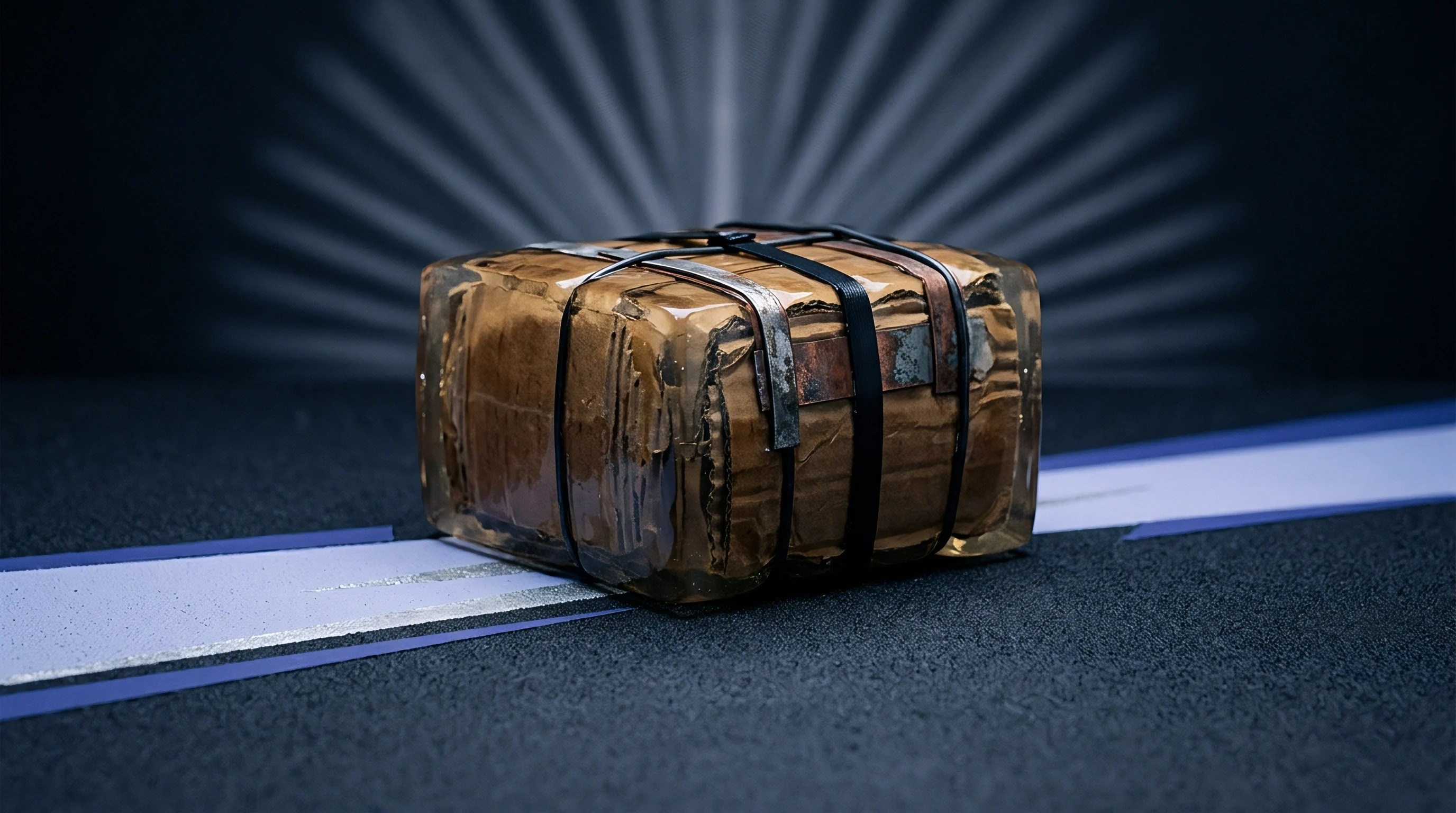
When paperboard supports a sustained mechanical load while simultaneously experiencing moisture flux, mechano-sorptive creep deformation proceeds at a rate significantly higher than the creep observed under any static moisture content within the cycling range. Outer plies experience alternating compression and tension as hygro-expansion strains superimpose upon external stacking stresses. The phenomenon undermines conventional structural calculations, leading to premature carton failure in commercial cold-chain operations.

Will Moisture Cycling Invalidate McKee Compressive Calculations?
Static engineering models predict box compression strength using the empirical McKee formula, which calculates ultimate stacking capacity from the edgewise compression test value, the total board thickness, and the box perimeter. The McKee equation assumes elastic, homogeneous behavior under steady-state environmental conditions. Relative humidity fluctuates during ocean transit.
Under cyclic humidity swings, the effective flexural stiffness and edgewise compression resistance decay continuously over time. Calculations derived from standard twenty-three-degree, fifty-percent laboratory data overestimate actual stacking life by a factor of three to five when dynamic moisture transitions occur.
Consider a typical commercial packaging run designed for produce transit. Assume a double-wall box constructed from a 200 g/m² kraftliner outer face, 140 g/m² semi-chemical flutings, a 150 g/m² recycled center liner, and a 175 g/m² kraftliner inner face, configured as a BC-flute combination with an overall thickness of 6.8 millimeters. Under standard conditioning, the board yields an edgewise compression value of 9.2 kilonewtons per meter.
With a perimeter of 1.6 meters, the standard McKee calculation predicts an initial top-to-bottom box compression strength of approximately 4,850 newtons.
Subjecting this container to five diurnal cycles between sixty and ninety percent relative humidity under an actual static pallet load of 1,200 newtons introduces intense mechano-sorptive fatigue. As moisture diffuses inward, the outer kraftliner expands transversely, while the compression load drives axial shortening. Cellulose fibrils within the fluting medium buckle locally at flute crests where stress concentrations intersect the adhesive meniscus.
Creep deflection accumulates during each sorption half-cycle. By the third cycle, permanent out-of-plane panel bowing exceeds four millimeters. Catastrophic buckling occurs during the moisture adsorption phase of the fourth cycle, dropping the ultimate compressive capacity below the static 1,200-newton burden.
- Furnish characterization step identifies the virgin versus recycled fiber ratios across each individual liner and fluting component to calculate baseline hygro-mechanical expansion coefficients.
- Diffusion boundary modeling maps the transient moisture front progression across exterior, center, and interior wall plies during expected distribution temperature and humidity shifts.
- Transient stiffness reduction adjustment recalculates localized flexural rigidity and edgewise compression properties for each individual ply at twelve-hour transit intervals.
- Mechano-sorptive creep factor integration applies an accelerated creep multiplier to account for alternating adsorption-desorption strain cycles under static pallet loads.
- Safety factor recalibration establishes the minimum top-to-bottom compressive rating required on the manufacturing floor to prevent box failure before delivery.
The structural decay follows clear mechanical progression. Microscopic examination of failed flutes reveals compressive shear lines angled at forty-five degrees across the fluting walls, distinct from the clean tensile tearing seen in overloaded dry corrugated board. Delamination occurs parallel to the neutral axis of the multi-wall panel because interlaminar shear stiffness drops faster than pure compressive strength.
As moisture plasticizes the hemicellulose matrix, fibers slide past one another under shear stress, preventing the multi-wall sandwich structure from acting as a unified composite beam.
A box engineered with a three-to-one static safety factor under steady-state conditions collapses when exposed to active humidity cycling under less than half its rated load.
Packaging designed purely around static edge crush criteria inevitably fails when exposed to the atmospheric fluctuations of real logistics corridors.
Recourse
Commercial disputes arising from collapsed corrugated pallets center on the gap between laboratory test reports and physical performance under real-world transit conditions. Importers and brand owners purchasing packaging manufactured in one regulatory jurisdiction and deployed in another face immediate commercial exposure when containers fail in transit. Freight forwarders reject collapsed pallet loads at port terminals, while customs agents detain shipments when distorted corrugated boxes breach pallet footprint tolerances or display structural degradation that endangers port handlers.
European packaging requirements under the Packaging and Packaging Waste Regulation mandate strict recyclability performance grades alongside restrictions on barrier coatings. Applying synthetic polyethylene extrusion coatings or wax laminations to outer kraftliners retards transient moisture ingress, but these treatments compromise the recyclability grading required for European market entry. Water-based barrier dispersions improve vapor resistance while maintaining theoretical repulpability under EN 13430, yet their resistance to transient sorption over multi-day shipping cycles varies widely depending on dispersion uniformity and pinhole formation during corrugated board conversion.
Customs officials verifying packaging conformity inspect physical declarations against technical dossiers. When an importer declares multi-wall boxes under specific customs classifications for recyclable paperboard packaging, the presence of undisclosed barrier polymers or uncertified laminates exposes the importer to misdeclaration penalties, retroactive duties, and shipment seizures. If boxes collapse during ocean transit due to unmodeled transient moisture sorption, cargo insurers investigate packaging compliance against carrier freight rules like the International Safe Transit Association standards or National Motor Freight Classification Item 222.
Insurers routinely deny damage claims when board specifications fail to meet minimum burst or edge-crush thresholds under actual ambient conditions.
| Regulatory or Scheme Gate | Applicable Instrument | Documentary Requirement | Direct Operational Exposure | Liability Bearer |
|---|---|---|---|---|
| EU Recyclability Performance | PPWR Annex II | Design for Recycling Assessment (EN 13430) | Packaging graded below Grade C faces market restrictions and eco-modulation fee surcharges | Importer of Record |
| Chain of Custody Claims | FSC-STD-40-004 / PEFC ST 2002 | Valid Certificate Code on Invoices and B/L | Unsupported sustainable packaging claims breach unfair commercial practices legislation | Brand Owner / Buyer |
| Carrier Freight Packaging | NMFC Item 222 / ISTA Series | Box Certificate Stamp with ECT / Burst Ratings | Cargo damage claims denied by maritime and road carriers following transit collapse | Shipper / Consignor |
| Border Phytosanitary Control | ISPM 15 / National Standards | Treatment Certificate for Structural Timbers | Pallets held at customs if moisture-softened board causes load leaning exceeding safety margins | Importer of Record |
Mitigating financial risk demands precise contractual allocation of moisture resistance responsibilities between packaging buyers, paper mills, and converters. Standard purchase orders specifying only static edgewise crush resistance or burst strength leave the packaging buyer completely exposed to moisture-induced field failures. Sourcing contracts must explicitly define environmental performance parameters, obligating converters to demonstrate board integrity under dynamic cyclic humidity testing matching the actual logistical corridor.
Supply agreements governing cross-border corrugated purchasing incorporate precise warranty clauses stipulating that delivered packaging retains sixty percent of its certified edgewise compressive strength when exposed to ninety percent relative humidity at twenty-five degrees Celsius for forty-eight hours under DIN 55437 test conditions, shifting the financial liability for collapsed cargo directly to the converter if physical laboratory audits confirm sub-standard fiber furnish or degraded adhesive integrity.