Mindlin Plate Corrections for Structural High Yield Core Deflection Analysis
Mindlin plate corrections eliminate deflection prediction errors in high-yield packaging cores by accounting for transverse shear deformation in low-density plies.

Shear
Paperboard structures engineered with low-density mechanical cores exhibit significant out-of-plane compliance under flexural loading. While thin solid panels resist bending effectively, multi-ply packaging board manufactured with Bleached Chemi-ThermoMechanical Pulp (BCTMP) or Stone Groundwood (SGW) central layers introduces an elastic mismatch between the outer face plies and the core. Classic Kirchhoff-Love plate theory assumes plane cross-sections remain normal to the neutral axis during bending, ignoring transverse shear strains.
That assumption introduces negligible error in solid bleached chemical boards, but in high-yield multi-ply grades, low core transverse shear modulus causes substantial shearing through the board thickness.
Calculating deflection in structural core panels with classical flexural equations underestimates panel displacement. Transverse shear deformation becomes the primary failure mechanism when the panel span-to-thickness ratio falls below 20:1. While high bulk reduces total sheet weight, it forces structural packaging engineers to apply Mindlin plate corrections that explicitly incorporate transverse shear compliance into deflection calculations.
High-yield cores gain substantial caliper per unit of basis weight, but their internal fiber matrix has far lower transverse shear rigidity than high-density chemical pulps.
| Span Ratio (L/h) | Kirchhoff Deflection (mm) | Mindlin Deflection (mm) | Shear Deflection Contribution (%) | Error in Kirchhoff Model (%) |
|---|---|---|---|---|
| 40:1 | 0.125 | 0.131 | 4.58 | 4.58 |
| 25:1 | 0.320 | 0.358 | 10.61 | 10.61 |
| 15:1 | 0.888 | 1.140 | 22.10 | 22.10 |
| 10:1 | 2.000 | 3.050 | 34.42 | 34.42 |
| 8:1 | 3.125 | 5.208 | 40.00 | 40.00 |
Under short structural spans, kraft face plies carry flexural tension while core fibers undergo transverse displacement. When short spans experience concentrated sidewall loads or vertical stacking forces, shear compliance in the high-yield core ply accounts for over 40 percent of measured total deflection. Failing to model this shear behavior leads to unexpected wall bulging in filled folding cartons, misaligned creasing scores during automated cartoning, and unpredicted box compression loss in high-humidity transit environments.
Ignoring the transverse elastic contribution during box compression modeling leads to premature package collapse under warehouse stacking loads.

Formulation
Mathematical modeling of shear-deformable core plates relies on displacement fields that separate pure bending rotation from transverse rotation angles. The Mindlin-Reissner formulation treats flexural rigidity and transverse shear rigidity as uncoupled elastic parameters operating simultaneously. Flexural rigidity depends on the elastic modulus of individual plies and their distance from the mid-plane, whereas transverse shear rigidity stems from the out-of-plane shear modulus of the core furnish and total board thickness.
Mindlin Governing Equations for Anisotropic Cores
The displacement field for a Mindlin plate combines mid-surface displacements with rotations of the normal section about the coordinate axes, so total vertical deflection is the direct sum of bending and shear components. Under a uniformly distributed load, the governing equation pairs the flexural rigidity constant with a shear compliance operator. A shear correction factor adjusts for the non-uniform distribution of transverse shear stresses across the multi-ply cross-section.
Homogeneous isotropic plates use a shear correction factor of 5/6 (0.833), but multi-ply boards with soft, high-bulk cores require a modified calculation. Integrating transverse shear stresses across layer interfaces shows that the effective shear correction factor for a high-yield BCTMP core panel ranges between 0.52 and 0.68. Because the central ply has a low shear modulus, shear stresses remain largely confined within the core boundary, accelerating transverse angular displacement relative to the outer chemical pulp plies.
Thick core substrates with low internal shear rigidity deform along transverse plane boundaries before the outer kraft plies reach their maximum tensile stress limit.

Worked Analysis of Core Deflection Amplification
Consider a 600 gsm structural sandwich paperboard panel specified with an overall caliper of 0.80 mm (0.0008 m). Outer bleached kraft face plies are 0.10 mm thick with an elastic modulus of 7500 MPa. The central high-yield BCTMP core ply is 0.60 mm thick with a transverse shear modulus of 22 MPa.
Under a four-point bending load across a 12 mm span, establishing a span-to-thickness ratio of 15:1, bending rigidity calculates to 1.15 N m.
Pure flexural calculation via Kirchhoff plate theory yields a predicted bending displacement of 0.42 mm under peak test loading. Applying the Mindlin correction formula requires the transverse shear stiffness coefficient ~ the product of the shear correction factor (0.60), the core shear modulus (22 MPa), and the board thickness (0.80 mm) ~ which equals 10.56 kN/m. Adding the shear deflection component of 0.18 mm brings total Mindlin deflection to 0.60 mm.
The classic Kirchhoff formulation omits 30 percent of total panel deflection under these geometry parameters.
Whether non-linear viscoelastic creep in moist mechanical pulps dynamically degrades the shear correction factor over multi-month storage cycles remains an open question in structural packaging research.

Furnish
Fiber morphology and mechanical pulping methods govern the transverse shear performance of thick interior paperboard layers. Fiber length distribution, degree of refining, and lignin retention dictate core bulk and out-of-plane mechanical properties. Because mechanical pulping retains nearly all raw wood lignin, it produces stiff, unrefined fiber bundles that resist consolidation during pressing and drying, directly altering core density and transverse compliance.

What Causes Transverse Shear Deficit in High Yield Cores?
High-yield mechanical pulps, including BCTMP, Stone Groundwood, and Neutral Sulfite Semi-Chemical (NSSC) stocks, create bulky sheet structures with densities typically between 0.45 and 0.65 g/cm³. While high bulk maximizes the section moment of inertia, it reduces inter-fiber hydrogen bonding per unit volume in the core. Transverse shear load transfer depends entirely on bond density and internal fiber orientation, so weak bonding in bulky cores yields low out-of-plane shear moduli (G13 and G23) and leaves the middle layer vulnerable to shear deformation under flexural stress.
Exposing high-yield core structures to elevated relative humidity weakens inter-fiber bonding networks and rapidly lowers internal shear rigidity. Lignin-rich mechanical fibers absorb moisture faster than bleached chemical fibers, causing cell wall swelling and matrix softening. While standard conditioning at 23 °C and 50 percent relative humidity establishes baseline performance metrics under ISO 187, shifting ambient conditions to 23 °C and 85 percent relative humidity degrades the core transverse shear modulus significantly.
Conditioning high-yield mechanical core plies at 23 degrees Celsius and 85 percent relative humidity under ISO 187 reduces transverse shear modulus by up to 42 percent compared to standard 50 percent relative humidity test environments.
Material failure within structural core boards subjected to excessive flexural shear forces manifests through distinct physical breakdown modes across converting and storage stages:
- Core Delamination occurs when peak transverse shear stresses exceed the internal bond strength of unrefined mechanical fibers during panel creasing.
- Fluting Collapse occurs under concentrated side-wall loads where low-density BCTMP fibers fail to maintain core thickness under transverse shear forces.
- Creep Buckling develops during long-term warehouse stacking when ambient moisture degrades the inter-fiber hydrogen bond network within the mechanical pulp matrix.
Minor transverse stiffness deficits are often treated as normal production variances when bulk and surface smoothness metrics meet contract target specifications.


Audit
Quality control on incoming paperboard stock verifies whether structural core parameters match published mill specifications. Standard mill certificates quote two-point bending resistance measured over a single 50 mm span, which isolates pure bending stiffness while hiding transverse shear compliance deficits. Specialized test methods are needed to isolate the core shear modulus, since small lab swatches rarely match real pallet performance.
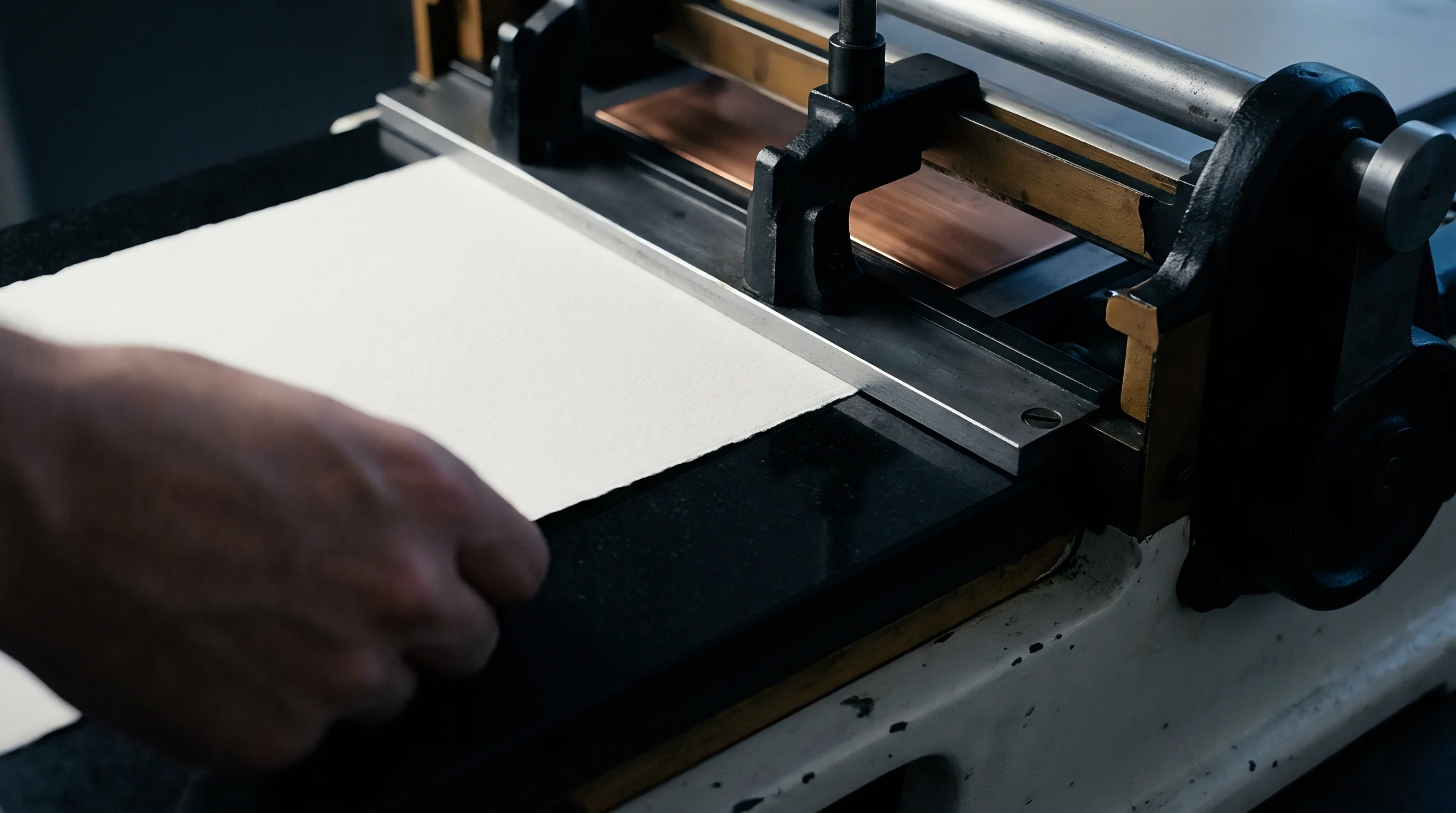
Bench Shear Stiffness Measurement Protocols
Determining internal core shear compliance requires multi-span bending procedures under ISO 5628 or variable-span resonance methods detailed in TAPPI T 820. Evaluating flexural stiffness across multiple span lengths separates pure bending rigidity from transverse shear stiffness. Plotting total measured compliance against the inverse square of span length yields a linear regression where the slope defines bending rigidity and the vertical axis intercept gives transverse shear compliance.
| Test Method | Standard Designation | Conditioning Parameter | Measured Metric | Acceptance Band |
|---|---|---|---|---|
| Multi-Span Bending | ISO 5628 / DIN 53121 | 23 °C, 50% RH (ISO 187) | Transverse Shear Stiffness (Sxz) | Target +/- 7.5% |
| Plate Resonance | TAPPI T 820 / SCAN-P 64 | 23 °C, 50% RH (ISO 187) | Out-of-Plane Shear Modulus (Gxz) | Minimum 18 MPa |
| Internal Bond Strength | ISO 16260 / TAPPI T 569 | 23 °C, 50% RH (ISO 187) | Z-Direction Tensile Energy | Minimum 150 J/m² |
| Humidified Creep Shear | ISO 22435 / TAPPI T 843 | 23 °C, 85% RH (Modified) | Humid Shear Retention Factor | Minimum 0.60 ratio |
Goods-in verification of structural paperboard shipments requires systematic sampling across master reels before packaging materials enter converting lines.
- Extract ten test specimens across the roll width, maintaining strict alignment with machine and cross directions according to ISO 186 sampling procedures.
- Condition all test pieces at 23 degrees Celsius and 50 percent relative humidity for 24 hours pursuant to ISO 187.
- Perform four-point bending tests across three distinct span lengths to decouple bending stiffness from transverse shear compliance.
- Calculate core shear modulus by plotting total deflection against inverse square span ratios and extracting the intercept.
Failure to specify minimum core transverse shear stiffness under ISO 5628 section 6 allows suppliers to fulfill orders using high-bulk mechanical pulps that collapse under short-span bending loads.
Incorporating mandatory ISO 5628 core shear compliance thresholds into raw material supply contracts allows buyers to reject paperboard lots that display excessive transverse deflection.


Economics
Commercial specification of packaging board requires balancing substrate caliper, pulp furnish costs, and structural panel performance, since material yield dictates landed pack cost. High-yield BCTMP cores allow mills to deliver high-caliper boards at lower basis weights, reducing the tonnage needed to achieve target flexural stiffness. While trim waste and shear compliance affect unit cost and box strength, aggressive core downgauging without Mindlin deflection analysis introduces severe commercial risks.

Financial Yields of High-Bulk Core Downgauging
Replacing solid bleached sulfate (SBS) board made from 100 percent chemical pulp with multi-ply folding boxboard (FBB) containing a 60 percent BCTMP core provides substantial basis weight reductions. Achieving a target bending stiffness of 15.0 mNm in the machine direction requires a 380 gsm SBS board at 0.44 mm caliper. The same bending stiffness is achieved by a 300 gsm FBB board at 0.52 mm caliper owing to the higher bulk of its mechanical core, reducing raw material tonnage purchases by 21 percent per unit surface area.
| Furnish Configuration | Basis Weight (gsm) | Caliper (mm) | Core Gxz (MPa) | Mindlin Deflection (mm) | Board Cost ($/tonne) | Landed Cost ($/1000 m²) |
|---|---|---|---|---|---|---|
| 100% Solid Bleached Kraft (SBS) | 380 | 0.44 | 65 | 0.31 | 1450 | 551.00 |
| Multi-Ply Standard FBB (50% BCTMP) | 320 | 0.49 | 28 | 0.44 | 1220 | 390.40 |
| High-Bulk Ultra-Light FBB (70% BCTMP) | 280 | 0.54 | 16 | 0.68 | 1180 | 330.40 |
When short structural panel spans govern package design, the High-Bulk Ultra-Light FBB option exhibits excessive Mindlin shear deflection despite meeting long-span flexural stiffness claims. Carton sidewalls bulge, leading to structural failure during high-density pallet stacking. Correcting box collapse by increasing caliper on the high-bulk FBB line offsets initial tonnage savings, making it essential to balance unit substrate costs against transverse load requirements.
The financial advantage of low-grammage mechanical pulp cores evaporates when unrecognized core shear deflection forces converters to increase board caliper to pass package stacking audits.
Packaging buyers evaluating core substitution proposals execute structural qualification procedures before committing tonnage orders:
- Span Ratio Thresholds defined by package geometry dictate whether Mindlin shear corrections govern structural core thickness selection.
- Moisture Exposure Profile across transport supply chains establishes the maximum acceptable mechanical pulp fraction inside the interior core ply.
- Freight Tonnage Savings evaluated against potential converting spoilage determine the net landed financial yield per thousand finished cartons.
Specifying paperboard caliper without verifying internal core shear stiffness pays for lost structural yield across every pallet shipped.