Paperboard Middle Ply Mechanical Furnish Characterization Methods
Middle ply mechanical furnish generates bending stiffness by maximizing caliper and bulk while balancing z-directional bond strength against score crack risks.


Caliper
Bending stiffness in multi-ply folding boxboard follows the cubic expansion of sheet thickness. The outer plies, typically composed of bleached chemical kraft pulp refined to low freeness, carry tensile and compressive stresses during bending. The middle ply exists primarily to space those stiff outer skins apart.
Mechanical furnish placed in the sheet core maximizes structural volume at the lowest grammage penalty. Groundwood, thermomechanical pulp, and bleached chemi-thermomechanical pulp supply this spacing because their stiff, uncollapsed fibres resist wet pressing consolidation.
Freeness Testing Protocols and Pad Density
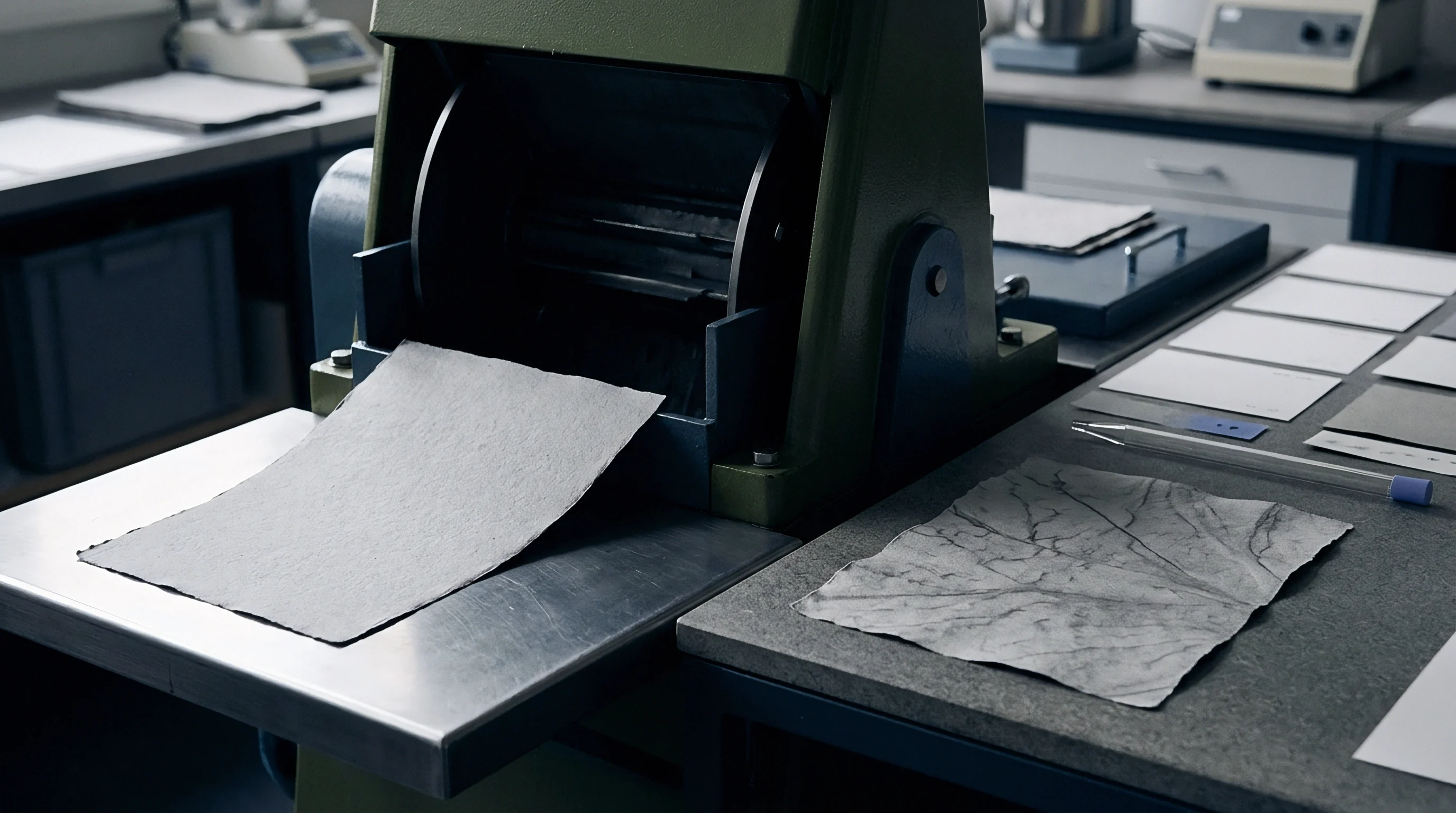
Drainage evaluation provides the earliest bench indicator of mechanical furnish performance on the forming fabric. Mills measure this drainage through Canadian Standard Freeness under ISO 5267-2 or Schopper-Riegler degree under ISO 5267-1. High freeness values correlate directly with bulky, open web structures.
Canadian Standard Freeness measurements between 350 ml and 550 ml yield bulk values exceeding 1.80 cm³/g in bleached chemi-thermomechanical pulp after press consolidation. Lower freeness pulp, refined down to 150 ml, drops bulk toward 1.45 cm³/g while increasing inter-fibre contact areas.
Drainage rate governs drainage box vacuum settings and table activity. Fast draining stocks leave the forming wire at elevated dryness. Water removal mechanisms differ fundamentally across mechanical furnish grades, as detailed below.
| Furnish Grade | Refining Yield (%) | CSF Freeness (ml) | Sheet Bulk (cm³/g) | Density (kg/m³) |
|---|---|---|---|---|
| Stone Groundwood (SGW) | 97.5 | 90 to 120 | 1.45 to 1.60 | 625 to 690 |
| Pressurized Groundwood (PGW) | 96.8 | 110 to 140 | 1.55 to 1.70 | 588 to 645 |
| Thermomechanical Pulp (TMP) | 95.2 | 180 to 240 | 1.75 to 1.95 | 512 to 571 |
| Bleached Chemi-Thermomechanical (BCTMP) Aspen | 90.5 | 350 to 450 | 1.90 to 2.20 | 454 to 526 |
| Bleached Chemi-Thermomechanical (BCTMP) Spruce | 91.0 | 420 to 520 | 2.10 to 2.45 | 408 to 476 |
Handsheet forming under ISO 5269-1 establishes the baseline furnish volume without wire dewatering shear. Laboratory sheets conditioned at 23 °C and 50 percent relative humidity under ISO 187 yield reference density curves. Discrepancies between laboratory handsheet bulk and fourdrinier board core density stem from dynamic wet suction boxes and extended nip shoe presses.
Core dewatering pressure above 600 kPa collapses tubular spruce tracheids. Thin-walled aspen vessels withstand that nip force poorly.
A delivered board lot losing four percent target thickness forfeits eleven percent of its design bending resistance.
Grammage measurement under ISO 536 isolates whether thickness loss stems from furnish loss or mechanical compaction. Caliper evaluation under ISO 534 applies 100 kPa static dead-weight pressure across a ten-second dwell. Fast online gauging sensors using nuclear absorption and magnetic reluctance drift during machine speed ramps.
Offline micrometer validation remains decisive when checking yield across delivered reels. Furnish blends dropping below target spacing increase converter waste during carton erect cycles, leading to high carton ejection counts on packaging lines.
Shive
Coarse fibre bundles impair surface smoothness and break local structural continuity when present in excess. Mechanical pulping processes separate wood tracheids mechanically through shearing bars or grindstones. Incomplete separation leaves bundles consisting of multiple bonded fibres.
Technicians designate these unseparated bundles as shives. Unrefined bundles lower internal bond strength and produce prominent sheet blemishes when migrating into intermediate ply positions adjacent to bleached chemical surface plies.

Fractionation through Physical Screens
Laboratory classification isolates furnish components by particle length and thickness. Somerville slotted screening under TAPPI T 275 separates debris through precision 0.15 mm cut slots. The mass fraction retained on the screen plate defines the shive content.
High-grade folding boxboard cores require Somerville values below 0.08 percent. Higher levels create density voids within the middle ply layer. Bauer-McNett classification under TAPPI T 233 or ISO 5635 separates the unbundled furnish across woven wire meshes.
The mesh sequence distributes pulp across distinct morphological tiers:
- R14 fraction isolates long, intact softwood fibres alongside coarse shives that generate web porosity.
- R28 fraction contains mature tracheids providing the elastic backbone for transverse structural stiffness.
- R48 fraction holds short fibres and broken cell walls contributing to sheet formation density.
- R100 fraction gathers fibrillar debris that bridges empty voids between stiff springwood tubes.
- P100 fraction collects fine particles and parenchyma cells that govern water retention values.
Fibre length distributions measured via automated optical image analysis follow ISO 16065-1. Instruments flow dilute pulp suspensions through a narrow quartz flow cell illuminated by polarized light sources. Digital cameras capture projected fibre lengths, width profiles, curl factors, and kink angles.
Mean length-weighted values quantify furnish integrity without bias from dust particles. Aspen BCTMP presents average lengths between 0.85 mm and 1.10 mm. Norway spruce TMP exhibits length-weighted values spanning 1.80 mm to 2.40 mm.
Somerville shive content exceeding 0.12 percent under TAPPI T 275 initiates micro-cracking across fold hinges.

Morphology Controls and Optical Classification
Optical analyzers classify particles using perimeter-to-area aspect ratios. Rigid shives exhibit aspect ratios below 4.0 alongside mean widths exceeding 65 micrometers. Fines fractions comprise particles passing through a 200-mesh screen or displaying lengths below 0.20 mm.
Secondary fines produced during chemical impregnation and high-consistency refining consist of delaminated fibrillar ribbons. Primary fines derived from ray cells and middle lamella debris lack fibrillar bonding potential. High primary fines fractions reduce drainage speed without contributing mechanical bond energy.
Curl index values dictate furnish packing efficiency during consolidation. Uncurled, straight mechanical fibres generate open networks with superior bulk. Refiner mechanical pulping creates curled fibres that straighten when treated in hot disintegration units at 85 °C under ISO 5263-3.
Failure to perform latency removal falsifies bench freeness by up to 100 ml CSF. Mill representatives frequently attribute sheet stiffness drops to seasonal wood decay, claiming delivered spruce logs contained abnormal juvenile heartwood ratios that resisted standard refiner bar action.

Cleavage
Internal bond strength determines whether multi-ply board withstands the blistering stresses of offset printing and rotary creasing. High bulk in the middle ply counteracts fibre-to-fibre cohesion. Lignin-rich mechanical fibres present stiff, smooth surfaces that form fewer hydrogen bonds than bleached kraft fibres.
Mills incorporate starch or functional synthetic polymers into the middle ply furnish to balance bulk preservation with internal cohesion. Without chemical promoters, low-density mechanical cores split under transverse stress.
Where Falls the Shear Plane under Dynamic Tension?
Delamination initiates within the weakest structural plane when board negotiates high-tack ink split forces. In triplex folding boxboards, failure occurs either directly inside the mechanical core or along the boundary between the mechanical core and the chemical liner. The Scott Internal Bond test under ISO 16264 or TAPPI T 569 measures the energy absorbed during rapid dynamic delamination.
A pendulum hammer strikes an angle bracket adhered to the board specimen with double-sided tape. Striking velocities exceed 2.0 m/s. The scale records absorbed energy in Joules per square metre.
| Core Furnish Configuration | Sheet Basis Weight (g/m²) | Core Density (kg/m³) | Scott Bond (J/m²) | Z-Tensile (kPa) |
|---|---|---|---|---|
| 100% Aspen BCTMP, unrefined | 280 | 460 | 115 to 130 | 240 to 280 |
| 80% Aspen BCTMP + 20% Hardwood Kraft | 280 | 510 | 145 to 165 | 310 to 350 |
| 100% Spruce TMP, latency removed | 280 | 525 | 140 to 160 | 290 to 330 |
| 70% Spruce SGW + 30% Deinked Pulp | 300 | 620 | 110 to 125 | 220 to 260 |
| 100% Aspen BCTMP + 1.2% Cationic Starch | 280 | 475 | 160 to 185 | 340 to 385 |
Static z-directional tensile strength under ISO 15754 applies uniform perpendicular tension across annular platen grips. Pull speeds run at 12 mm/min. Static testing eliminates kinetic pendulum losses, revealing genuine adhesive bond limits.
Scott bond energy and z-directional tensile show diverging trends when furnish compressibility shifts. Soft, springy mechanical cores absorb pendulum impact energy through internal elastic deformation, yielding elevated Scott bond numbers while exhibiting low static tensile strength.
Internal cohesion in multi-ply board demands a minimum z-directional tensile threshold of 280 kPa under ISO 15754.
Adhesive tape selection governs bench test reproducibility. Standard acrylic transfer adhesives fail when testing porous BCTMP cores, peeling prematurely from outer plies during pendulum impact. Technicians specify high-tack rubber adhesives under strict clamping pressures of 1.4 MPa for three seconds.
Incomplete tape anchorage registers artificially low cleavage resistance. Mill specification contracts state that board showing Scott Bond values below 135 J/m² on delivered reels triggers immediate lot quarantine, regardless of surface smoothness or visual defect scores.

Crease
Boxboard blanks convert into functional cartons through scoring, folding, and gluing operations. The middle ply mechanical furnish dictates how cleanly the board deforms along male-to-female creasing rules. A successful score forms an internal delamination pocket within the mechanical core while keeping the outer chemical liners intact.
The stiff, unbonded nature of mechanical fibres allows controlled internal micro-buckling. If the core furnish is overly bonded, shear forces propagate outward, cracking the printed chemical liner. If the core furnish is overly weak, the crease shears completely through.
Die Mechanics and Delamination Windows
Creasing rule width, female channel width, and penetration depth establish the deformation severity. Caliper governs tool geometry selection. The channel width must equal sheet thickness multiplied by 1.5, added to the rule thickness.
Scoring presses push the rule into the board, creating severe shear zones between the plies. Good creasability manifests as a defined internal delamination bubble across the mechanical middle layer. The board hinges with minimal resistance, preventing package bowing.
- Platen clearance verification sets anvil alignment within 0.01 mm across the cutting table.
- Channel matrix insertion fixes female crease geometry against rule centerline coordinates.
- Stroke penetration calibration drives the rule to eighty percent of total sheet thickness.
- Blank extraction inspection isolates crease cross-sections under ten-times optical magnification.
- Torque resistance measurement records bending moment profiles across ninety-degree fold movements.
Crease recovery evaluation under DIN 55437 measures the spring-back force of folded carton blanks. Testers clamp the scored specimen, fold it to ninety degrees, and record the counter-acting force over a fifteen-second period. Low recovery force indicates clean core breakdown.
BCTMP cores provide superior score retention because their high-yield fibres buckle internally without losing transverse wall alignment. SGW furnish creates brittle fold lines that snap abruptly under rotary gluers running at 400 metres per minute.
Should Converters Reject Caliper Gain from Unrefined Shives?
Unrefined mechanical fibres expand aggressively when exposed to humidity shifts during storage. Ambient moisture plasticizes remaining core lignin, reducing the residual elasticity of the score line. Converting lines running blanks with fluctuating moisture encounter frequent carton jams.
High freeness pulps contain intact vessel elements that resist score bending. The crease rolls unevenly along the score path.
| Board Caliper (µm) | Rule Width (mm) | Channel Width (mm) | Crease Moment (mN·m) | Fold Crack Threshold |
|---|---|---|---|---|
| 350 (Aspen BCTMP Core) | 0.71 | 1.25 | 18.5 | No surface split |
| 450 (Aspen BCTMP Core) | 1.05 | 1.75 | 32.0 | No surface split |
| 450 (SGW Core) | 1.05 | 1.75 | 46.5 | Tension liner fissure |
| 550 (Spruce TMP Core) | 1.42 | 2.25 | 58.0 | Micro-crack along bead |
| 600 (Recycled Mechanical Core) | 1.42 | 2.35 | 68.5 | Complete liner burst |
Scoring characteristics vary substantially between machine direction and cross direction. Cross-direction folds place high tensile strain across long softwood tracheids. Machine-direction creases stress the inter-fibre bond interfaces.
Mechanical core furnishes must balance long softwood fibres for tear prevention with short hardwood vessels for formation uniformity. Creases showing ragged edges indicate uneven core density profiles. Board with balanced core furnish maintains clean fold profiles regardless of grain direction relative to the packaging knife.
Lignin
Lignin preservation accounts for the high yield and physical resilience of mechanical furnish. Pulp yields exceed ninety percent of the original log mass because lignin remains in the fibre walls. This chemical constituent imparts hydrophobic stiffness and compression strength to the sheet core.
Chemical pulping removes lignin to enable high conformability and bonding. Mechanical processes retain lignin, ensuring fibres remain hollow, rigid cylinders that refuse to flatten during calendar nip consolidation.
Sulfonation Chemistry and Residual Extractives
Chemi-thermomechanical pulping treats wood chips with sodium sulfite under elevated temperature prior to atmospheric or pressurized refining. Sulfonation introduces polar sulfonic acid groups onto the lignin polymer matrix. This chemical modification softens the lignin glass transition temperature from 135 °C down to roughly 75 °C. Softening permits fibre separation within the middle lamella without shattering tracheid walls.
Sulfonate content determines the balance between bulk generation and bonding strength. Technicians quantify sulfonation through conductometric titration under ISO 6974:
- Low sulfonation pulp retains hydrophobic lignin, maintaining maximum dry bulk and rigidity.
- Medium sulfonation pulp generates balanced middle plies with moderate z-directional tensile strength.
- High sulfonation pulp behaves similarly to semi-chemical stock, trading caliper for surface cohesion.
High residual lignin concentrations provoke rapid brightness reversion when exposed to ultraviolet radiation or atmospheric oxygen. Folding boxboard cores shielded by thick chemical pulp surface plies avoid optical fading. Lignin reactions remain problematic in food packaging due to off-flavor migration.
Unsaturated fatty acids, resin acids, and terpene extractives contained in spruce and pine heartwood oxidize into volatile aldehydes and ketones. Hexanal generation imparts rancid notes to chocolate, butter, and confectionery products packed inside virgin board cartons.
Sensory analysis under the Robinson test specified in ISO 13302 identifies taint potential. Food simulant chocolate buttons or water samples sit adjacent to board specimens in sealed glass chambers for forty-eight hours at 23 °C. Human sensory panels grade taste impairment from zero, indicating no perceptible difference, to four, indicating strong off-flavor. Bleached chemi-thermomechanical pulps destined for food contact undergo hydrogen peroxide washing and thorough steam stripping to lower extractives below 0.15 percent under ISO 624.
Chemical extractive testing through gas chromatography coupled with mass spectrometry identifies volatile oxidation compounds before stock reaches the board machine headbox. Solvents like acetone or hexane extract non-polar wood resin fractions. High extractive loads impair internal sizing agents like alkyl ketene dimer or alkenyl succinic anhydride added to middle ply stock.
Unsized cores absorb edge moisture during refrigerated storage, initiating core collapse and carton deformation.
The economic equation behind multi-ply board hinges on this chemical balance. Virgin chemical kraft pulp commands significant price premiums over BCTMP furnish. Replacing chemical pulp with bulky mechanical furnish lowers board grammage by up to twenty percent while maintaining identical bending resistance.
A package designer specifying a 350 g/m² solid bleached sulphate board achieves equivalent bending resistance with a 290 g/m² folding boxboard containing an aspen BCTMP core. The yield advantage translates directly into lower freight tonnage and reduced environmental fees per million cartons produced.
Testing laboratories continue to debate whether conductometric titration measures all internal sulfonic acid sites or merely the exposed surfaces of swollen cell walls, leaving buyers to balance pulp supplier chemical data against physical bulk retention on the converting line.