Thickness Reduction
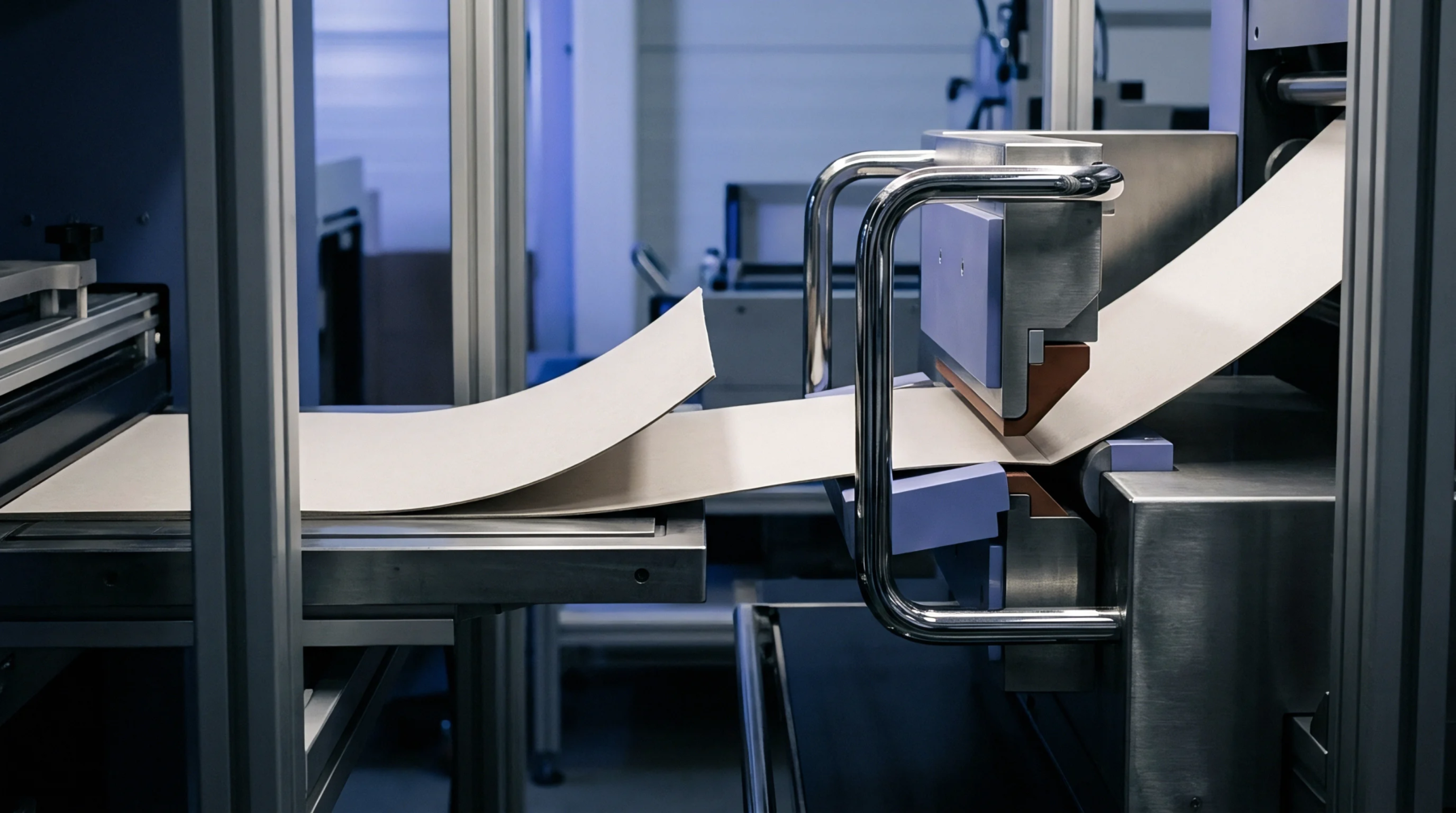
Mechanical strain describes the fractional loss of sheet thickness that occurs when paper or paperboard passes through a pressurized nip. Under the mechanical loads exerted by offset blanket cylinders, gravure impression rollers, or flexographic plate sleeves, caliper compression reduces the cross-sectional bulk of the sheet through structural rearrangement and consolidation of the void spaces between fibres. This dimensional change remains predominantly elastic across fleeting transit durations, though high compressive stresses exceeding the yield threshold of the fibre network introduce permanent plastic deformation.
Sourcing specifications track this response because the loss of thickness alters the actual rolling radius of the cylinder, displaces impression pressure targets, and directly alters density.
Deformation Behaviour
Compressibility varies sharply between rigid bleached chemical pulps and porous mechanical stocks. Mechanical furnish retains substantial air volume between stiff, lignin-rich fibres, yielding a springy web that compresses readily under load and rebounds quickly upon leaving the nip zone. Chemical pulps, by contrast, possess dense, bonded matrices that offer immediate resistance to deformation, requiring higher nip forces to achieve comparable contact area.
Calendering operations performed during mill production intentionally drive out internal air voids, leaving finished art papers with low residual capacity for caliper compression relative to uncalendered folding boxboards. When moisture content rises above standard equilibrium targets, the glass transition temperature of hemicellulose drops, softening the fibre network and accelerating both reversible compaction and unrecoverable crush.
Converting Impact
Excessive sheet compaction during printing flattens the porous surface structure required for regular ink absorption, driving ink outwards into halo patterns along image edges. When folding boxboard exhibits uneven caliper compression across the width of the web, the differential thickness changes yield inconsistent creasing depths, cracked linerboards, and skewed carton squaring on high-speed folder-gluers. Residual thickness following impression establishes the ultimate stacking strength of corrugated shippers and solid board cartons.