Recycled Paperboard Flexural Stiffness Loss Mechanisms
Recycled paperboard loses flexural stiffness through fiber hornification and caliper collapse, demanding strict cubic-thickness specification over basis weight.
Swell
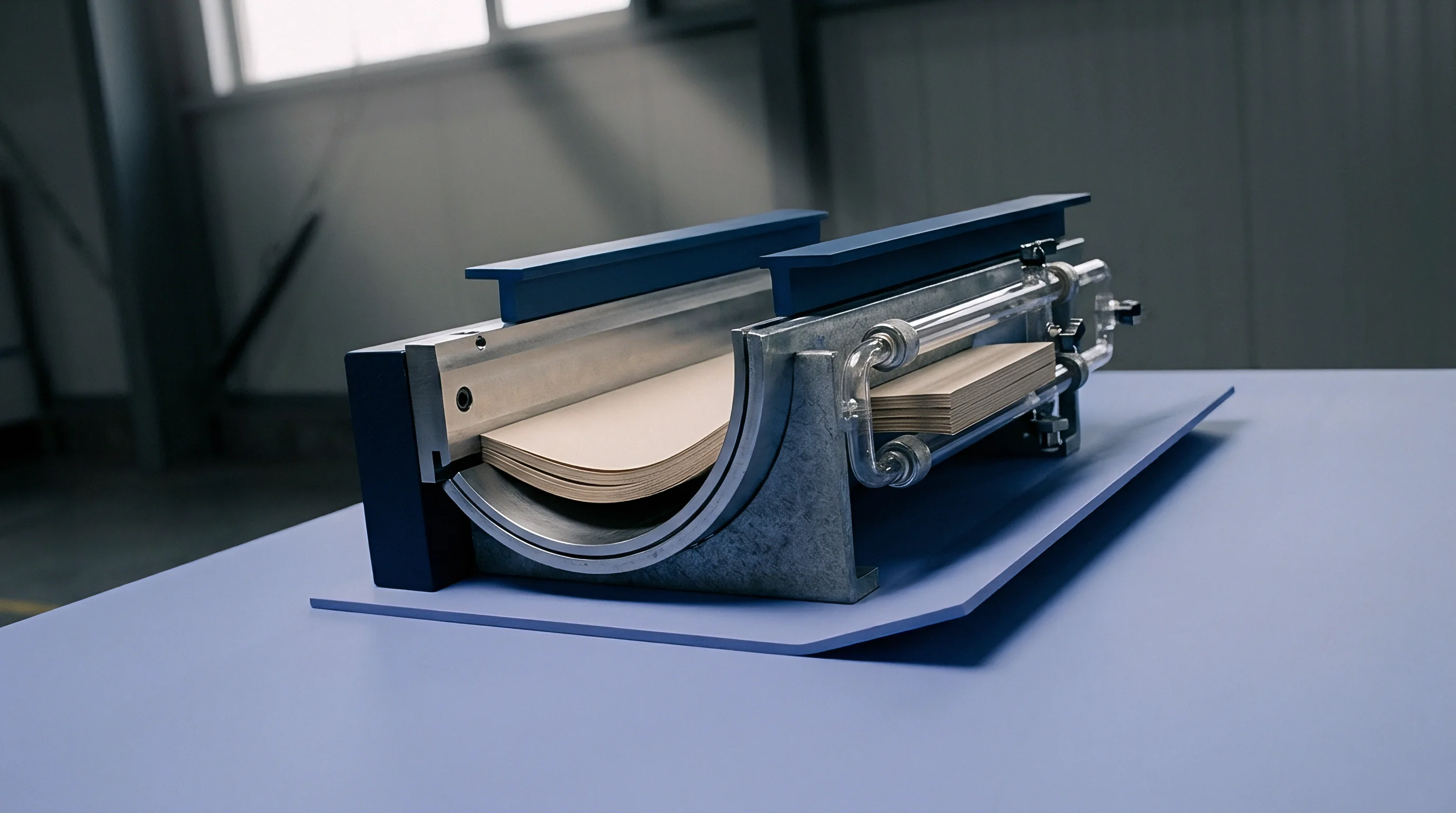
Fiber walls collapse irreversibly during the first evaporative drying cycle at the paper mill. Papermakers term this physical closure hornification, a state where internal hydrogen bonds seal the microfibril voids within the secondary cell wall. When dry pulp enters a secondary repulping vat, liquid water fails to reopen these bonded macromolecular clefts.
Water retention value tests conducted under ISO 23714 show an unbleached kraft virgin pine pulp holding 1.65 grams of water per gram of dry mass, whereas three-cycle recycled fiber from the same furnish holds 1.18 grams per gram. The fiber loses 28 percent of its liquid absorption capacity under centrifugal force at 900 g. Cell walls that do not take up water remain flat, stiff, and ribbons of collapsed cellulose.
This loss of re-wetting volume limits the contact area available for consolidation on the forming wire, depressing sheet thickness and density simultaneously.
Flexural rigidity in solid paperboard depends directly on elastic modulus and the third power of caliper, described by the product of elastic modulus and area moment of inertia. When recycled furnish replaces virgin chemical pulp, bulk drops because hornified fibers pack without spring-back during wet pressing. The resulting calendered sheet shows a 12 to 18 percent loss in thickness at an identical basis weight.
Because caliper operates under a cubic exponent in flexural stiffness equations, a 15 percent drop in sheet thickness produces a 39 percent collapse in bending resistance, even if the inherent tensile modulus of the solid material remains unchanged. Virgin fiber walls maintain internal pores that preserve caliper under press nips. Recycled fibers pack into an inelastic, compressed sheet.
A 15 percent reduction in finished sheet thickness produces a 39 percent drop in board flexural resistance under ISO 2493 test conditions.
Furnish degradation follows distinct physical paths during continuous recycling operations:
- Macrofibril delamination strips outer cell wall layers during mechanical pulping, reducing the transverse shear strength across consolidated sheets.
- Lumen collapse flattens tubular softwood structures into dense planar bands that yield poor structural bulking during web consolidation.
- Fines accumulation fills void spaces with secondary micro-debris, driving up sheet density without contributing load-bearing structural span.
- Porous volume shrinkage restricts adhesive anchor points, forcing converters to apply higher nip loads to achieve bonding.
Shortened fibers cannot distribute concentrated tensile loads across the outer surface during out-of-plane deflection. Virgin kraft fibers average 2.5 to 3.2 millimeters in length, providing extensive stress transfer through overlapping hydrogen bonds. Mechanical handling, shredding, and high-consistency pulping break these chains into fragments measuring under 1.2 millimeters.
The fiber length index drops. Lower aspect ratios force the sheet to behave like a discontinuous composite where stresses concentrate at fiber ends. Cracks initiate under minimal bending moments, causing sudden box wall failure during top-load compression inside humid warehouses.
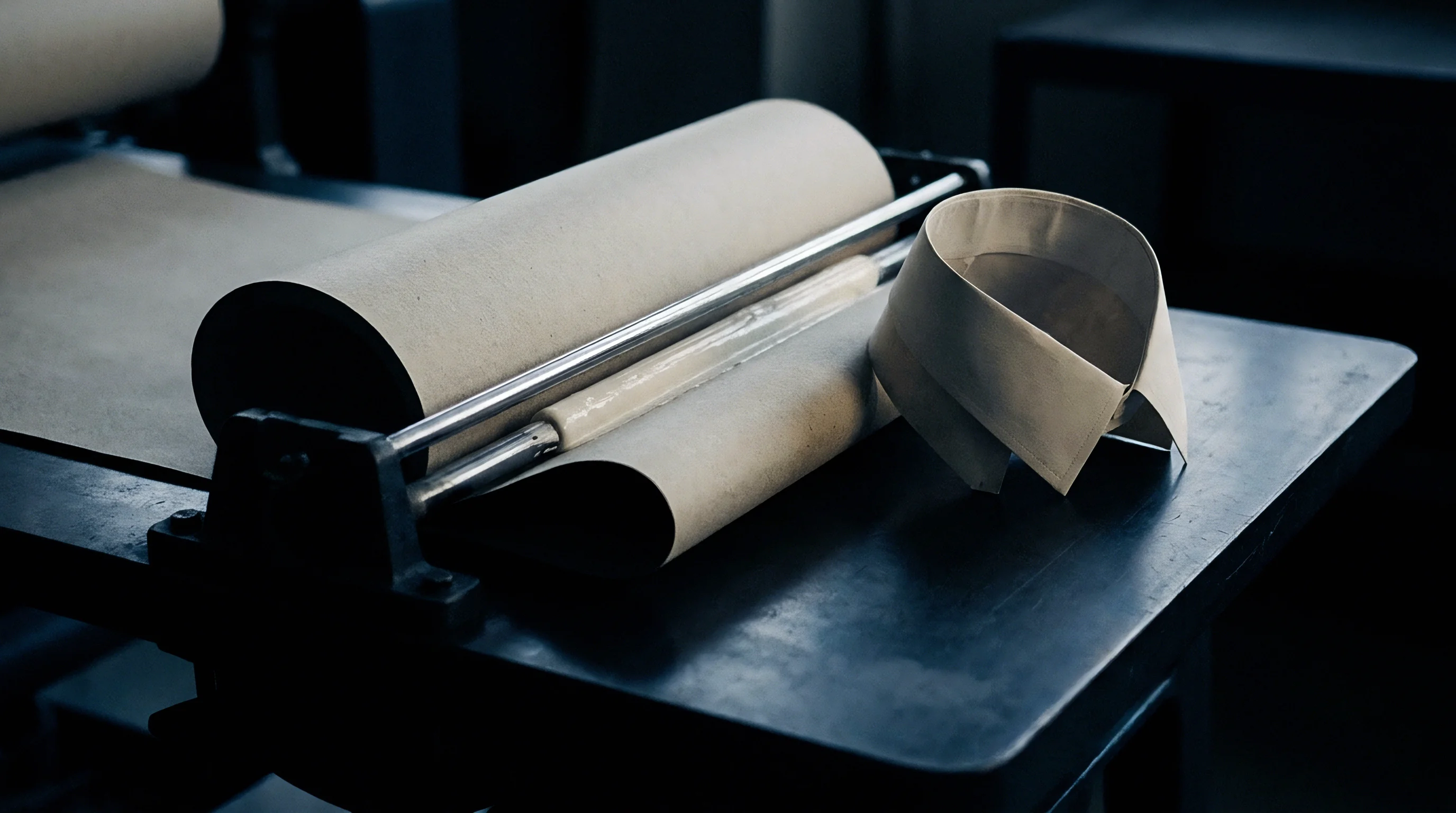
Calendering operations compound this structural deficit. Mills running white lined chipboard pass the dry web through steel nips to flatten surface peaks for coating application. The collapsed fibers possess little elastic recovery.
Virgin boards compress under the steel roll and rebound partially in the reel. Recycled sheets retain the compressed dimension permanently. Buyers specifying recycled grades based solely on basis weight instead of bending stiffness watch pallet stacks lean in distribution centers as bottom cartons bow under dead loads.
Strata
Multi-ply sheet construction separates mechanical functions across the paperboard cross section. In a three-ply or four-ply folding boxboard, the outer plies govern tensile and compressive stresses during bending, while the center plies resist transverse shear deformation. Virgin folding boxboard places bleached chemical pulp on the outer surfaces and high-bulk mechanical pulp in the center.
Recycled paperboard replaces this engineered distribution with recovered newsprint, corrugated clippings, and mixed office waste across all layers. The structural efficiency of an I-beam disappears. Modulus of elasticity plummets precisely where tensile stress peaks under flexural deflection.
Forming recycled paperboard on multi-cylinder vats introduces uneven fiber orientation. Machine direction stiffness frequently reaches 2.5 to 3.0 times the cross direction stiffness because the cylinder moulds align recycled fiber fragments along the running web. Virgin fourdrinier boards maintain machine to cross direction ratios between 1.6 and 2.0.
When converting cartons on high-speed gluers, this severe anisotropy produces variable spring-back. Cartons cut with creases parallel to the machine direction hold their shape, whereas panels creased across the web bow outward.
ISO 5628 defines structural stiffness as the product of the sheet elastic modulus and the second moment of area per unit width.
Engineers evaluate multi-ply cohesion through standardized lab steps:
- Cut five test strips measuring 25.4 by 150 millimeters parallel to the machine direction.
- Condition samples at 23 degrees Celsius and 50 percent relative humidity under ISO 187 parameters.
- Affix double-sided adhesive tape along the outer faces without introducing shear pre-strain.
- Clamp the specimen between the rigid platen and the tensile jaw of an internal bond tester.
- Apply dynamic pendulum separation to record the rupture energy per unit area in Joules per square meter.
The distribution of internal bond strength dictates whether the plies survive creasing and folding passes. In structural engineering, reinforced concrete beams under cyclic traffic loads fail through horizontal shear along internal construction joints when shear reinforcement is omitted. Multi-ply recycled board behaves the same way when top and bottom plies shear apart along the weak center layer.
Recycled fiber plies exhibit Scott bond values between 110 and 150 Joules per square meter, compared to virgin chemical plies that exceed 250 Joules per square meter. Low ply cohesion invites premature core shear, destroying the moment of inertia before the carton walls reach their theoretical compressive yield.
Can Starch Spray Restore Lost Internal Bonding?
Cationic potato or corn starch applied between forming vats creates chemical bridges between inert fiber mats. Papermakers spray cooked starch slurries at rates between 3 and 7 grams per square meter onto the wet plies before the press section. The amylopectin molecules link outer cellulose surfaces through hydrogen bonding, raising Scott bond values by 20 to 35 percent.
This chemical intervention fails to restore bulk. Starch adds dry weight without increasing cross-sectional thickness. The sheet gains tensile strength and internal bond strength, yet flexural stiffness remains depressed because the third power of caliper still dominates bending resistance.
| Furnish Grade | Virgin Fiber Content (%) | Apparent Density (g/cm³) | Tensile Modulus E (GPa) | Bending Stiffness MD (mNm) | Scott Bond (J/m²) |
|---|---|---|---|---|---|
| Solid Bleached Board (SBB) | 100 | 0.72 | 5.8 | 24.5 | 280 |
| Folding Boxboard (FBB) | 100 | 0.55 | 4.2 | 31.0 | 210 |
| White Lined Chipboard (WLC) | 10 to 15 | 0.82 | 3.6 | 14.8 | 135 |
| Coated Recycled Board (CRB) | 0 | 0.86 | 3.1 | 11.2 | 115 |
Mill managers routinely state that secondary starch additions and higher calendering loads yield identical carton performance to virgin fiber. This claim dismisses the cubic relationship between thickness and bending resistance, leaving the converter to manage carton bulging on packing lines.

Crease
Scoring rules crush the board matrix locally to establish a controlled hinge. During scoring on a flatbed die cutter, a steel rule drives the paperboard into an underlying channel matrix, forcing the sheet to delaminate cleanly into multiple thin sub-plies. This internal delamination prevents outer tension cracking when the panel bends 90 degrees on the folding line.
Virgin chemical fibers slide and shear without breaking, creating a uniform, rounded bead on the carton interior. Recycled boards lack the shear resistance to separate cleanly into distinct lamellae.
Fibers with short average lengths and brittle cell walls tear during rule penetration. The score line fractures internally. When the gluer folds the blank, the outer liner cracks open, exposing the dark grey recycled under-layer.
Deepening the crease to prevent liner splitting crushes the entire thickness of the board along the score axis, destroying what remaining flexural stiffness the hinge shoulder possesses. The panel looses bending resistance along the perimeter, causing the finished carton to barrel outward when filled with granular goods.
Die make-ready tolerances drop below twenty microns when scoring recycled boards prone to liner delamination.
Proper hinge formation on recycled stock demands precise mechanical adjustments:
- Rule width selection matches exact board thickness to avoid shear cuts along the creasing shoulder.
- Counter-die depth maintains precisely seventy percent of the uncompressed sheet thickness to prevent core fracture.
- Channel width geometry expands by twenty percent over virgin board setups to accommodate the lower compressibility of recycled furnish.
- Crease recovery ratio measures the moment needed to hold the folded panel at ninety degrees against initial stiffness.
Platen speed influences score integrity. Fast cycle rates impart shock loads to the sheet. Recycled fibers exhibit lower viscoelastic relaxation compared to virgin fibers.
At press speeds above 6,000 sheets per hour, the impact of the steel rule shatters hornified fibers instead of displacing them into the matrix channel. Make-ready operators must run wider channels and lower rule penetration depths, compromising the sharpness of the folded edge to prevent total substrate split.
| Board Caliper (µm) | Substrate Class | Unscored Stiffness MD (mNm) | Creased Resistance 90° (mNm) | Residual Moment Ratio (%) | Outer Liner Integrity |
|---|---|---|---|---|---|
| 400 | Virgin FBB | 22.4 | 7.2 | 32.1 | Intact, smooth bead |
| 400 | Recycled WLC | 11.8 | 5.8 | 49.1 | Micro-cracking present |
| 500 | Virgin FBB | 43.1 | 12.8 | 29.7 | Intact, clean delamination |
| 500 | Recycled WLC | 21.5 | 12.2 | 56.7 | Severe liner rupture |

Which Surface Treatment Arrests Creep?
Barrier coatings containing crosslinked polymers provide dimensional stability under varying humidity. Water vapor softens recycled fibers faster than virgin fibers because secondary fines absorb environmental moisture through capillary condensation. When atmospheric humidity rises from 50 to 80 percent, White Lined Chipboard loses up to 52 percent of its flexural stiffness within 24 hours.
Applying an aqueous polymer emulsion barrier on the reverse side retards vapor transmission. The coating arrests moisture ingress temporarily, preventing early carton creep under pallet compression.
A score line that fractures internally loses its panel righting force permanently.

Varnish
Surface coatings apply physical tension to the top ply during drying and curing cycles. When an offset press lays down an ultraviolet-cured overprint varnish, the liquid acrylic oligomers crosslink under mercury vapor lamps within milliseconds. This free-radical polymerization produces volumetric shrinkage between 6 and 9 percent within the varnish film.
On a rigid, high-modulus virgin board, the substrate resists this surface contraction without out-of-plane distortion. On a recycled board with lower shear modulus and diminished cross-directional stiffness, the contracting coating pulls the edges upward, inducing severe sheet curl.
Heated drying tunnels on flexographic and gravure lines drive residual moisture from the board core. Recycled boards release water unevenly due to variable density pockets across the sheet area. As moisture escapes, hornified fibers contract along their transverse axes.
When this thermal pass combines with hot foil stamping, the platen heat of 130 degrees Celsius degrades the synthetic adhesives used in multi-ply starch formulation. The top ply shrinks, the center ply loses moisture, and the composite paperboard leaves the press with a permanent concave bow.
Aqueous varnish coats on recycled board require twenty percent longer infrared dwell times to clear surface porosity.
Converters running high-gloss UV passes over recycled substrates face flatbed feeder jams when the curl exceeds 8 millimeters along the trailing edge. The press operator increases suction air and slows the feeder, adding machine hours to the job docket. The cured varnish layer increases surface brittleness.
When the curled sheet enters the die cutter, the tensioned varnish film splits across the creasing bead, propagating micro-tears through the clay coating and into the recycled top liner.
Take an operational run of 100,000 pharmaceutical cartons converted from 350-micron recycled board versus 300-micron virgin folding boxboard. The recycled sheet demands a 400-micron caliper to approach the flexural stiffness of the 300-micron virgin board, adding 18 percent more mass to the pallet shipping weight. In the pressroom, the recycled run generates 4.5 percent make-ready waste across the coating pass due to curl corrections, compared to 1.8 percent for the virgin board.
The cured varnish coat cracks at the corner scores on 3 percent of the recycled cartons during high-speed folding on the bobst gluer. The economic savings realized at raw material procurement vanish in pressroom spoilage and finishing downtime.
Enzymatic fibrillation trials claim a 7 percent flexural recovery in secondary fiber furnish, yet reproducible industrial trials remain unavailable across commercial converting lines. A buyer discounts unverified chemical enhancements, calculating structural resistance strictly from verified dry micrometer measurements. Unresolved questions remain regarding how nano-fibrillated cellulose additives might stabilize recycled fiber shrinkage under direct thermal curing passes without rendering the pulp un-drainable on the wire.

Tariff
Extended Producer Responsibility regulations penalize packaging designs that fail to meet strict recyclability thresholds. Under European packaging directives, modulated fees tax complex structures that blend plastic laminates with fiber cores to recover lost stiffness. Brand owners who attempt to compensate for recycled board stiffness deficits by adding a 15-micron polyethylene or biaxially oriented polypropylene lamination face severe fee surcharges.
The composite board falls into lower recyclability bands, doubling the eco-contribution fee per metric ton placed on the consumer market.
Procurement teams must audit board specifications against dry functional metrics rather than nominal weight. Standard mill contracts specify board basis weight with a tolerance of plus or minus five percent, but allow flexural stiffness to vary by up to fifteen percent within a single production lot. When purchasing recycled grades, relying on basis weight guarantees carton collapse.
The mill delivers the correct mass of fiber while supplying insufficient bulk and caliper. To secure package integrity, the purchase order must specify minimum bending resistance in millinewton-meters under ISO 2493, alongside strict Scott bond thresholds under TAPPI T 569.
Contractual annexes governing paperboard delivery must state that lots failing to meet minimum cross-directional flexural stiffness measured under ISO 2493 at twenty-three degrees Celsius and fifty percent relative humidity are subject to immediate rejection without remanufacturing allowances.