Evaluating Mechanical Pulp Fiber Bonding in Board Middle Plies
Internal bond strength in mechanical middle plies relies on fines retention and controlled refining to preserve bulk while meeting 180 J per square metre Scott Bond.
Cohesion
Multi-ply paperboard relies on mechanical pulps to build caliper while maintaining lower overall grammage. In folding boxboard and solid unbleached board constructions, bleached chemithermomechanical pulp, thermomechanical pulp, and pressure groundwood form the structural center layer between outer kraft liners. These mechanical fibres possess high flexural rigidity and thick cell walls, resisting the compaction forces applied during wet pressing.
The resulting sheet architecture delivers high specific bulk, which directly governs the flexural stiffness of the finished carton substrate. Specific bulk in the middle plies routinely ranges from 1.6 to 2.4 cubic centimetres per gram, compared to 1.1 to 1.3 cubic centimetres per gram for fully bleached chemical kraft pulps. Fibre stiffness limits contact area.
This structural volume comes at the expense of inter-fibre contact area, creating a fundamental tension between caliper yield and internal sheet integrity.

Morphological Drivers of Middle Ply Structure
Individual mechanical pulp fibres display minimal lumen collapse during stock processing. Unlike chemical fibres, where lignin removal allows the cell wall to flatten into a flexible ribbon, mechanical pulps retain their rigid tubular geometry. Lignin content in chemithermomechanical pulps stays between 20 and 28 percent, maintaining structural stiffness.
Hydrogen bond formation requires molecular proximity under 0.3 nanometres between free hydroxyl groups on adjacent cellulose microfibrils. The rigid wall structure reduces the actual area of contact to less than 20 percent of the total fibre surface area. Consequently, dry fibre networks formed purely from mechanical pulps exhibit low specific bond strength per unit volume, creating internal weakness under transverse shear and z-directional tensile forces.
Fines content in mechanical pulps serves as the primary physical bridge between rigid fibre walls. Mechanical refining generates micro-filaments, primary wall fragments, and lamellar debris, categorized as pulp fines when passing through a 200-mesh screen (ISO 5269). Fines possess high specific surface area, often exceeding 8 square metres per gram compared to 1.5 square metres per gram for long fibres.
During the consolidation phase of sheet drying, these fine particles collect in the capillary wedges formed at fibre intersections. Surface tension forces drawn by evaporating water draw the fines tightly into the intra-ply voids, creating secondary hydrogen bonding bridges across gaps that rigid fibre walls cannot bridge. Fines migrate during web consolidation.
Mechanical pulp middle plies achieve specific bulk values up to 2.4 cubic centimetres per gram, but their rigid fibre morphology restricts bonded contact area to under 20 percent of total fibre surface.
Capillary Forces and Fines Retention Mechanics
The consolidation of the wet web establishes the physical distribution of fines throughout the central plies. High vacuum levels on wet suction boxes can wash fine material away from the ply interfaces toward the wire side, depleting the specific bonding surface at the couch line. Retention aids, including cationic polyacrylamides and bentonite microparticle systems, lock fines onto long fibre surfaces prior to sheet consolidation.
Controlled retention ensures uniform distribution across the thickness profile, preventing localized weak zones. Over-flocculation creates coarse fibre clusters, which reduce local contact points and degrade internal bond strength by forming localized void networks.
- Lumen geometry retention keeps mechanical fibres rigid and tubular throughout pressing, preventing the broad area contact typical of chemical pulps.
- Specific surface area deficit limits natural hydrogen bonding sites until mechanical refining liberates microfibrillar fines from the middle lamella.
- Capillary meniscus consolidation draws fine material into fibre intersections during water removal, forming localized bonding nodes as drying completes.
- Z-directional fines migration alters internal density gradients when excessive dewatering vacuum strips fine particles from lower web layers.
Balancing energy input during refining against bulk degradation remains an ongoing operational challenge. Additional refining increases fines liberation and specific bonding area, elevating internal bond strength. Additional refining also collapses cell lumens, reducing specific bulk by 0.1 to 0.3 cubic centimetres per gram for every 50 Canadian Standard Freeness drop.
The papermaker must determine whether refining intensity or chemical binder additions should carry the load of meeting target internal strength parameters without sacrificing caliper advantages.
Bench
Standardized measurement of internal strength in paperboard relies on two distinct physical stress modes: pendulum impact shear energy and perpendicular z-directional tensile force. Standard methods ISO 16260 and TAPPI T 569 measure the total energy absorbed when an L-shaped aluminum block attached to a sample strip by double-sided tape is struck by a calibrated pendulum. Standard method ISO 15754 measures the maximum uniform tensile stress applied perpendicular to the plane of the sheet until structural failure occurs.
These tests reveal different mechanical properties of the furnish. Scott Bond measures total fracture energy including plastic deformation, whereas z-directional tensile strength measures ultimate peak force resistance.
Scott Bond Energy versus Z-Direction Tensile Mechanics
Specimen preparation introduces significant variability into internal bond strength measurements. Double-sided adhesive tape selection alters measured Scott Bond values. High-tack acrylic tapes, such as 3M 410M, penetrate into porous mechanical pulp surfaces, reinforcing the uppermost fibre layers and forcing the failure plane into the true center of the middle ply.
Low-tack or thicker rubber-based tapes absorb pendulum impact energy through elastomeric compliance, artificially inflating energy readings by 10 to 30 Joules per square metre. Tape compliance dampens measured energy. Specimen pressing conditions must obey exact parameters.
ISO 16260 mandates an anvil pressing force of 1.4 Megapascals applied for 3.0 seconds. Lower pressure reduces tape adhesion, causing interfacial pop-off failures that register as invalid low energy values.
Impact velocity in Scott Bond testing alters the viscoelastic response of the mechanical fibre network. Pendulums swinging at standard velocities (approx 3.0 metres per second) induce rapid strain rates within the lignin-rich mechanical plies. Lignin acts as a viscoelastic polymer, displaying higher dynamic stiffness under rapid impact than under slow, rate-controlled tensile stress.
Unconditioned test sheets yield erratic data. Environmental conditioning per ISO 187 (23 degrees Celsius, 50 percent relative humidity) remains non-negotiable. Moisture content shifts from 6 percent to 9 percent reduce Scott Bond values by up to 25 percent due to water molecules plasticizing the hemicellulose matrix and weakening hydrogen bonds.
Standard mill purchase specifications for folding boxboard stipulate a minimum Scott Bond value of 150 Joules per square metre under ISO 16260, where any lot falling below 135 Joules per square metre permits immediate rejection.

When Does Z-Tensile Testing Outperform Scott Bond?
Z-directional tensile testing per ISO 15754 provides superior diagnostic clarity when evaluating multi-ply structures prone to localized skin-peel defects. Tensile testing mounts a 50 millimetre by 50 millimetre board sample between rigid steel platens using high-tensile structural adhesives. The testing machine pulls the platens apart at a constant crosshead speed of 2.5 millimetres per minute, recording the force-elongation curve until fracture.
Peak stress values in kilopascals quantify ultimate resistance, while the stress-strain integral reveals total work to rupture.
- Cut five test strips measuring 25.4 millimetres by 120 millimetres along the machine direction using a dual-blade precision cutter.
- Apply double-sided adhesive tape (3M 410M or equivalent certified acrylic) to both faces of the test strip, eliminating air bubbles with a rubber hand roller.
- Mount the taped assembly between five pairs of aluminum angle blocks inside the standardized specimen preparation press.
- Apply a continuous hydraulic compression force of 1.4 Megapascals for exactly 3.0 seconds to achieve complete adhesive wetting into the board surface.
- Transfer the block assembly to the magnetic specimen holder of the pendulum impact tester and execute the swing within 60 seconds of pressing.
| Furnish Type | Freeness Level (CSF ml) | Middle Ply Bulk (cm³/g) | Scott Bond Energy (J/m²) | Z-Directional Tensile (kPa) |
|---|---|---|---|---|
| Stone Groundwood (SGW) | 90 – 110 | 1.75 | 110 – 130 | 220 – 260 |
| Pressure Groundwood (PGW) | 100 – 120 | 1.85 | 125 – 145 | 250 – 290 |
| Thermomechanical Pulp (TMP) | 120 – 150 | 2.05 | 140 – 175 | 310 – 360 |
| Bleached CTMP (BCTMP) | 140 – 180 | 2.30 | 160 – 210 | 370 – 430 |
| Test conditions: ISO 187 (23 °C, 50% RH); Scott Bond per ISO 16260; ZDT per ISO 15754; board grammage 300 g/m². | ||||
Delivery contracts for multi-ply boxboard frequently mandate adherence to ISO 16260 testing protocols, specifying that any single tambour reel showing a mean Scott Bond below the agreed threshold allows the buyer to place the entire production batch on commercial hold pending secondary z-tensile verification.
Press
Paper machine wet-end operations utilize chemical additives and mechanical nip controls to build internal strength within mechanical plies without causing unacceptable bulk loss. Cationic starch represents the primary strength additive deployed in middle-ply machine chests. Derived from corn or potato starch and modified with quaternary ammonium groups, cationic starch carries a positive charge density between 0.02 and 0.04 equivalents per mole.
This positive charge promotes electrostatic attachment to negatively charged mechanical fibres and fines. Optimum starch dosage ranges from 0.8 percent to 1.5 percent based on dry furnish weight. Cationic starch increases bond density.

Chemical Additive Strategies for Low-Density Furnish
Excessive cationic starch addition leads to charge reversal within the stock suspension. When the cationic charge of the starch exceeds the anionic demand of the fibre fines system, residual unattached starch molecules remain in the white water loop. This free starch causes foaming, deposits on dryer cans, and reduces retention efficiency.
Papermakers combine cationic starch with anionic co-factors such as carboxymethyl cellulose or microfibrillated cellulose. Adding carboxymethyl cellulose at a ratio of 1 part to 3 parts cationic starch forms an in-situ amphoteric gel complex. This complex deposits across rigid fibre walls, creating a flexible chemical matrix that increases Scott Bond energy by 30 to 50 Joules per square metre without requiring additional wet pressing.
Synthetic dry-strength resins provide alternative pathways for bond enhancement. Polyacrylamide resins modified with glyoxal functional groups form covalent bonds with cellulose hydroxyl groups during thermal sheet drying. Unlike starch, which relies solely on hydrogen bonding, glyoxalated polyacrylamides build cross-linked chemical networks that resist moisture degradation.
Adding microfibrillated cellulose at 1.0 to 3.0 percent dosages dramatically increases internal cohesion. Microfibrillated cellulose acts as a high-surface-area nano-binder, filling cell wall gaps and boosting z-directional tensile strength by up to 40 percent. Resin addition increases unit furnish cost.
| Chemical System | Dosage Rate (% dry basis) | Scott Bond Delta (J/m²) | Bulk Delta (cm³/g) | Retention Efficiency (%) |
|---|---|---|---|---|
| Cationic Potato Starch | 1.0 % | + 25 | – 0.03 | 88 % |
| Cationic Starch + CMC Complex | 1.2 % + 0.3 % | + 42 | – 0.04 | 92 % |
| Glyoxalated Polyacrylamide (GPAM) | 0.4 % | + 30 | – 0.01 | 85 % |
| Microfibrillated Cellulose (MFC) | 2.0 % | + 55 | – 0.06 | 96 % |

Shoe Press Loading and Wet Couching Parameters
Mechanical dewatering in shoe presses balances moisture removal against sheet compaction. Modern multi-ply board machines employ wide-nip shoe presses capable of applying peak hydraulic pressures up to 6.0 Megapascals over a nip residence time of 20 to 30 milliseconds. High residence times allow water to drain from bulky mechanical plies without disrupting the internal fibre network.
Pressing pressure must be metered carefully; excess pressure destroys sheet caliper. Operating the shoe press at an optimal peak pressure of 4.5 Megapascals achieves 48 percent dry solids entering the dryer section while retaining over 90 percent of the original middle ply bulk.
- Cationic starch adsorption requires precise monitoring of stock system anionic demand to prevent chemical waste and deposit formation in white water loops.
- Amphoteric complex formation pairs cationic starch with carboxymethyl cellulose to deposit structural strength gels across rigid mechanical fibre walls.
- Extended nip press profiling optimizes water extraction using wide-nip shoe presses, preventing hydraulic crush failure in heavy-grammage middle plies.
- Inter-ply couching nip control manages moisture content at the couching zone (82 to 85 percent water) to ensure fibre entanglement across ply boundaries.
Adding 1.2 percent cationic potato starch combined with 0.3 percent carboxymethyl cellulose to a BCTMP middle ply increases Scott Bond energy from 130 to 172 Joules per square metre at 50 percent relative humidity.
A mill representative will often claim that a drop in middle ply internal bond strength during spring production runs is an unavoidable consequence of seasonal wood species shifts in the chip supply, rather than a failure of wet-end chemical retention controls.
Fracture
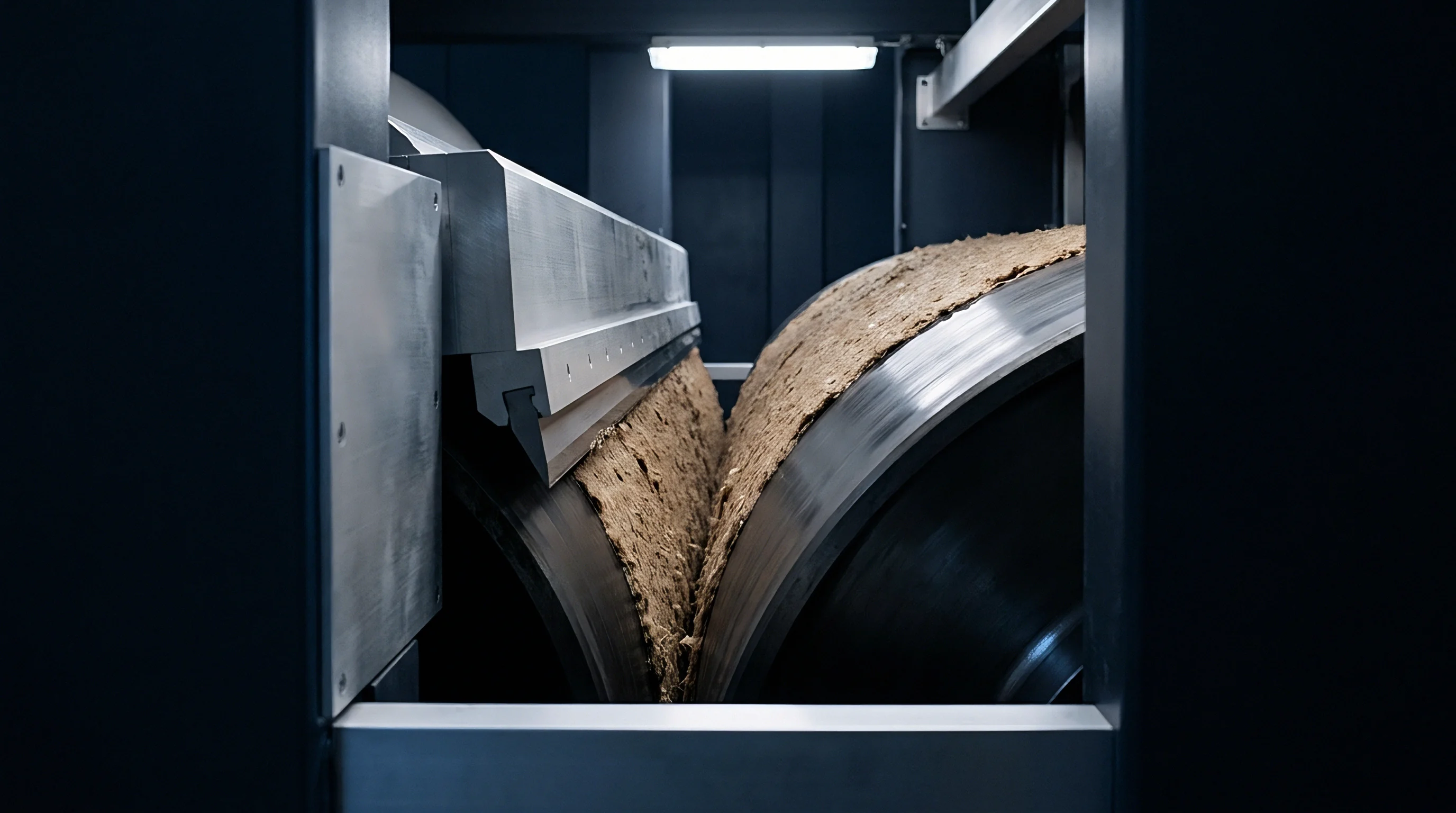
Converting solid bleached board and folding boxboard into packaging cartons requires controlled internal failure within the middle plies during creasing and folding operations. Creasing tools press a male rule into the board substrate against a female die channel, creating a localized internal shear failure. Thicker boards demand higher internal shear.
This deliberate internal delamination allows the board to fold cleanly through 90 or 180 degrees without tearing the outer kraft liners or splitting the printed surface coating. The internal mechanical pulp ply acts as a strain energy damper during the bending process.
Crease Formation Mechanics and Interlayer Shear
Inadequate internal bond strength leads to uncontrolled delamination during high-speed scoring. When Scott Bond energy falls below 110 Joules per square metre, the middle ply splits too easily across a wide zone surrounding the crease. Low cohesion causes severe box splitting.
The crease loses its structural memory, resulting in bulging carton side walls, sloppy corner geometry, and automatic packing line jams. Linear score depth determines delamination. If internal bond strength is excessively high (exceeding 230 Joules per square metre in high-density middle plies), the mechanical pulp layer resists internal shearing, transferring bending stresses to the outer top liner.
Top liner cracking occurs, exposing raw unprinted fibres and ruining package aesthetics.
Female matrix channel width directly influences shear zone geometry. Standard converting rules set the female groove width equal to the board caliper multiplied by 1.5, plus the male rule thickness. When converting a 400 micrometre folding boxboard with a 0.71 millimetre male rule, the female channel width equals 1.31 millimetres.
Deviations in board middle-ply internal bond strength alter this geometric relationship. High-bond mechanical plies require wider matrix channels to force delamination, while low-bond plies require narrower channels to prevent broad, unconstrained sheet collapse.
Offset Ink Tack and High-Speed Printing Pick Resistance
High-speed sheet-fed and web offset printing presses exert strong z-directional peel forces on the board surface. Fast-drying, high-viscosity offset inks possess high ink tack values, measured between 12 and 18 on an Inkometer at 1200 revolutions per minute. As the printed board leaves the impression cylinder nip at speeds reaching 16,000 sheets per hour, the ink film splits.
High tack inks pull middle plies. This ink film splitting applies a rapid z-directional pulling force against the top liner, which propagates directly into the underlying mechanical pulp middle ply.
- Top liner cracking failure occurs when high middle ply internal bond strength prevents shear separation, forcing tensile strain onto outer kraft layers during folding.
- Carton wall bulging results from extremely low Scott Bond energy, causing wide unconstrained internal delamination that destroys score line stiffness memory.
- Blistering under heat sealing develops when trapped moisture expands rapidly inside weak middle plies during plastic film lamination or blister sealing cycles.
- Z-direction ink picking manifests when impression cylinder ink tack forces exceed middle ply internal cohesion, pulling away structural surface areas during printing.
Selecting middle ply bond thresholds without accounting for converter creasing parameters leads to severe structural failure, high scrap rates on automated gluers, and package rejection at the retail packing line.

Outlay
The economic optimization of folding boxboard manufacturing relies on maximizing specific bulk to achieve target carton bending stiffness at minimum total grammage. Bending stiffness scales with the third power of caliper (board thickness cubed) multiplied by the elastic modulus of the outer liners. By substituting low-cost, high-bulk mechanical pulps into the middle ply, papermakers maintain overall caliper while reducing board grammage by 10 to 15 percent compared to solid bleached sulphate (SBS) boards.
Grammage reduction lowers total shipping weight. The economic viability of this downgauging strategy depends on balancing pulp savings against the cost of dry-strength chemistry needed to maintain Scott Bond targets.

Downgauging Yield Models and Caliper Retention
High bulk preserves carton bending stiffness. To illustrate the commercial trade-off, consider a 100-tonne production run of folding boxboard intended for pharmaceutical packaging. The baseline specification calls for a 320 gram per square metre board manufactured with a thermomechanical pulp middle ply (bulk 1.95 cubic centimetres per gram) reaching a total board caliper of 450 micrometres.
An optimized alternative utilizes a high-yield bleached chemithermomechanical pulp middle ply (bulk 2.30 cubic centimetres per gram), reducing total board grammage to 280 grams per square metre while maintaining the identical 450 micrometre caliper. This downgauging strategy yields 14.3 percent more sheet area per tonne of purchased paperboard.
Pulp index pricing governs raw material savings. Assuming a market price of 920 US dollars per tonne for bleached CTMP and 1,150 US dollars per tonne for bleached hardwood/softwood kraft pulp, the raw material cost per square metre drops significantly. Maintaining a 170 Joules per square metre Scott Bond energy in the 280 gram per square metre high-bulk board requires adding 12 kilograms per tonne of cationic starch (1.20 US dollars per kilogram) and 3 kilograms per tonne of carboxymethyl cellulose (3.50 US dollars per kilogram).
Chemical additive costs equal 24.90 US dollars per tonne of finished board. Subtracting chemical costs from raw material savings demonstrates a net cost reduction of 62.10 US dollars per tonne, yielding substantial savings over large packaging runs.
| Specification Parameter | Baseline TMP Middle Ply | Optimized BCTMP + Starch | High-Bond Over-Refined CTMP |
|---|---|---|---|
| Total Board Grammage (g/m²) | 320 | 280 | 300 |
| Middle Ply Caliper Contribution (µm) | 310 | 310 | 270 |
| Total Board Caliper (µm) | 450 | 450 | 410 |
| Scott Bond Energy (J/m²) | 140 | 175 | 220 |
| Chemical Additive Cost per Tonne ($) | $4.50 | $24.90 | $8.20 |
| Total Sheets Produced per 100 Tonnes | 312,500 | 357,140 | 333,330 |
| Landed Cost per 1,000 Sheets ($) | $352.00 | $314.50 | $342.10 |

Financial Trade-Offs in Middle Ply Strength Formulation
Converting spoilage rates must enter the yield calculation. If an under-formulated middle ply drops Scott Bond energy below 130 Joules per square metre, box converting line speeds must be reduced by 20 percent to prevent corner splitting. A two percent increase in converting spoilage due to score line cracking eliminates all raw material yield gains achieved through downgauging.
Investing in robust chemical strength packages ensures operational headroom across high-speed packaging lines.
Downgauging board grammage through high-bulk mechanical plies generates commercial savings only when wet-end chemical additions hold internal bond strength above converting failure thresholds.
Formulating middle ply mechanical pulps around high specific bulk while backing that bulk with cationic starch complexes protects carton stiffness, secures high yield per tonne, and prevents delamination failures on converting floors.