Standard Testing Methods for Paperboard Structural Integrity Assessment
Verify paperboard integrity by pairing short-span compression (ISO 9895) with bending stiffness (ISO 2493) to prevent carton jamming and stack failure.

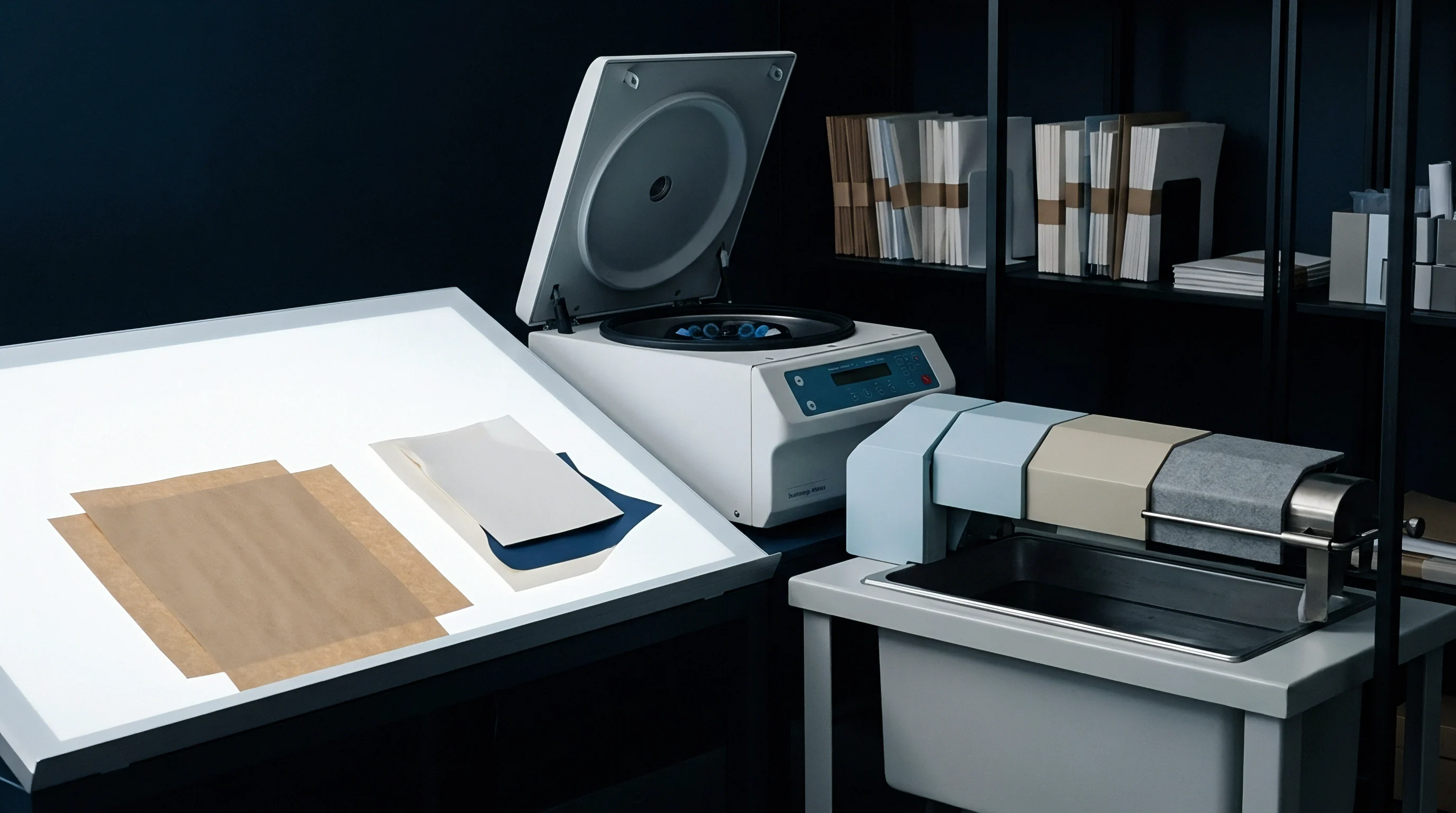
Platen
Axial compression across the plane of a paperboard specimen reveals structural failure long before gross material crushing occurs. When two flat steel blocks travel toward one another in an automated testing press, the sheet faces local buckling governed by fiber network orientation. In the evaluation of structural container performance, compressive integrity forms the foundation of stack survival.
Corrugated medium and linerboard grades experience combined shear and axial loads during transit, yet standard laboratory procedures deliberately isolate pure edge-wise resistance to build predictive models.
The standard Short-Span Compression Test, defined under ISO 9895 and TAPPI T 826, isolates edge-wise compressive strength over an unsupported gap of zero point seven millimeters. Clamping jaws hold the specimen under pneumatic pressure between two hundred thirty and two hundred eighty kilopascals to prevent slippage while precluding premature core damage. The sub-millimeter free span prevents macro-buckling modes, forcing fiber walls into pure axial failure.
Moisture content dictates ultimate strength.
Fiber orientation controls the result. During web formation on a Fourdrinier or multi-ply former, stock velocity relative to wire speed aligns cellulose structures preferentially along the travel axis. Consequently, machine-direction compressive values exceed cross-direction values by thirty to eighty percent depending on jet-to-wire ratios and refining energy applied to the furnish.
Softwood kraft pulps generate distinct failure geometries compared to neutral sulfite semi-chemical fluting.
Conditioned at 23 degrees Celsius and 50 percent relative humidity under ISO 187, short-span compression values for unbleached softwood kraftliner peak between 2.8 and 3.2 kilonewtons per meter across the machine direction.
For decades, container manufacturers specified Ring Crush Test figures per TAPPI T 822 or ISO 12192 to estimate edge crush values in downstream box manufacturing. The procedure bends a one-half inch strip into an annular groove held inside an aluminum disc before applying vertical pressure. Thin liners buckle along unsupported spans within the groove, distorting the instrument reading with premature elastic instability rather than intrinsic material failure.
For paperboard calipers below zero point three eight millimeters, ring crush yields erratic numbers that systematically undervalue high-stiffness recyled stocks.
| Substrate Classification | Grammage Basis | ISO 9895 SCT Cross Direction | TAPPI T 822 RCT Cross Direction | Failure Strain Percentage |
|---|---|---|---|---|
| Unbleached Kraftliner | 175 g/m² | 2.95 kN/m | 220 N | 1.45% |
| Semi-Chemical Fluting | 130 g/m² | 2.40 kN/m | 175 N | 1.15% |
| Recycled Testliner II | 160 g/m² | 2.10 kN/m | 165 N | 1.60% |
| Recycled Medium | 120 g/m² | 1.55 kN/m | 110 N | 1.30% |
| White Top Kraftliner | 200 g/m² | 3.20 kN/m | 265 N | 1.50% |
Calibrating edge crush predictions requires careful distinction between component sheet metrics and combined board performance. McKee derived mathematical relationships linking board thickness, combined edge crush values, and flexural stiffness to finished carton performance. When converting plants substitute testliner for virgin kraft components without accounting for short-span index discrepancies, structural container capacity drops precipitously.
Recycled fibers display reduced individual wall thickness, lower intrinsic microfibril angle uniformity, and shorter average lengths, lowering pure edge resistance under continuous mechanical stress.
Specifying materials solely on basis weight exposes supply chains to structural carton collapse during warehouse storage when inferior compression stock allows bottom panels to bulge outward under sustained dead loads.

Stiffness
Bending resistance establishes the panel deflection boundaries of folding cartons and setup boxes during automated high-speed packaging lines. When suction cups grip a carton blank to erect four walls at rates exceeding three hundred units every minute, the substrate acts as an elastic spring. Insufficient rigidity yields jamming inside carton feeder magazines, whereas excessive resistance prevents clean pre-breaking along vertical carton corners.
Flexural rigidity represents the product of elastic modulus and the third power of material caliper. Because thickness exerts a cubic influence on flexural outcomes, minor drifts across the papermaking web induce significant mechanical changes. Papermakers run multi-ply headboxes specifically to manipulate this physics: high-modulus virgin chemical pulp occupies outer surfaces to endure maximum tension and compression stresses, while high-bulk mechanical or recycled furnish sits in the center ply to maximize cross-sectional separation.
Specimen geometry alters test outcomes depending on the chosen international standard. The Lorentzen and Wettre two-point deflection method under ISO 2493 clamps a thirty-eight millimeter wide strip and deflects it through a fifteen-degree arc at a test length of fifty millimeters. In contrast, TAPPI T 489 specifies the Taber-type tester, which deflects a thirty-eight millimeter strip through fifteen degrees using a specimen length of fifty millimeters with free-wheeling rollers driving the load.
Both instruments yield moment values, yet mathematical conversion factors vary across furnish categories due to non-linear shear deformation within soft inner plies.
Invocation of ISO 2493 deflection tolerances penalizes suppliers five percent on the billing unit for every ten percent shortfall in cross-direction bending resistance.
Caliper loss destroys panel rigidity. Calendering stacks on the paper machine compress wet webs to achieve smooth surfaces for gravure or flexographic ink transfer. Excessive nip pressure densifies sheet fibers, reducing overall caliper for a given mass.
If a mill trades two points of caliper to chase Bekk smoothness targets, bending resistance falls by roughly six to eight percent. High grammage masks localized defects.
| Test Protocol | Specimen Geometry | Angular Deflection | Loading Method | Standard Units |
|---|---|---|---|---|
| ISO 2493-1 | 38 mm wide, 50 mm length | 15 degrees | Two-point motorized clamp | milli-Newtons (mN) |
| ISO 2493-2 | 38 mm wide, 10 mm length | 15 degrees | Short-span clamp assembly | milli-Newtons (mN) |
| TAPPI T 489 | 38.1 mm wide, 70 mm length | 15 degrees | Taber pendulum with rollers | Taber Stiffness Units (g-cm) |
| TAPPI T 556 | 38 mm wide, variable span | 15 or 30 degrees | Two-point electronic sensor | milli-Newton meters (mN·m) |
| DIN 53121 | Various width options | 1 to 5 degrees | Two-point, three-point, four-point | Bending moment (N·mm) |
Consider the structural performance of solid bleached sulfate board compared to coated recycled board across automated packing lines. Solid bleached sulfate features uniform chemical pulp throughout the cross section, providing predictable flexural curves and superior recovery angles. Coated recycled board contains variable short fibers, mineral pigments, and residual starches from multiple repulping cycles.
Converting operations run trials across both substrates using standardized bending parameters to lock in carton blank dimensions.
- Two Point Resistance measures the peak mechanical force needed to deflect an upright clamped specimen through fifteen degrees of movement.
- Elastic Springback Angle captures the residual displacement percentage after bending loads release from carton flaps.
- Bending Moment Capacity indicates the internal torque generated across parallel fiber networks before outer surface tensile rupture occurs.
- Dynamic Deflection Ratio expresses the mechanical difference between instantaneous line speeds and standard quasistatic laboratory measurements.
Procurement agreements governing carton board deliveries routinely enforce ISO 2493 minimum cross-direction values, rejecting any lot where mean stiffness falls beyond five percent below nominal targets.

Ply
Cohesion between individual fibrous plies prevents catastrophic separation when boards undergo severe mechanical stress during creasing, embossing, and carton erection. As multi-cylinder formers lay successive wet fiber layers over each other on the wet end, hydrogen bonds develop across the interfaces. In multi-ply solid bleached boxboard, folding boxboard, and coated recycled board, interfacial bonding governs whether the sheet flexes smoothly or splits prematurely under converting pressures.
The standard measurement for internal ply cohesion is the Scott Internal Bond Test, defined in TAPPI T 569. Laboratory staff clamp a one-inch square board specimen between a metal base anvil and an aluminum angle bracket, held securely by high-tack double-sided adhesive tape. A calibrated pendulum swings from a fixed release angle, striking the vertical face of the aluminum bracket.
The kinetic energy expended during complete delamination registers on an analog scale or digital sensor in Joules per square meter.
Z-directional tensile testing, conducted in accordance with ISO 15754, provides an orthogonal tensile evaluation without dynamic impact errors. Pneumatically driven platens pull the flat surfaces of the specimen directly apart along the perpendicular axis under a controlled displacement rate of one millimeter per minute. While the Scott bond impact test reflects a mix of cleavage, shear, and peel mechanisms, z-directional tensile yields a pure tensile stress figure expressed in kilopascals.
Thicker calipers preserve box top-to-bottom loading capacity far better than equal mass added through surface starch or mineral fillers.
Recycled containerboard grades frequently exhibit micro-delamination along interface boundaries due to high contamination of micro-stickies, degraded fines, and reduced surface hydroxyl accessibility. Mills apply oxidized or cationic starch sprays across the web between forming wires to restore interlaminar bond strength. Starch application raises internal cohesion.
Excessive surface sizing without deep fiber consolidation creates brittle interfaces that peel under rapid directional shifts.
Tear resistance complements ply bond metrics by identifying sheet vulnerability to edge propagate damage. The Elmendorf tear tester, governed by ISO 1974 and TAPPI T 414, releases a heavy pendulum to tear through an initial notch cut into a stacked pack of board sheets. Long softwood fibers dissipate tearing energy across extensive fiber pull-out networks, whereas short hardwood fibers snap cleanly, yielding low tear indices.
Hardwood fibers reduce tearing endurance.
Interlaminar bond failures in production drop when operators ensure that z-directional tensile strength exceeds two hundred kilopascals on heavy calipers.
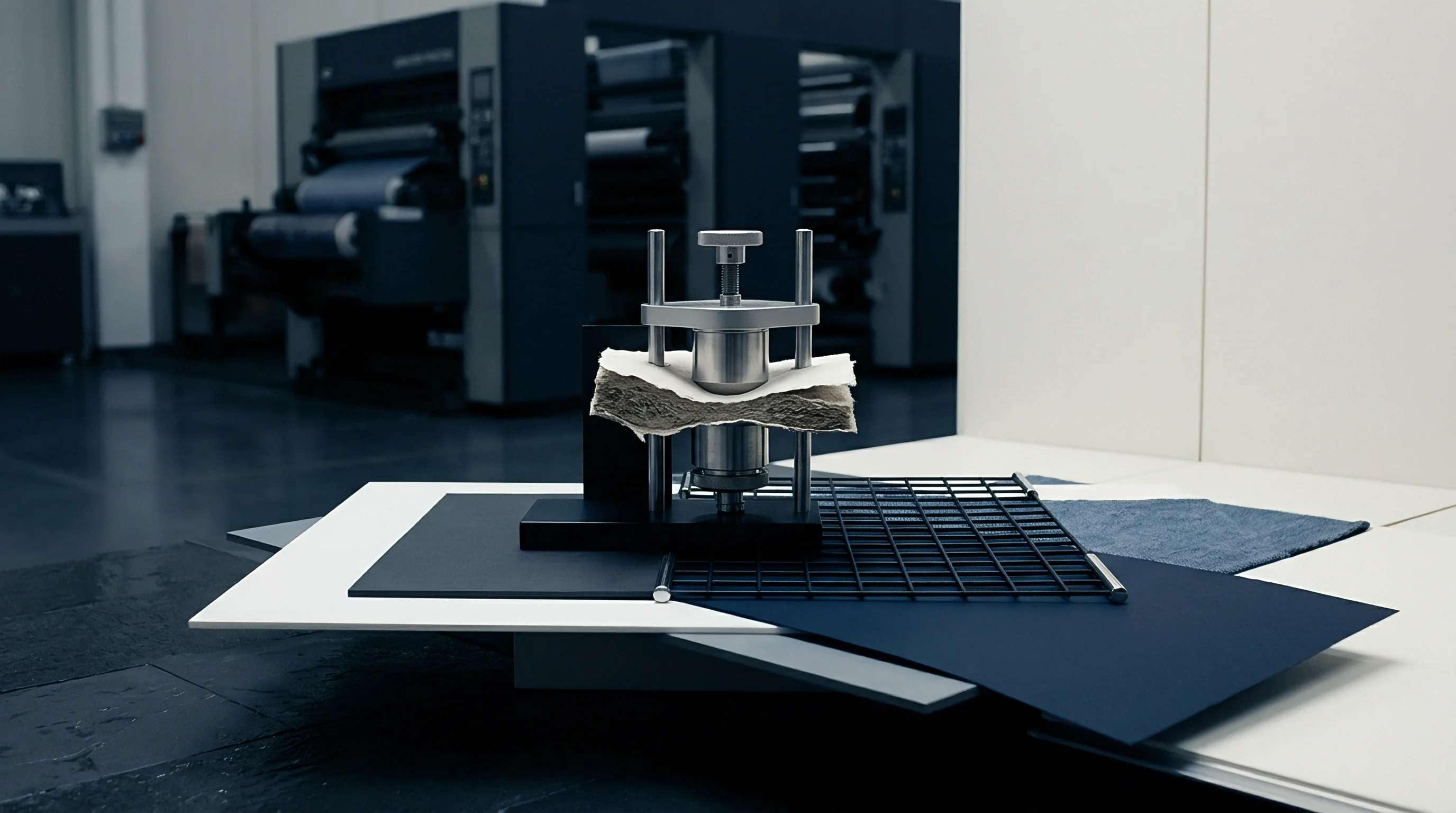
Score
Mechanical creasing defines the hinging zones that permit planar paperboard to transform into three-dimensional carton structures. A male steel rule drives the board substrate into an underlying female groove matrix, creating permanent internal shear delamination while leaving exterior surfaces structurally intact. When scoring parameters drift, carton panels bow outward, glue seams shift out of alignment, and fold corners split open along printed edges.
Score quality assessment utilizes the ratio between the bending force of a creased sample and the bending force of the uncreased parent board, measured at a ninety-degree angle under TAPPI T 829. A pristine fold line exhibits a creasing ratio between thirty and fifty percent. If the ratio climbs past sixty percent, the crease remains too rigid, forcing adjoining carton panels to bow inward or outward during line assembly.
Ratios sinking below twenty percent indicate damaged surface fibers and ruptured scores.
Delamination ruins high-speed carton erectors. Controlled internal delamination along the neutral axis allows inner plies to roll into a neat bead upon ninety-degree folding, which prevents the outer printable skin from undergoing destructive tensile strains. Virgin kraft holds score integrity.
Recycled furnishes with shortened fibers snap under identical matrix depth settings, exposing unprinted grey pulp along branded package edges.
The mechanics of the creasing die dictate conversion success across varying environmental temperatures and board calipers:
- Matrix Channel Width matches board thickness multiplied by one point five plus the male rule width.
- Rule Penetration Depth compresses the internal plies down to roughly fifty percent of original caliper.
- Blank Positioning Alignment prevents offset creases where the fold wandering misses the underlying container slot.
- Rotary Matrix Clearance maintains even radial pressure across cylinder-fed inline die-cutting units.
A supplier will claim that edge flaking along scored boundaries stems from dry ambient air on the converter floor rather than poor fiber refinement at the wet end.

Transit
Warehouse stacking loads and dynamic transport stresses expose finished paperboard packaging to multi-axial mechanical strain over months of handling. Mullen burst testing, governed by ISO 2759 and TAPPI T 807, measures hydraulic pressure necessary to rupture a clamped circular specimen. A motorized piston drives ethylene glycol against a synthetic rubber diaphragm, which expands upward through an orifice until the substrate bursts.
While burst strength tracks total tensile energy absorption and outer fiber stretch, it fails to model long-term vertical column collapse.
Edge Crush Testing under ISO 3037 and TAPPI T 811 isolates the vertical compressive strength of combined corrugated board specimens. Short rectangular blocks cut with parallel edges stand between flat compression platens without guide blocks. The recorded peak load in kilonewtons per meter serves as the direct operational input for McKee stacking formulas.
Edge crush correlates with stacking. Corner joints bear vertical loading.
Scoreline cracking during dry winter production originates from fiber brittleness rather than improper rule penetration on the die cutter.
Environmental conditions profoundly alter structural capacity during commercial distribution. Cellulose molecules adsorb atmospheric moisture, disrupting internal hydrogen bond networks between adjacent microfibrils. Under cyclic relative humidity, board specimens undergo accelerated creep deformation, buckling at vertical loads well below their static laboratory limits.
| Relative Humidity Level | Equilibrium Moisture Content | SCT Retention Factor | Edge Crush Retention | Stack Life Expectancy Multiplier |
|---|---|---|---|---|
| 50% RH (Standard ISO 187) | 7.5% | 1.00 | 1.00 | 1.00 |
| 65% RH (Tropical Ambient) | 9.2% | 0.86 | 0.88 | 0.60 |
| 80% RH (Chilled Storage) | 12.8% | 0.68 | 0.71 | 0.25 |
| 90% RH (Marine Transit) | 16.5% | 0.48 | 0.52 | 0.08 |
Testing environments alter measured values. Puncture resistance tests under TAPPI T 803 swing a triangular pyramidal point through a clamped board sheet to evaluate resistance against blunt handling impacts, combining tear, tensile, and delamination energies. Box compression tests under ISO 12048 compress entire empty cartons between moving platens to capture panel deflection, scoreline yield, and corner pillar failure in a single gross mechanical value.
Humidity accelerates board creep failure.
What remains unsettled across international logistics contracts is how standard laboratory measurements performed in static chambers can accurately quantify carton longevity under dynamic, multi-week ocean transport featuring random vibration and continuous relative humidity cycling.