Understanding Paperboard Ply Separation Principles during Score Bending Operations
Controlled internal ply separation during creasing prevents outer liner rupture by converting bending tension into internal shear sliding across middle layers.
Stock
Paperboard creasing relies on intentional internal failure to create a durable hinge without surface cracking. When an uncreased board bends ninety or one hundred eighty degrees, tensile stress concentrates on the outer printed liner while compressive force squeezes the inner surface. Uncoated or unindented board structures react to this bending moment by cracking across the outer face, ruining print graphics and structural integrity.
Applying a scoring rule forces the multi-ply architecture to yield along internal interfaces, causing microscopic delamination so individual plies slide past one another during carton erection.
How forces redistribute across sheet thickness during scoring depends on the board’s construction. Solid Bleached Board, composed entirely of long chemical fibers, deforms through progressive shear yielding between successive fiber networks. Folding Boxboard behaves differently: its bleached chemical pulp outer liners sandwich dense mechanical pulp middle plies whose lower internal bond strength concentrates shear strain within the core.
Coated Recycled Board uses multiple reclaimed fiber layers with variable hydrogen bonding capacity, creating distinct boundary conditions at each inter-ply junction. Tensile failure breaks outer liners when these internal layers refuse to slip.
As the male scoring blade enters the female matrix groove, the sheet undergoes severe localized vertical compression and transverse shear strain. Shear failure initiates early in the stroke. The top liner stretches under tension across the rule nose while the bottom liner presses down into the female channel gap.
Internal plies situated between these boundary zones experience maximum shear stress, initiating delamination along predefined weak planes. This separation converts a single rigid slab of caliper t into several thinner, flexible sub-laminates that bend along smaller individual radii of curvature.
- Outer Liner Rupture describes complete tensile failure of the printed surface sheet during folding, occurring when internal plies fail to delaminate and relieve outer surface strain.
- Score Line Rolling occurs when asymmetric shear stresses cause the crease bead to shift laterally away from the center of the scoring male rule during female channel entry.
- Internal Delamination Spreading extends microscopic ply separation beyond the designated scoring zone, reducing panel stiffness and compromising carton side-wall compression strength.
- Bead Bursting happens when excessive score indentation depth shears the reverse liner completely through, destroying the inner moisture barrier or decorative coating.
Fibers inside mechanical middle layers shift under local compression, forming an internal crease bead. This relief bulge projects inward toward the interior of the folded carton, filling the volume created by a ninety-degree fold. Without proper bead formation, the outer liner remains under continuous tension after folding, driving post-converting strain recovery and score line spring-back.
Controlling the ratio between liner elongation and core shear displacement forms the technical foundation of defect-free high-speed converting.
Thick paperboard grades require deeper score indentation to initiate internal shearing before outer liner tension exceeds tensile limit.
Scoring depth specifications must balance ply separation against total structural degradation. Inadequate rule penetration leaves internal bonds intact, forcing the outer liner to absorb all flexural strain during high-speed folder-gluer execution. Excessive rule depth cuts through individual fibers, creating permanent weakness that reduces box compression strength.
Effective converter setups match scoring pressure to specific fiber furnish composition rather than relying on uniform machine press setups.
Anisotropy
Paperboard exhibits distinct physical properties along its principal manufacturing axes due to fiber alignment during wet-end web formation. Machine direction fibers align parallel to web travel, yielding higher tensile modulus and resistance to bending deformation. Cross direction fibers lay transverse to web flow, offering lower tensile strength and increased extensibility under flexural load.
Scoring parallel to the machine direction forces the score line to deform across short fiber widths, whereas scoring parallel to the cross direction strains long fiber axes.
Cross-direction scoring operations generate higher internal shear forces because machine-direction aligned fibers resist inter-ply sliding. When the scoring blade strikes parallel to the cross direction, internal delamination propagates cleanly between plies due to uniform lateral fiber distribution. Machine-direction scoring places long fibers directly under tension along the score edge, elevating the risk of outer liner tearing.
Consequently, matrix channel clearances and rule profiles undergo deliberate modifications based on score orientation relative to web grain.
Directional Strain Vectors in Web Conversion
Deformation forces during crease indentation split into normal vertical vectors and lateral horizontal shear components. The normal force compresses the board caliper directly beneath the rule tip, reducing local thickness by thirty to fifty percent. The lateral force pushes material sideways into the clearance zone between the scoring rule edge and the female channel wall.
Cross direction scores require wider female channel clearance to accommodate lateral fiber expansion without pinching outer liners against die walls.
Ply separation quality depends on maintaining precise moisture equilibrium within the fiber matrix. Moisture content between six point five and eight point five percent optimizes hydrogen bond flexibility within chemical pulp layers and mechanical core plies. Dry paperboard below five point five percent moisture becomes brittle, causing outer liners to snap before internal plies can shear.
Excessively moist paperboard above nine percent moisture softens the fiber network completely, resulting in squashed, ill-defined score beads that collapse under folder-gluer pressure belts.
| Substrate Grade | Test Condition (ISO 187) | Scott Bond Energy (ISO 16260) | Z-Directional Tensile (ISO 15754) | Optimal Moisture Band (ISO 287) | Delamination Mode |
|---|---|---|---|---|---|
| Solid Bleached Board (SBB) | 23 C / 50% RH | 180 to 240 J/m2 | 420 to 510 kPa | 6.8% to 7.8% | Continuous micro-shear across chemical layers |
| Folding Boxboard (FBB) | 23 C / 50% RH | 110 to 160 J/m2 | 310 to 390 kPa | 7.5% to 8.5% | Core shear within mechanical pulp plies |
| Coated Recycled Board (CRB) | 23 C / 50% RH | 90 to 130 J/m2 | 240 to 320 kPa | 6.0% to 7.0% | Stepwise failure along recycled inter-ply size lines |
| Data measured on production grades ranging from 300 to 450 micrometres caliper. ISO 187 conditioning applied for 24 hours prior to physical testing. | |||||
Can Controlled Delamination Prevent Liner Rupture?
Initiating internal micro-cracks inside the core layer absorbs bending energy that would otherwise rupture the exterior surface. As the crease rule enters the board, local shear stress exceeds the z-directional tensile strength of the inter-ply interface. Controlled micro-delamination splits the rigid board structure into discrete layers, lowering the area moment of inertia for each individual layer.
Each split layer flexes independently, reducing maximum tensile stress at the outer print surface below its ultimate failure limit.
TAPPI T 569 internal bond testing reveals multi-ply board failing below 120 J/m2 exhibits liner bursting during 180-degree folding at 50 percent relative humidity.
When internal plies fail to delaminate, the outer liner acts as the primary tension member for the entire sheet caliper. Tensile strain accumulates rapidly as the fold angle approaches ninety degrees, exceeding the four to six percent strain limit of coated bleached liners. Delamination transfers strain into inter-ply slip, spreading linear elongation over a broader deformation zone.
Moisture Equilibrium and Elastic Recovery
Paperboard stored in unconditioned converter environments loses or gains moisture rapidly through exposed roll edges and sheet stacks. Loss of bound water stiffens individual cellulose fibers, elevating the critical shear stress required to start ply separation. Stiff fibers refuse to slide, forcing scoring equipment to exert higher vertical penetration forces.
Elevated vertical force crushes the board caliper permanently, destroying structural stiffness across finished carton panels.
Elastic recovery after creasing differs between machine and cross direction scores. Machine direction scores exhibit higher elastic spring-back because long fibers aligned parallel to the crease line resist permanent plastic deformation. Crease geometry setups compensate for this spring-back by increasing male rule penetration or narrowing the female matrix channel slightly.
Operating outside established moisture specifications causes inconsistent spring-back, leading to carton jamming on automated packing lines. High liner tension during high-speed folding leads directly to surface cracking, unreadable barcodes, and immediate rejection at goods-in inspection.
Matrix
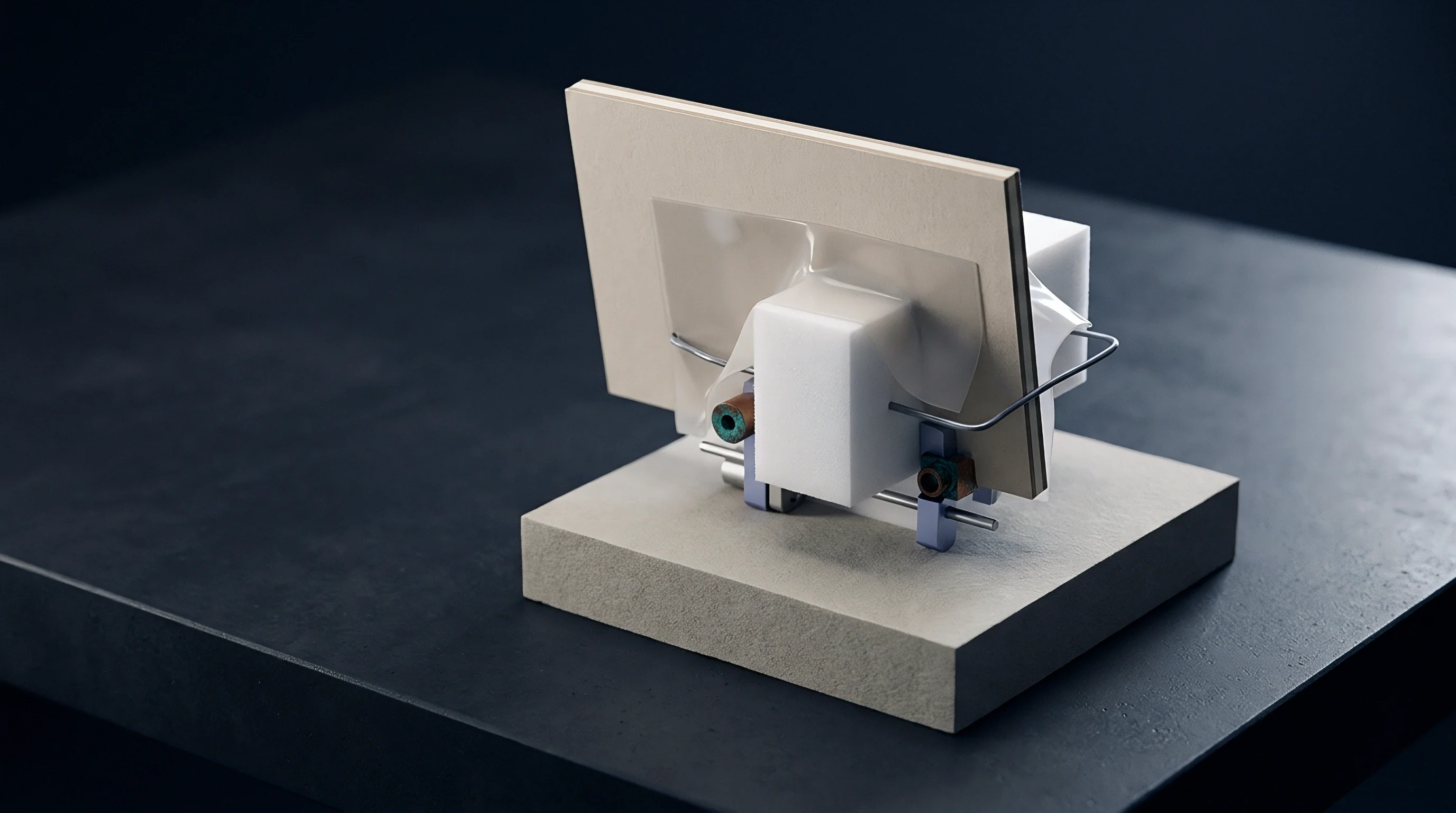
Die-cutting platens establish the mechanical geometry required to generate clean paperboard scores. The creasing system comprises a steel male creasing rule, a flat anvil platen, and a female matrix groove fixed to a counter-die plate. Male rule thickness, female matrix channel width, and channel depth govern the extent of internal ply separation.
Incorrect tooling dimensions alter the ratio of vertical compression to horizontal shear, causing score failure.
Female matrix depth selection corresponds directly to paperboard caliper. Selecting a matrix depth smaller than board caliper crushes the sheet excessively, while a channel deeper than caliper prevents adequate vertical compression required to lock the internal bead. Female matrix channel width relies on a mathematically defined relationship incorporating creasing rule thickness and board caliper.
Channel Dimensions and Clearance Calculations
Determining female matrix channel width w utilizes the standardized equation w = tr + 1.5t for Folding Boxboard and w = tr + 1.7t for Solid Bleached Board, where tr represents male rule thickness and t represents paperboard caliper. The constant multiplier accounts for fiber extensibility and volumetric expansion into the clearance zone. Solid Bleached Board requires wider channels due to its higher density and long chemical fiber content, which demands more room to form the internal bead without pinching.
Female matrix depth d generally equals paperboard thickness t for light calipers below four hundred micrometres. For heavy-weight board above four hundred micrometres, matrix depth is set to zero point eight5 to zero point nine times caliper to maintain firm vertical compression. Insufficient channel depth prevents the male rule from driving the board fully into the groove, resulting in shallow scores with inadequate internal ply delamination.
- Verify paperboard caliper across five points on the delivered pallet using an ISO 534 dead-weight micrometer to establish baseline sheet thickness t.
- Select male creasing rule thickness tr based on carton structure requirements, using zero point seven one millimetres for folding cartons under four hundred micrometres caliper.
- Calculate required female channel width w using the formula appropriate for the board furnish grade, verifying channel depth d against micrometer readings.
- Mount press matrix channels onto the counter-plate, checking center-line registration relative to male rules with a high-magnification optical gauge before running production.
| Paperboard Caliper (mm) | Grade Category | Male Rule Thickness (mm) | Female Channel Width (mm) | Female Channel Depth (mm) | Score Clearance Ratio |
|---|---|---|---|---|---|
| 0.30 | FBB / SBB | 0.71 | 1.15 to 1.22 | 0.30 | 1.5t |
| 0.40 | FBB | 0.71 | 1.31 to 1.39 | 0.40 | 1.5t |
| 0.40 | SBB | 0.71 | 1.39 to 1.47 | 0.40 | 1.7t |
| 0.50 | CRB | 1.05 | 1.80 to 1.90 | 0.45 | 1.5t |
| 0.60 | FBB / CRB | 1.05 | 1.95 to 2.07 | 0.55 | 1.5t |
Tooling Alignment and High-Speed Mechanical Wear
Platen press alignment tolerances demand extreme precision across the die surface. Misalignment of the male rule relative to the female channel center-line creates uneven shear distribution across the score width. The side of the board closer to the channel wall experiences severe localized shear, while the opposite side lacks sufficient compression to initiate ply separation.
Asymmetric delamination causes the carton panel to fold off-center, producing skewed boxes that fail automated filling line pick-and-place operations.
High-speed converting platens operating at eight thousand sheets per hour generate significant mechanical wear on matrix channel walls. Synthetic phenolic matrix channels degrade under continuous lateral impact, widening the effective channel width over extended production runs. Channel widening reduces lateral shear resistance, causing ply separation efficiency to drop gradually during a single shift.
Tooling inspection protocols specify channel width verification every fifty thousand impressions to prevent unobserved score quality decay.
DIN 55437-1 specifies channel depth tolerances of plus or minus 0.02 millimetres to prevent score shearing under high-speed converting.
Outer liner cracking on high-speed lines often traces to unconditioned storage rather than structural board defect, as press room humidity fluctuations alter board flexibility faster than furnish formulations adapt. Converters mitigate this operational risk by maintaining strictly controlled environmental conditioning in raw material staging areas and verifying channel wear prior to press setup.

Bond
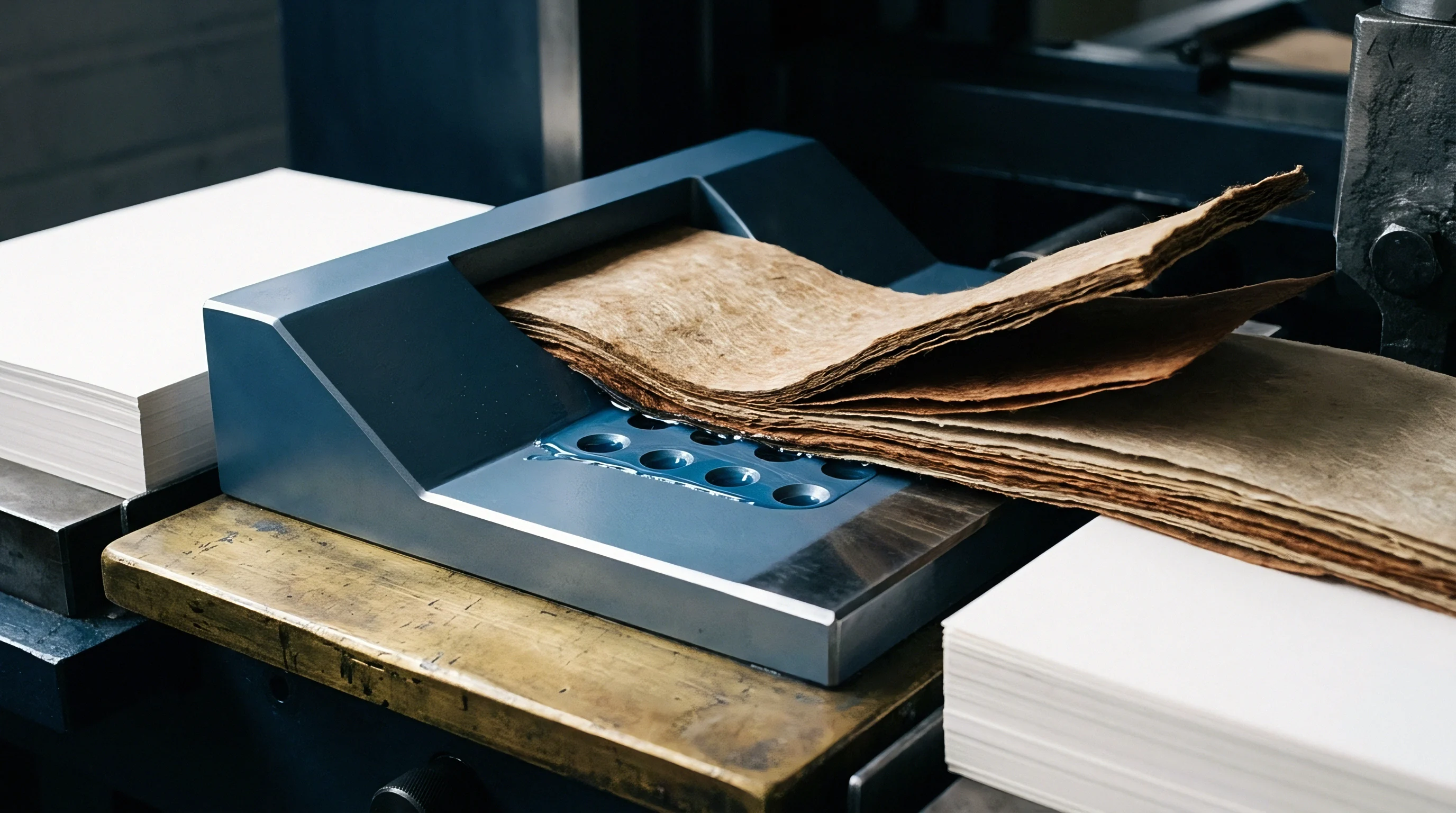
Interlayer bond strength dictates the precise energy threshold required to initiate micro-delamination during score formation. Papermakers control this strength by adjusting fiber refining levels, wet-end chemical additives, and multi-ply former couch press pressures. Z-directional tensile testing per ISO 15754 and Scott Bond impact testing per ISO 16260 provide numerical measurements of this internal cohesion.
Refining increases fiber fibrillation, raising the surface area available for hydrogen bonding between adjacent plies. Higher refining levels elevate z-directional tensile strength, making the board stiffer and more resistant to ply separation. Excessive refining prevents internal shearing during creasing, causing outer liner tension to spike during folding.
Conversely, under-refined plies yield low Scott Bond values, allowing delamination to spread uncontrollably across carton panels away from the score line.

Analytical Measurement of Interlayer Cohesion
Scott Bond testing measures the energy required to rupture internal fiber networks under high-speed impact shear. A pendulum strikes a double-sided adhesive tape assembly holding the paperboard sample, fracturing the internal layers. Results express energy absorption per unit area in Joules per square metre.
SBB grades typically range between one hundred eighty and two hundred forty J/m2, whereas FBB cores exhibit lower values between one hundred ten and one hundred sixty J/m2 due to weaker mechanical pulp fiber networks.
Z-directional tensile testing applies uniform static tension perpendicular to the board surface using specialized clamping jaws. This test isolates the weakest ply interface, recording ultimate tensile stress at failure in kilopascals. Static z-tensile measurements correlate directly with low-speed folding resistance, while dynamic Scott Bond values align closely with high-speed die-cutting platen performance.
Combining both analytical parameters provides a reliable profile of board creasability.
- ISO 16260 Scott Bond Test quantifies dynamic impact energy absorption during internal fiber plane separation, establishing minimum threshold values for core shearing.
- ISO 15754 Z-Directional Tensile Test measures static perpendicular force capacity, identifying the absolute weakest inter-ply boundary within multi-ply board structures.
- ISO 2493 Bending Resistance Test measures force required to deflect a board sample through a fifteen-degree arc, evaluating sheet stiffness prior to scoring.
- ISO 534 Caliper and Bulk Determination establishes true sheet thickness under standardized contact pressure, enabling accurate matrix dimension calculation.

Chemical Additives and Ply Interface Physics
Starch application at the couch roll or spray sizing units modifies inter-ply adhesion significantly. Cationic starch additions increase hydrogen bonding between re-pulped fibers in CRB, reinforcing weak recycled networks. Spraying starch unevenly across wet webs creates localized zones of high bond strength adjacent to weak spots.
During scoring, these uneven bond zones cause sporadic ply separation, resulting in erratic score folding resistance along a single package crease line.
Hydrophobic sizing agents added for moisture resistance alter internal surface energy, shifting inter-ply shear dynamics. Fluorine-free sizing agents and alkyl ketene dimer treatments reduce internal friction between sliding fiber layers once delamination begins. Lower internal friction allows separated plies to slide smooth, forming compact crease beads with minimal resistance.
Papermakers fine-tune starch and size addition rates to optimize the balance between structural stiffness and score delamination capability.
Coated board grades exhibiting uniform internal bond distribution sustain ninety-degree folds without microscopic coating fractures across print zones.
Standard purchase contracts for premium packaging stock specify compliance with ISO 16260 internal bond limits alongside target caliper ranges. These agreements enforce minimum and maximum Scott Bond bands to ensure consistent delamination behavior on converter folder-gluers. Stock falling outside these certified bands alters crease resistance, requiring press operators to adjust counter-die channel dimensions midway through a production run.
Waste
Carton production economics depend directly on converting line efficiency, press speed, and waste minimization. Score failure during high-speed folding-gluing causes immediate operational disruption, leading to machine jams, damaged carton blanks, and unscheduled line downtime. When board plies fail to separate cleanly, the increased force required to fold each blank forces operators to reduce machine speeds to prevent jam-ups.
Scrap generation during folder-gluer operations traces back to improper ply delamination and outer liner cracking. Ruptured print graphics convert fully processed, printed, and die-cut blanks directly into waste paper scrap. The commercial impact extends beyond raw material loss, consuming valuable press time, labor, and energy without generating saleable finished packaging units.
Speed Penalties and Crease Fatigue in Packaging Lines
High-speed filling and packaging machines demand consistent carton opening force and fold torque. Cartons manufactured from board with incomplete score delamination exhibit high bending resistance, resisting ninety-degree erection inside automatic cartoning pockets. High bending resistance causes carton misfeeds, crushed glue flaps, and line stoppages on filling lines operating at speeds over four hundred packs per minute.
Crease fatigue occurs when repeated flexing weakens an improperly delaminated score line, causing complete structural failure along the carton hinge. Packaging applications such as flip-top cigarette packs or reclosable food cartons demand durable score lines capable of surviving multiple opening cycles without tearing. Proper internal ply separation distributes bending stresses across broad internal sliding surfaces, preserving hinge strength over repeated use cycles.

Converting Yield and Material Cost Arithmetic
Evaluating total converting economics requires comparing substrate costs against landed sheet yield and spoilage rates. Assume a converting run of one million folding cartons produced from thirty-tonne lots of 350-micrometre board priced at 1,200 USD per tonne. Case A utilizes a budget recycled board grade with erratic internal bond strength (Scott Bond variance from 80 to 190 J/m2).
Case B utilizes a specified Folding Boxboard grade with controlled internal bond strength (Scott Bond tight band of 130 to 150 J/m2).
In Case A, inconsistent ply separation causes outer liner cracking on four percent of blanks during die-cutting and folding, while high crease stiffness causes an additional two percent filling line jam rate at the customer plant. Total waste equals six percent of the order volume, representing sixty thousand ruined cartons. Direct material loss equals 2,160 USD, combined with eight hours of press downtime priced at 350 USD per hour, totaling 4,960 USD in direct failure costs.
In Case B, uniform ply delamination limits total converting and filling spoilage to zero point five percent (five thousand cartons). Direct waste cost drops to 180 USD, and press lines run at full rated speed without stoppages. The FBB stock carries a five percent price premium over the recycled board (1,260 USD per tonne vs 1,200 USD per tonne), adding 1,500 USD to initial substrate cost.
Comparing net financials demonstrates that paying 1,500 USD extra for controlled delamination substrate saves 4,780 USD in waste and downtime, netting a direct operational saving of 3,280 USD per thirty-tonne run.
Folder-gluer operational data confirms that maintaining score bending force below zero point three Newtons per metre enables sustained line speeds above three hundred fifty metres per minute. Bending force spikes whenever board caliper increases or relative humidity drops below press room specifications. Converters track score bending moment continuously using automated bench testers to adjust die press parameters before spoilage rates rise.